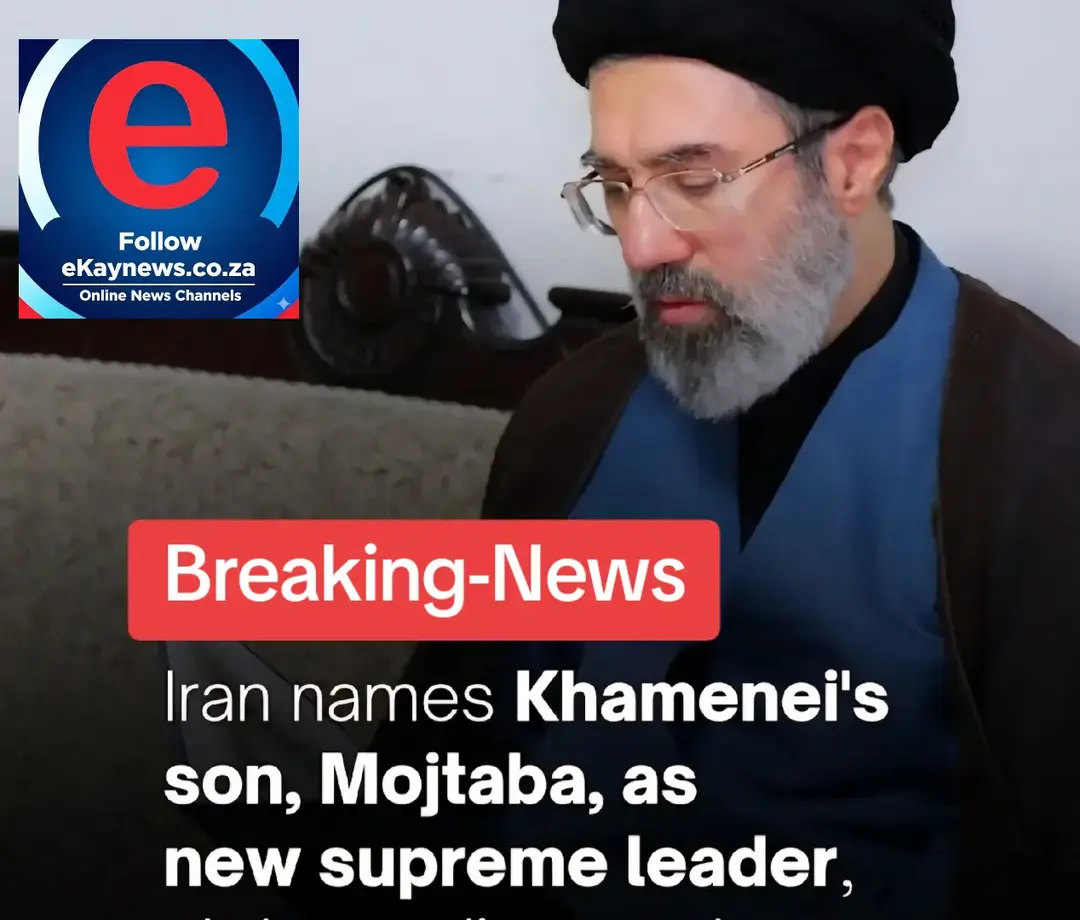
Iran appoints Mojtaba Khamenei as Supreme Leader. March 8-9, 2026, Iran’s Assembly of Experts has appointed Mojtaba Khamenei, the son of the assinated late Supreme Leader Ayatollah Ali Khamenei, as the country’s new Supreme Leader.
This development follows the assinating of Ali Khamenei on February 28, 2026, in joint US-Israeli strikes, which caused a major crisis in the Iranian leadership.
Here are the key details based on reports:
Who is the new leader: Mojtaba Khamenei (56), the second-eldest son of the late Ali Khamenei, has been appointed to succeed his father.
Context of Appointment: The Assembly of Experts announced the decision amid an ongoing conflict with the US and Israel, which began after the senior Khamenei was killed.
Background: Mojtaba Khamenei is considered a hardline figure and has long been a powerful behind-the-scenes operator, often described as a close ally of the Islamic Revolutionary Guard Corps (IRGC).
Reaction: The move has drawn international attention, with US President Donald Trump having previously stated that the appointment of Khamenei’s son would be “unacceptable”. Israeli officials have indicated that any successor to Ali Khamenei remains a target.
Significance: This marks the first time in the history of the Islamic Republic that leadership has passed from father to son, which critics argue resembles a hereditary system rather than a republic.
In a move that has sent shockwaves through the Middle East and the international diplomatic community, the Assembly of Experts officially announced the elevation of Ayatollah Seyyed Mojtaba Khamenei to the position of Leader of the Islamic Revolution. This decision comes just over a week after the assassination of his father, Ayatollah Ali Khamenei, in strikes attributed to US-Israeli forces.
The transition marks a pivotal moment for the Islamic Republic. For the first time since its inception in 1979, the nation has moved toward a model of succession that resembles a hereditary dynasty—a concept previously rejected by the revolutionary guardrails of the state.
The Rise of the New Supreme Leader
Mojtaba Khamenei, 56, has long been a figure of intense speculation. While he has never held a formal public office or a top-tier cabinet position, his influence within the “Beit-e Rahbari” (the Office of the Supreme Leader) has been absolute for over a decade. As Iran appoints Mojtaba Khamenei as Supreme Leader, the world is finally seeing a shadow power-player step into the light.
Born in 1969, Mojtaba’s credentials among the hardline establishment were forged on the battlefields of the Iran-Iraq War (1987–1988). This military service provided him with the necessary “revolutionary “DNA” to command respect from the IRGC (Islamic Revolutionary Guard Corps). Unlike many other potential candidates who focused purely on clerical scholarship in Qom, Mojtaba balanced his religious studies with deep-rooted connections to the country’s security apparatus.
The Influence of the IRGC in the Appointment
It is widely reported that the IRGC played a decisive role in the Assembly of Experts’ deliberations. The Guard Corps, which controls vast swaths of the Iranian economy and military infrastructure, sought a leader who could guarantee continuity and stability amidst external threats. By ensuring Iran appoints Mojtaba Khamenei as Supreme Leader, the IRGC has effectively secured its own position at the helm of the state’s decision-making process.
The relationship between Mojtaba and the IRGC is not new. For years, he has been linked to the oversight of the Basij militia, particularly during the crackdown on the 2009 Green Movement protests. His ability to manage internal dissent with a firm hand made him the preferred choice for a military establishment that views civil unrest as a threat to national survival.
A Controversial Succession and Clerical Legitimacy
The shift toward hereditary succession is not without its detractors. The Islamic Republic was founded on the rejection of the Pahlavi monarchy, with Ayatollah Khomeini famously emphasizing that leadership should be based on clerical merit and “Vilayat-e Faqih” (Guardianship of the Jurist), not bloodlines.
-
Clerical Opposition: Many senior clerics in Qom remain skeptical of Mojtaba’s religious rank. While he has recently been referred to as “Ayatollah,” some traditionalists argue his scholarly achievements do not match those of previous leaders.
-
Public Perception: While state media showed supporters celebrating in the streets of Tehran, the underlying sentiment among the broader population remains complex. The move from a theocratic republic to what looks like a clerical dynasty is a significant ideological pivot.
-
Constitutional Authority: The Assembly of Experts cited Article 108 of the Constitution to justify the appointment, emphasizing that the “decisive vote” of its members was based on the need for “continued grace and favor upon this country.”
Breaking Down the Assembly of Experts’ Decision
The Assembly of Experts, the body responsible for electing the Supreme Leader, reportedly held emergency sessions following the death of Ali Khamenei. During these meetings, an interim leadership council—comprising the president, the judiciary chief, and members of the Guardian Council—briefly held the reins to prevent a power vacuum. However, the pressure to find a permanent successor was immense.
The final statement from the Assembly was clear: “After careful and extensive deliberations… Ayatollah Seyyed Mojtaba Hosseini Khamenei has been appointed and introduced as the third Leader of the Islamic Republic of Iran.”
Global Implications of Iran’s New Leadership
As Iran appoints Mojtaba Khamenei as Supreme Leader, the geopolitical landscape of the Middle East faces a new reality. The international community is closely watching how this change will impact Iran’s foreign policy, particularly its “Axis of Resistance” and its nuclear ambitions.
-
Stance Toward the West: Given Mojtaba’s close ties to the IRGC, analysts expect a continuation—if not an intensification—of Iran’s hardline stance against the United States and Israel.
-
Regional Proxies: Groups like Hezbollah and the Houthis are expected to see a seamless transition in support, as Mojtaba has been a key bridge between the Office of the Leader and these regional affiliates for years.
-
Nuclear Policy: The new Supreme Leader inherits a nuclear program that is more advanced than ever. His alignment with the military wing suggests that a policy of “strategic defiance” will likely remain the order of the day.
Domestic Challenges for Mojtaba Khamenei
Beyond the international stage, the new Supreme Leader faces significant internal hurdles. Iran’s economy continues to struggle under the weight of international sanctions and inflation. Furthermore, the memory of recent social movements remains fresh in the minds of the youth.
Mojtaba’s challenge will be to transition from a behind-the-scenes “power broker” to a public-facing spiritual and political guide. His legitimacy will be tested not just by his ability to command the IRGC, but by his ability to maintain the internal cohesion of the various factions within the Iranian political elite.
YOU MAY LIKE:
Conclusion: A New Era for Iran
The news that Iran appoints Mojtaba Khamenei as Supreme Leader marks the end of an era and the beginning of a highly unpredictable chapter in the history of the Middle East. By choosing Mojtaba Khamenei, the regime has signaled that it prioritizes security, continuity, and the strength of the IRGC over traditional clerical succession norms.
Whether this move will solidify the regime’s power or create new fractures within the clerical establishment remains to be seen. For now, the “Third Leader” of the Islamic Republic stands at a crossroads, leading a nation that is both mourning its past and bracing for a deeply uncertain future.
Mainstream Media References
-
The Guardian Ali Khamenei’s son Mojtaba chosen as Iran’s new supreme leader https://www.theguardian.com/world/2026/mar/08/ali-khameneis-son-mojtaba-chosen-as-irans-new-supreme-leader
-
The Washington Post Khamenei’s son chosen as Iran’s supreme leader, extending hardline rule https://www.washingtonpost.com/world/2026/03/08/iran-supreme-leader-ali-khamenei-son-mojtaba/
Keep the Headlines Fresh!

Quality news takes time, effort, and a whole lot of coffee. If you value what we do at eKayNews, consider “buying a round” for the team!
-
Join the Inner Circle: Set up a custom subscription.
-
The Instant Jolt: Send a one-time “coffee” donation.
Why trust us? We use PayFast for 100% secure, encrypted transactions. Your data stays yours; the news stays ours.
To our amazing readers: You’re the reason we’re first on the scene. Thanks for being part of the family!
Feel the Pulse of the News with eKayNews!

Join the ever-growing eKayNews community and stay connected to the stories that matter. Follow us on Facebook, X, and WhatsApp for real-time updates, breaking news, and exclusive alerts straight to your feed. Your support keeps us digging deeper and sharing the news you can trust.
Stay Connected:
-
Facebook: [eKayNews on Facebook]
-
X (Twitter): [eKayNews on X]
-
WhatsApp: [Join the eKayNews WhatsApp Channel]
Become part of our inner circle and get instant news alerts as events unfold across South Africa and beyond!
Promote Your Brand with eKayNews
Looking to reach a wide, engaged audience? Explore our advertising packages:
-
Link Booster: 7 links to 7 articles over 7 days – R2,500
-
Permanent Feature: Sponsored blog article hosted permanently – R4,000
-
Prime Visibility: Home page banner ad for 30 days – R5,000
Don’t miss your chance to connect with our audience. Book your package today via email at info@ekaynews.co.za or WhatsApp us on +27710961185.
Be part of a platform where news meets community—stay informed, stay ahead, stay with eKayNews!