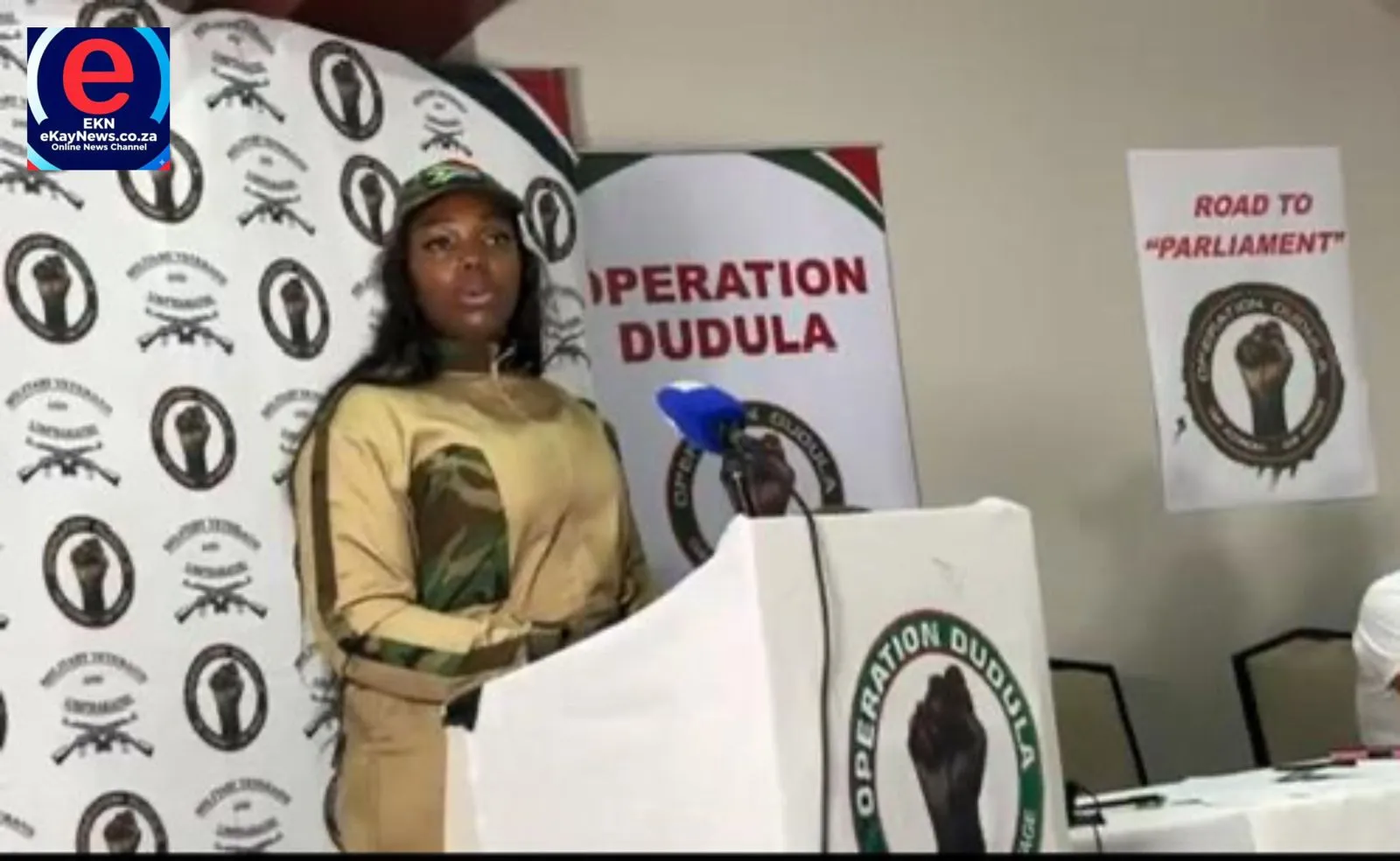
Zandile Dabula Resigns as Operation Dudula President Amid Internal Divisions
Zandile Dabula resigns as Operation Dudula president amid internal divisions, marking a monumental turning point in the often volatile socio-political landscape of South Africa. In an unexpected and highly publicized move, the prominent activist formally announced that she has resigned as both the president and a card-carrying member of Operation Dudula with immediate effect. Citing growing internal fractures and fundamental disagreements over the organisation’s overarching political direction, her departure leaves a massive leadership vacuum in one of the country’s most controversial movements.
The Rise of Operation Dudula from Soweto to National Politics
Operation Dudula, which originally burst onto the national scene as an anti-migrant vigilante group founded in the historic township of Soweto in 2021, has become internationally known for its fiercely hardline stance on undocumented immigration. Under Dabula’s tenure, the group aggressively expanded its operational footprint across multiple provinces, ultimately transitioning into a registered political party. However, this rapid expansion and major structural shift have clearly taken a heavy toll on the movement’s internal cohesion.
A Shocking Resignation Rocks South Africa
The sudden announcement that Zandile Dabula resigns as Operation Dudula president amid internal divisions has sent shockwaves through grassroots communities and formal political circles alike across South Africa. Dabula originally took over as the national leader of the movement in June 2023, stepping into the immense void left by the departure of the group’s charismatic but controversial founder, Nhlanhla Dlamini, widely known as Nhlanhla Lux.
Her ascension marked a major turning point for the organisation, pivoting it from a purely reactionary street movement toward more structured, albeit deeply polarizing, national campaigns. In her comprehensive and widely circulated resignation letter, Dabula described her sudden departure as a profoundly painful but ultimately necessary decision. She revealed that the move followed “a long period of introspection regarding the future direction of the organisation.”
Inside the Resignation Letter: A Heavy Heart
The emotional weight of her choice was evident in her written statement to her thousands of devoted followers and political allies.
“It is with a heavy heart and deep reflection that I, Zandile Dabula, formally resign from my position as president, as well as a member, of Operation Dudula Political Party,” she wrote, bringing an abrupt end to a highly turbulent chapter in her public life and plunging the organization’s future into immediate doubt.
How Internal Divisions Fractured the Movement
The central catalyst behind the split appears to be the group’s highly contested decision to enter formal electoral politics. Dabula openly stated that several prominent leaders within the organisation had increasingly begun to question whether the rapid transition from a localized civic movement into a fully-fledged political party had happened entirely prematurely.
The intense pressures of nationwide campaigning, policy formulation, and navigating the strict compliance laws of the Independent Electoral Commission (IEC) placed immense strain on a group originally designed for direct street-level action.
“During the course of our journey, there were moments where some among the national leadership reflected on whether the transition of Operation Dudula into a political party may have happened earlier than necessary,” she explained in her letter.
The Debate: Grassroots Activism vs. Electoral Politics
She added that a significant faction of traditionalists within the movement firmly believed that Operation Dudula had built a much stronger, more authentic sphere of influence while operating strictly as a civic organisation. For these members, the group’s true power was deeply rooted in direct “activism, advocacy, and community mobilisation,” rather than the bureaucratic maneuvering required in the formal political arena.
Because Zandile Dabula resigns as Operation Dudula president amid internal divisions, the fundamental ideological battle between grassroots activism and institutional politics has been fully exposed to the public.
Zandile Dabula Steps Away from Operation Dudula
Delving deeper into the specific mechanics of the internal friction, the outgoing president was remarkably candid about the strategic divergence that led to her exit. While she has fiercely defended the group in the past, she acknowledged that maintaining unity among the top brass had become an impossible task.
“While I respected and supported the collective decisions taken by the organisation at the time, I have come to accept that my own vision for the future of the movement differs from the current political direction being pursued,” Dabula said.
Strategic Divergence and Leadership Deadlock
She openly acknowledged the presence of deep-seated internal disagreements over critical issues such as leadership hierarchy, structural integrity, and long-term strategy, noting that differing views had naturally emerged over time as the organization swelled in size.
“I believe it is in the best interest of both myself and the movement that I step aside and allow the organisation to continue on another path chosen by its leadership,” she said, signaling a clean break rather than a hostile takeover attempt. Furthermore, Dabula strongly suggested that she no longer wished to pursue political leadership through the Operation Dudula machinery, stating:
“My conscience will not allow me to continue asking supporters to make further sacrifices when I personally believe that my contribution moving forward would be more meaningful outside of the current political structure.”
Controversies and the Broader Impact on South Africa
Her resignation arrives at a time of heightened national debate over immigration, border security, anti-illegal migration activism, and the overarching political direction of South Africa. Operation Dudula has been a constant fixture in the national headlines, often for highly contentious reasons. Over the past few years, the movement has repeatedly been heavily criticised by prominent civil society groups, legal watchdogs, and international human rights organisations, all of which have consistently accused the group of weaponizing xenophobia and utilizing violent intimidation tactics.
Polarizing Healthcare and Education Campaigns
Under Dabula’s watch, the organization launched several highly polarizing campaigns, including controversial attempts to physically prevent undocumented foreign children from accessing public schools, and staging protests outside public hospitals to demand that foreign nationals be denied government-funded healthcare services. These actions drew widespread condemnation from educators and medical professionals, who labelled the tactics as unconstitutional and fundamentally inhumane.
Legal Battles and Constitutional Challenges
The legal ramifications of these campaigns have been severe. Various civil rights bodies publicly condemned the movement’s attempts to disrupt school activities, citing strict constitutional protections regarding the universal right to basic education. Furthermore, the organisation faced several high-profile interdicts in the High Court aimed at halting their controversial operations.
Defending these continuous legal battles drained the organization’s resources and created a massive rift between those who favored aggressive, headline-grabbing street action and those who wanted to focus on building a legitimate, legally compliant political manifesto.
Accusations of Hypocrisy and Ancestral Scandals
Adding to the internal chaos, several high-ranking leaders within the movement have recently faced intense public backlash and damaging accusations of hypocrisy following sudden social media revelations about their own foreign family roots and complex ancestral backgrounds. These scandals severely undermined the group’s strict nativist messaging and undoubtedly fueled the toxic internal environment.
The fact that Zandile Dabula resigns as Operation Dudula president amid internal divisions during such a critical period suggests that the pressure from both external legal challenges and internal ideological purity tests simply became too much to manage.
YOU MAY LIKE:
Operation Dudula sparks tension in Joburg CBD after operations resume
Victoria Africa and Dudula members are violating the court order
Conclusion: An Uncertain Future for Populist Movements
Although Zandile Dabula has formally cut ties with Operation Dudula, she explicitly stated that her commitment to the movement’s foundational ideologies remains intact. She continues to fiercely advocate for the core socio-economic issues that initially fueled the organization, such as immigration reform, community safety, and economic inclusion for South Africans. By indicating that she will announce her future plans at an appropriate time, Dabula has left the door open for a potential return to independent public activism, keeping both her supporters and political detractors in suspense.
Dabula’s sudden departure highlights the broader challenges of transforming localized populist anger into a sustainable national political strategy amid South Africa’s ongoing socio-economic struggles. Consequently, Operation Dudula is left in a highly precarious position, grappling with a severe leadership vacuum and an ongoing identity crisis following its transition into formal electoral politics. The controversial movement now faces a monumental battle to consolidate its remaining base and maintain unity, with its ultimate survival as a cohesive political entity hanging entirely in the balance.
Mainstream Media References
-
Inside Metros: Zandile Dabula resigns as Operation Dudula president amid internal divisions
-
Johannesburg News Today (via Apple Podcasts): Operation Dudula Moves Forward After Leader’s Resignation
Kindly consider to support eKayNews, Buy Us a Coffee & Keep the News Flowing!

Love what we do? You can now support eKayNews directly! Your contributions empower us to deliver the breaking news, sports, and local updates you trust.
Ways to Support:
-
Subscribe: Choose any amount (cancel anytime).
-
Virtual Coffee: A quick, once-off donation to say thanks.
Note: Payments are 100% secure via PayFast. We never see your banking details.
To our amazing readers: Your support fills us with gratitude. You are the reason we can keep doing this every day. Thank you for being a vital part of the eKayNews family!
We’re feeling the love at eKayNews!

Facebook: [eKayNews on Facebook] X (Twitter): [eKayNews on X] WhatsApp: [Follow the eKayNews WhatsApp Channel] Join our inner circle for real-time news alerts!
📢 Advertising Packages on www.eKayNews.co.za
Package 1. Link Booster: We add 7 links to 7 articles over 7 days – R2,500
Package 2. Permanent Feature: Sponsored Blog Article (hosted permanently) – R4,000
Package 3. Prime Visibility: Home Page Banner Ad (30 days) – R5,000
Book now: Email info@ekaynews.co.za or WhatsApp us on +27710961185