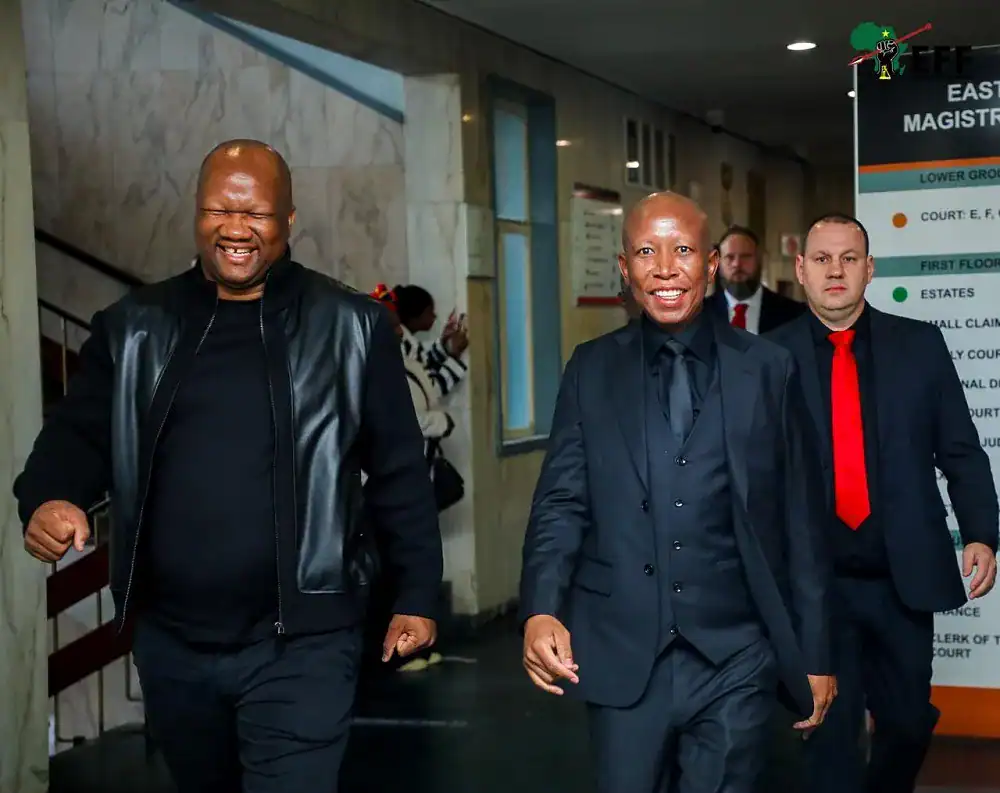
Julius Malema Court Judgment Today
Julius Malema court judgment Today is the phrase dominating headlines as the long-running case against the Economic Freedom Fighters (EFF) leader nears its conclusion. Magistrate Twanette Olivier spent Monday reviewing testimonies from state witnesses and is set to deliver her ruling on Tuesday. Alongside Malema, his former bodyguard Adriaan Snyman stands accused, and the outcome of this trial has attracted national attention.
Background to the Julius Malema Trial
The Julius Malema trial has been in the spotlight for months due to the high-profile status of the EFF leader and the allegations tied to his conduct. Malema, a central figure in South African politics, has repeatedly framed the proceedings as politically motivated.
His co-accused, Adriaan Snyman, once served as his bodyguard and has been charged in connection with the same matter. Together, they have consistently denied wrongdoing, asserting that the charges are aimed at undermining their political influence.
The Role of State Witness Testimonies
A key aspect of the proceedings has been the weight of state witness testimonies. Magistrate Olivier dedicated Monday to a thorough review of these accounts before preparing her judgment. Witnesses have provided conflicting versions of events, forcing the court to carefully evaluate credibility and consistency.
Observers note that the testimonies could tip the scales either way. The defense maintains that the witnesses’ evidence is unreliable, while the state argues that it establishes a pattern of conduct warranting conviction.
Courtroom Drama and Public Attention
The court judgment has drawn attention not only from the legal community but also from South Africans nationwide. Supporters of Malema have filled courtrooms and rallied outside, claiming that their leader is being persecuted for his outspoken views on land reform, corruption, and economic justice.
Opponents, however, argue that no individual, regardless of political position, should be above the law. The case has therefore become symbolic of South Africa’s broader struggle between accountability and political influence.
The Adriaan Snyman Case
While much focus has been on Malema, the Adriaan Snyman case is equally critical. Snyman faces charges tied to the alleged facilitation of Malema’s actions. His defense team has argued that his role was misrepresented, and that he should not be held liable for actions he did not directly commit.
Legal analysts point out that the Snyman case could set a precedent for how bodyguards and associates of political leaders are treated under the law. If convicted, it may redefine accountability for individuals connected to high-ranking politicians.
Political Repercussions for the EFF
The EFF, under Malema’s leadership, has positioned itself as a voice of the disenfranchised, campaigning for land expropriation without compensation and pushing for radical economic transformation.
Should the Julius Malema court judgment Tuesday end in a conviction, it could destabilize the party’s leadership and weaken its influence ahead of future elections. Conversely, an acquittal could embolden Malema and reinforce his narrative of resilience against political persecution.
Legal Community Weighs In
Legal experts have highlighted the complexity of the case, particularly regarding the interpretation of the law and the role of intent. Many agree that state witness testimonies will be central to Magistrate Olivier’s final decision.
The question remains whether the prosecution has proven its case beyond reasonable doubt or whether the defense’s arguments of political targeting will sway the court’s reasoning.
Public Reaction and Media Spotlight
The South African public has been deeply divided on the case. For Malema’s supporters, the trial is seen as a waste of judicial resources aimed at discrediting a popular opposition leader. For critics, however, it represents an essential step toward ensuring accountability.
Media outlets have provided continuous coverage, with the phrase Julius Malema court judgment Today trending across platforms. This reflects the intense anticipation surrounding the ruling.
The Broader Context of Political Trials in South Africa
South Africa’s history is marked by politically charged trials. From apartheid-era courtrooms to modern corruption cases, legal battles involving political figures often carry implications beyond the courtroom.
The Julius Malema trial fits into this larger pattern, highlighting how justice, politics, and public opinion intersect. The Adriaan Snyman case further complicates the narrative, reminding observers that political figures rarely act alone and that accountability can extend to associates.
What to Expect on Today
As Tuesday approaches, all eyes are on Magistrate Twanette Olivier. The court judgment will not only determine the fate of Julius Malema and Adriaan Snyman but also shape public trust in the judiciary.
-
A conviction could be celebrated as a victory for accountability but may spark unrest among EFF supporters.
-
An acquittal may strengthen Malema’s standing but could invite criticism of the judiciary’s impartiality.
Either way, the ruling will resonate beyond the courtroom.
Conclusion
The Julius Malema court judgment Today marks a critical moment for South African politics and law. With state witness testimonies under review and the Adriaan Snyman case intertwined, the outcome could have wide-reaching consequences.
Whether viewed as justice served or political persecution, the judgment will be a defining event in Malema’s career and in South Africa’s pursuit of balancing law with political realities.
For now, the nation waits as Magistrate Olivier prepares to deliver a decision that could reshape political narratives for years to come.
You May Like: