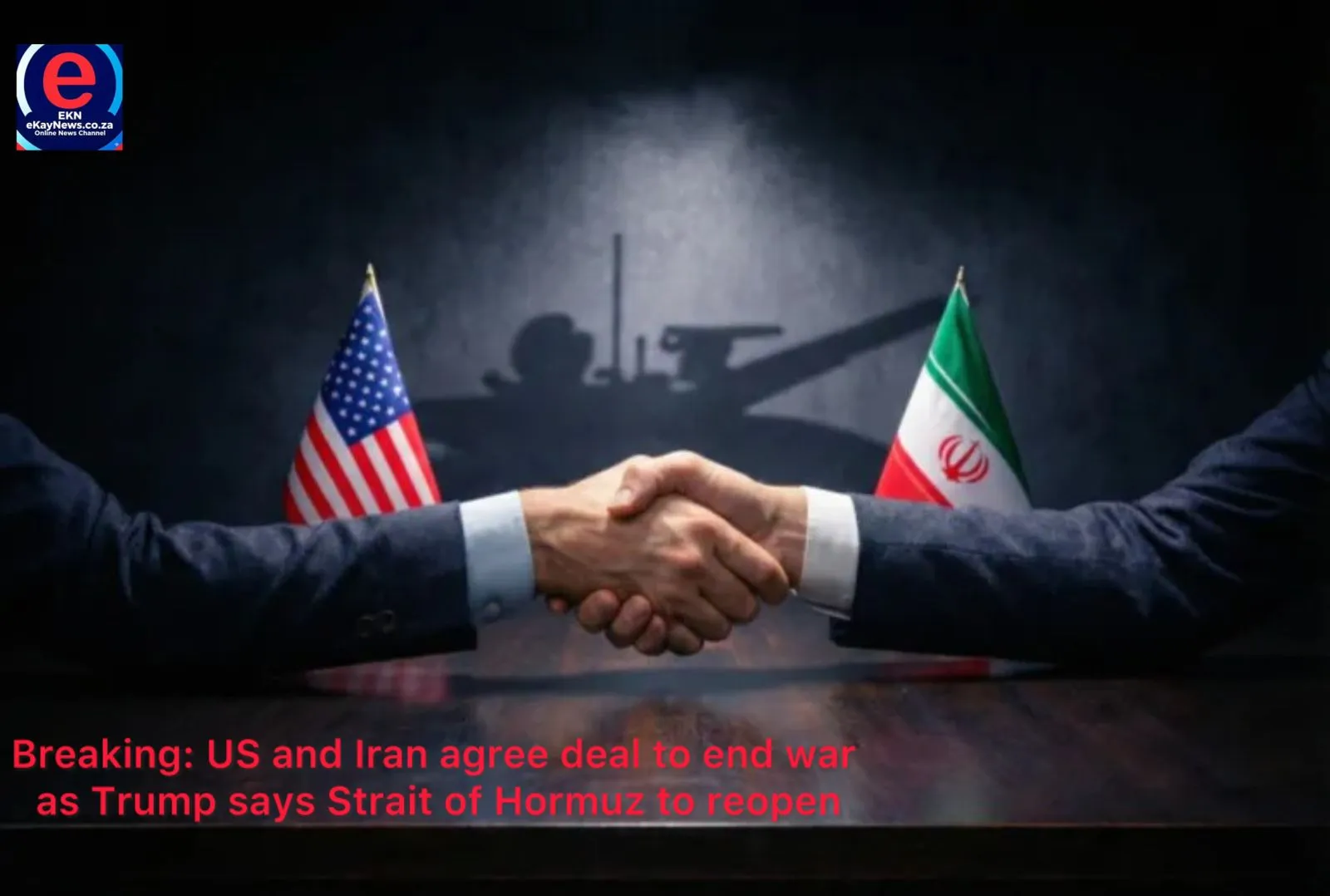
US and Iran agree deal to end war as Trump says Strait of Hormuz to reopen
The agreement, which is expected to be formally signed in Geneva, Switzerland, marks the most significant diplomatic breakthrough between Washington and Tehran in years. While many critical issues remain unresolved, including Iran’s nuclear program and sanctions relief, the deal establishes a foundation for further negotiations and provides hope for lasting peace.
The announcement was welcomed by world leaders, financial markets, and observers who have closely followed the escalating tensions between the two nations since military hostilities erupted earlier this year.
US-Iran Peace Deal Signals Diplomatic Breakthrough
The emerging US-Iran peace deal represents a rare moment of cooperation between two countries whose relationship has been defined by decades of hostility.
President Donald Trump announced the agreement through social media, declaring that a deal with the Islamic Republic of Iran had been completed after months of negotiations.
Iran’s Supreme National Security Council also confirmed that a memorandum of understanding had been finalized following extensive discussions.
The agreement reportedly includes:
- A 60-day ceasefire.
- The immediate suspension of military operations.
- Reopening of critical shipping routes.
- Removal of the U.S. naval blockade on Iranian ports.
- Continued negotiations on unresolved issues.
Although the full text has not yet been released publicly, officials from both countries have described the framework as an important first step toward ending the conflict.
Months of Conflict Lead to Negotiations
The road to this agreement was marked by significant violence and uncertainty.
The conflict began following military strikes involving the United States, Israel, and Iran, triggering a series of retaliatory attacks throughout the region.
Iran launched missile strikes targeting Israeli territory and U.S. military assets in Gulf states, while tensions escalated further when Hezbollah became involved from Lebanon.
The resulting instability created fears of a wider regional war that could draw in additional countries and disrupt global trade.
As casualties mounted and economic pressures increased, diplomatic efforts intensified behind the scenes.
Pakistan, Qatar, and several European nations played crucial roles in facilitating dialogue between the two sides.
Strait of Hormuz Reopening Boosts Global Markets
One of the most significant aspects of the agreement is the planned Strait of Hormuz reopening.
The Strait of Hormuz is among the world’s most strategically important waterways.
Approximately one-fifth of global oil and natural gas supplies pass through the narrow channel connecting the Persian Gulf to international markets.
Its closure during the conflict created severe concerns about energy security and contributed to rising fuel prices worldwide.
President Trump announced that the shipping route would reopen following the signing of the agreement.
“Ships of the World, start your engines. Let the oil flow!” Trump declared.
Why the Strait of Hormuz Matters
The Strait of Hormuz serves as a vital transportation corridor for energy exports from several Gulf nations.
Countries relying heavily on this route include:
- Saudi Arabia
- United Arab Emirates
- Kuwait
- Iraq
- Qatar
- Iran
Any disruption to shipping traffic in the strait has immediate consequences for global oil markets.
Investors responded positively to news of the agreement.
Oil prices fell sharply after reports emerged that unrestricted shipping could soon resume.
Financial analysts noted that restoring normal operations would help stabilize global energy supplies and reduce inflationary pressures in many countries.
Markets React Positively
Global stock markets also responded favorably to the announcement.
Energy companies, shipping firms, and investors viewed the deal as a sign that tensions in one of the world’s most volatile regions could finally begin to ease.
Economists suggested that reduced geopolitical uncertainty could support economic growth and improve investor confidence.
The reopening of the Strait of Hormuz is therefore seen not only as a diplomatic achievement but also as a major economic development.
Donald Trump Ceasefire Agreement Marks Political Victory
The Donald Trump ceasefire agreement is being presented by the White House as a major foreign policy success.
President Trump argued that his administration’s strategy had reshaped the balance of power in the Middle East and created the conditions necessary for negotiations.
During interviews and public statements, Trump emphasized that the agreement would bring peace, security, and stability to the region.
The president also highlighted the lifting of the naval blockade on Iranian ports as evidence of progress toward normalization.
Trump Claims Diplomatic Success
Supporters of the administration view the agreement as proof that sustained pressure and diplomacy can produce results.
The White House argues that military and economic measures compelled Iran to engage seriously in negotiations.
According to administration officials, the agreement demonstrates the effectiveness of combining strategic pressure with diplomatic outreach.
Critics, however, caution that the most difficult issues remain unresolved and that declaring victory may be premature.
Iran Also Claims Success
Iranian officials have portrayed the framework agreement as a victory for Tehran.
State media emphasized that Iran had resisted pressure and secured concessions from the United States.
Senior Iranian figures argued that the agreement demonstrated the resilience of the country and its allies.
This dual narrative reflects the reality of many international agreements, where each side seeks to reassure domestic audiences that its interests have been protected.
Iran Nuclear Negotiations Remain Unresolved
Despite the optimism surrounding the agreement, the future of Iran nuclear negotiations remains uncertain.
The nuclear issue has long been one of the most contentious aspects of relations between Iran and Western nations.
While the framework agreement establishes a ceasefire and outlines future talks, it does not resolve disputes over Iran’s nuclear activities.
Key Questions About Iran’s Nuclear Programme
Several major questions remain unanswered:
- What limits will be placed on uranium enrichment?
- How will compliance be monitored?
- What verification mechanisms will be implemented?
- When might sanctions relief occur?
- How will international inspectors access facilities?
These issues are expected to dominate negotiations during the next sixty days.
Both sides have acknowledged that finding common ground will be challenging.
International Community Watches Closely
European leaders have welcomed the agreement while emphasizing the importance of preventing Iran from acquiring nuclear weapons.
Leaders from the United Kingdom, France, Germany, and Italy issued a joint statement expressing support for diplomacy and verification measures.
They indicated that sanctions relief could be considered if Iran takes verifiable steps regarding its nuclear programme.
International observers view the upcoming negotiations as crucial to determining whether the framework agreement evolves into a lasting peace settlement.
Middle East Conflict Resolution Faces Challenges
Although the framework represents progress, achieving lasting Middle East conflict resolution remains a complex task.
The region’s conflicts are interconnected and involve multiple actors with competing interests.
Israel Raises Concerns
One of the most significant challenges comes from Israel.
Israeli officials were not direct participants in the U.S.-Iran negotiations and have expressed reservations about the agreement.
National Security Minister Itamar Ben-Gvir stated that Israel is not bound by the deal.
Defense Minister Israel Katz similarly indicated that Israel would continue acting to protect its security interests.
These statements highlight the difficulties involved in translating a bilateral agreement into broader regional stability.
Hezbollah and Lebanon Remain Key Issues
The situation in Lebanon also presents ongoing challenges.
The agreement reportedly calls for an end to military operations involving Hezbollah and Israeli forces.
However, implementing such provisions will require cooperation from multiple parties.
Recent strikes in Beirut underscored the fragility of the situation and demonstrated how quickly tensions can escalate.
Diplomats acknowledge that sustaining peace will require continued engagement from regional and international actors.
Pakistan and Qatar Play Crucial Mediating Roles
The agreement would likely not have been possible without the efforts of international mediators.
Pakistan and Qatar played particularly important roles in facilitating communication and reducing tensions.
Diplomatic Channels Remain Essential
Pakistan’s Prime Minister Shehbaz Sharif announced the agreement and praised the willingness of both sides to pursue peace.
Qatari mediators reportedly conducted extensive discussions lasting more than fourteen hours to finalize the framework.
Their involvement highlights the importance of third-party mediation in resolving complex international disputes.
Diplomatic channels often provide opportunities for dialogue even when direct communication becomes difficult.
Geneva Signing Ceremony Planned
The framework agreement is expected to be formally signed in Geneva later this week.
The ceremony will symbolize a commitment to diplomacy and continued negotiations.
Observers will closely monitor the event for additional details regarding implementation timelines and verification mechanisms.
Economic Implications of the Peace Framework
The economic consequences of the agreement could be significant.
Months of conflict disrupted trade, increased energy costs, and created uncertainty across global markets.
Potential Benefits for the Global Economy
If implemented successfully, the agreement could:
- Reduce energy prices.
- Improve shipping reliability.
- Restore investor confidence.
- Strengthen international trade.
- Lower geopolitical risk premiums.
Businesses and governments around the world have welcomed the possibility of greater stability.
Energy Markets in Focus
Energy analysts expect the Strait of Hormuz reopening to remain one of the most closely watched aspects of the agreement.
Because such a large share of global energy exports passes through the waterway, any improvement in shipping conditions could have immediate economic benefits.
The announcement has already influenced market expectations and commodity prices.
Challenges Ahead for the Peace Process
Despite the optimism surrounding the agreement, significant obstacles remain.
History demonstrates that ceasefires and framework agreements require sustained commitment from all parties.
Key Risks Facing the Agreement
Potential risks include:
- Renewed military incidents.
- Disagreements over nuclear issues.
- Regional opposition.
- Verification disputes.
- Domestic political pressures.
Any of these factors could complicate implementation.
Diplomats therefore stress that the framework should be viewed as the beginning of a process rather than its conclusion.
Building Long-Term Stability
Achieving durable peace will require continued negotiations, trust-building measures, and international support.
Both Washington and Tehran face difficult decisions as talks move forward.
Success will depend on their willingness to compromise while addressing legitimate security concerns.
YOU MAY LIKE:
Conclusion
U.S. and Iran Reach Framework for Peace in a landmark diplomatic development that could reshape the Middle East and reduce one of the world’s most dangerous geopolitical confrontations. The emerging US-Iran peace deal establishes a ceasefire, paves the way for the Strait of Hormuz reopening, and creates a platform for future negotiations on unresolved issues.
While the Donald Trump ceasefire agreement has generated optimism among international leaders and financial markets, substantial challenges remain. The future of Iran nuclear negotiations, regional security arrangements, and broader Middle East conflict resolution efforts will determine whether this framework evolves into a lasting peace settlement.
For now, however, the agreement represents a rare moment of diplomatic progress in a region that has endured years of instability, conflict, and uncertainty. The coming weeks will reveal whether this historic framework can become the foundation for a more peaceful and secure future.
References
- Reuters. Iran, US agree to halt war and reopen Hormuz, sending oil prices tumbling (15 June 2026)
https://www.reuters.com/world/asia-pacific/iran-us-agree-halt-war-reopen-hormuz-sending-oil-prices-tumbling-2026-06-15/ - The Guardian. US and Iran reach framework peace deal to end war (15 June 2026)
https://www.theguardian.com/world/2026/jun/14/trump-calls-for-restraint-israel-airstrikes-beirut-us-iran-peace-deal
Keep the News Flowing – Buy the Team a Coffee! ☕

Love the updates? Help us stay on the beat! Whether it’s a quick one-time donation or a monthly subscription, your support keeps the eKayNews lights on and the stories flowing.
-
Secure & Simple: We use PayFast for total transaction peace of mind.
-
Make an Impact: Every “coffee” you send directly supports our newsroom.
Your Brand, Our Audience: Let’s Make Headlines Together! 🚀

Looking for real engagement? At eKayNews, we don’t just share news—we build connections. Whether you’re a local startup or a growing business, our advertising packages are designed to put your brand in front of a loyal, highly engaged audience.
Choose Your Spotlight:
-
Link Booster (R2,500): Dominate the feed with 7 links across 7 days.
-
Permanent Feature (R4,000): Your story, hosted on our site for a lifetime.
-
Prime Visibility (R5,000): Claim the top spot with a 30-day homepage banner.
Ready to grow? 📩 Email us: info@ekaynews.co.za 💬 WhatsApp us: +27 71 096 1185
Get Connected:
-
Facebook & X (Twitter) : Follow us for real-time updates and community debates.
-
WhatsApp Channel: Get exclusive alerts sent directly to your phone.
Stay informed, ahead, connected with the eKayNews family!