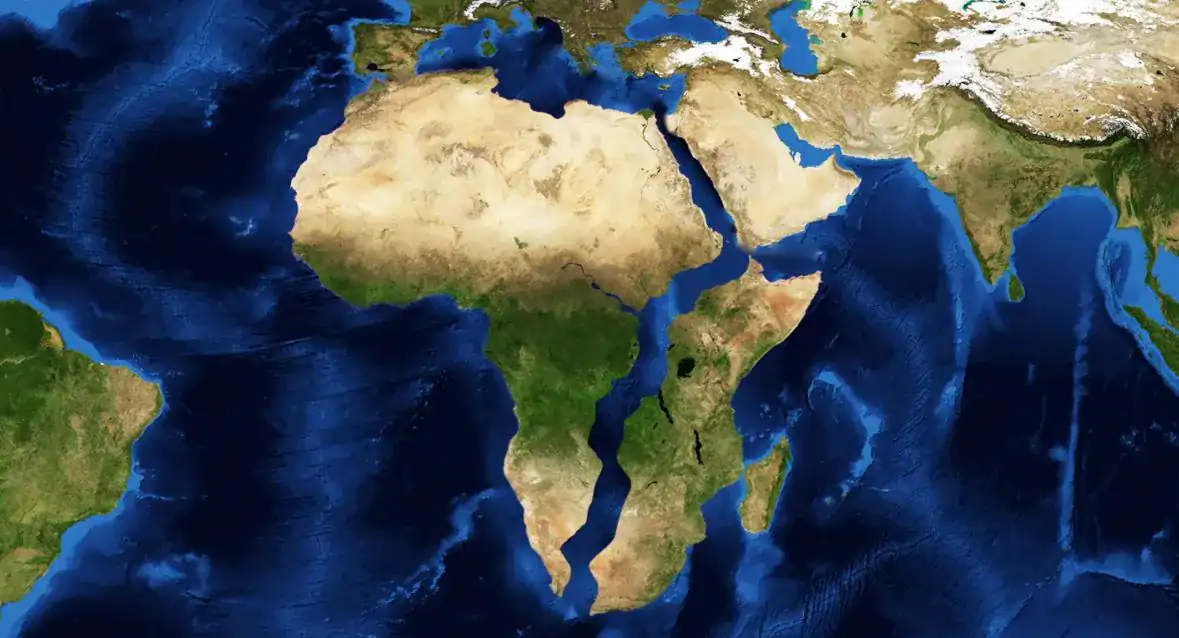
Africa is slowly splitting into two continents, and scientists say a new ocean could eventually form
Africa is slowly splitting into two continents, and scientists say a new ocean could eventually form. This extraordinary geological event is currently unfolding across the East African landscape. Farmers who walk the same paths every morning have started noticing new cracks slicing through their fields. Roads buckle. A single dirt track suddenly drops away into a jagged trench. From far above, satellite images show it clearly: East Africa is stretching, like a slow, silent tear in the continent’s skin.
Scientists say this isn’t just a local landslide or a one-off earthquake. Africa splitting into two continents is a process they insist is happening very slowly. In a distant future, a new ocean formation in Africa could see water seep in and fill the gap. The idea sounds like science fiction, yet the data, the maps, and the videos don’t blink. The ground we trust under our feet is moving. Literally.
A continent opening, frame by frame: The East African Rift
On a bright morning in 2018, a huge crack opened in the Kenyan countryside almost overnight. It ripped through fields, cut a highway in two, and went viral on social media within hours. Geologists rushed to the scene with a strange sense of recognition. They had seen this shape before on the floor of the Red Sea and in underwater images of the Atlantic.
Zoom out on a map and you can see the pattern spreading across countries. From Ethiopia down through Kenya, Tanzania, and Mozambique, the East African Rift runs like a scar. It’s a 3,000-kilometre-long zone where the African Plate is splitting into two: the Somali Plate vs Nubian Plate. GPS stations nailed into bedrock show the plates drifting apart by a few millimetres every year.
That sounds tiny, yet over millions of years, a few millimetres add up to hundreds of kilometres. Every tremor, every small earthquake, every visible crack is another frame in that slow-motion film. The videos that pop up online after earthquakes in Ethiopia or volcanic activity in the Afar region are just flashes of something deeper: the crust beneath East Africa is thinning. Hot magma is pushing up from below, prising the continent open from the inside.
The birth of a new ocean
At the heart of this story is heat. Deep below the East African Rift, plumes of hot rock rise from the mantle, weakening the crust. This kind of tearing is how oceans are born. The Atlantic once began as a rift on a supercontinent, not so different from the one slicing through East Africa today.
How scientists “watch” a continent crack
If you want to understand if Africa is slowly splitting into two continents, and scientists say a new ocean could eventually form, you start with tiny movements that no one feels. Researchers bolt GPS receivers into bedrock to log micrometre shifts. The data confirms the drift of the Somali Plate vs Nubian Plate.
To make those dry numbers visible, teams create animations. Watch closely and the arrows on the eastern side slowly tilt and lengthen, pointing away from the rest of the continent. Earthquakes add the sound to that picture. Seismometers scattered across East Africa listen to those vibrations like stethoscopes on a giant chest. They tell scientists how deep the cracks go and where magma is moving.
Behind the scenes, scientists talk in quiet, cautious tones about timelines. Will a new ocean really form? Yes, they say, if the rifting continues and the crust finally opens wide enough for water to flood in from the Red Sea or the Indian Ocean. That’s a story playing out over something like 5 to 10 million years.
What a “new ocean” really means for us
When headlines shout that Africa splitting into two continents is inevitable, the mind jumps to disaster. That’s not the reality. The real story is more subtle. The new ocean will probably start as a series of deep basins, filling with water slowly.
From a risk perspective, the East African Rift is both a threat and an opportunity. That same thin crust that makes earthquakes more likely also brings geothermal energy closer to the surface. Countries like Kenya and Ethiopia are already drilling deep wells to capture steam and turn it into clean electricity.
Summary Table: Continental Breakup
| Point clé | Détail | Intérêt pour le lecteur |
| East African Rift | Splitting the Nubian and Somali plates | Explains the science behind viral “crack” videos |
| Somali Plate vs Nubian Plate | Drifting apart millimetres per year | Proves the continent is not a static landmass |
| New ocean formation in Africa | Seawater will eventually flood the rift | Redefines our long-term understanding of world maps |
FAQ: Africa’s Geological Future
Is Africa really splitting into two continents?
Yes, geological data shows the African Plate is separating into the Nubian and Somali plates along the East African Rift, though the full “split” will take millions of years.
Will a new ocean actually appear in East Africa?
Most geologists think so, if rifting continues: the crust will thin, sink, and eventually allow seawater from nearby oceans to flood in, forming a new ocean formation in Africa.
Are the viral videos of giant cracks in Kenya and Ethiopia fake?
No, they show real ground fissures. While often triggered by heavy rain, they sit inside the broader rift zone where the crust is actively stretching.
YOU MAY LIKE:
South Africa Leads Africa as Luxury & Sustainable Tourism Hub
Conclusion: Watching Earth Evolve
In an age where so much feels unstable, there’s something strangely grounding in the fact that Africa is slowly splitting into two continents, and scientists say a new ocean could eventually form. The continents have always been drifting. What’s new is that we finally have the instruments—and the cameras in our pockets—to watch it happen, frame by frame, crack by crack.
Would you like me to find the latest satellite data from 2026 showing the exact millimetre shift recorded in the Afar region this year?
Mainstream Media References
1.NBC News
-
Article Title: Africa is splitting into two, and a new ocean could form
Kindly consider to support eKayNews, Buy Us a Coffee & Keep the News Flowing!

Love what we do? You can now support eKayNews directly! Your contributions empower us to deliver the breaking news, sports, and local updates you trust.
Ways to Support:
-
Subscribe: Choose any amount (cancel anytime).
-
Virtual Coffee: A quick, once-off donation to say thanks.
Note: Payments are 100% secure via PayFast. We never see your banking details.
To our amazing readers: Your support fills us with gratitude. You are the reason we can keep doing this every day. Thank you for being a vital part of the eKayNews family!
We’re feeling the love at eKayNews!

Facebook: [eKayNews on Facebook] X (Twitter): [eKayNews on X] WhatsApp: [Follow the eKayNews WhatsApp Channel] Join our inner circle for real-time news alerts!
📢 Advertising Packages on www.eKayNews.co.za
Package 1. Link Booster: We add 7 links to 7 articles over 7 days – R2,500
Package 2. Permanent Feature: Sponsored Blog Article (hosted permanently) – R4,000
Package 3. Prime Visibility: Home Page Banner Ad (30 days) – R5,000
Book now: Email info@ekaynews.co.za or WhatsApp us on +27710961185