
Standard Bank mentioned in the Epstein Files has sent shockwaves through the South African financial sector as new documents reveal that disgraced financier Jeffrey Epstein funneled significant sums into local accounts. According to the latest 2026 data released by the U.S. Department of Justice, Jeffrey Epstein utilized Standard Bank branches in Constantia and Wynberg to facilitate regular monthly payments of $5,000 (R81,000) or more. These records provide a chilling look into how the convicted child sex offender and alleged human trafficker embedded his financial operations within South Africa.
Monthly Payments and Redacted Identities
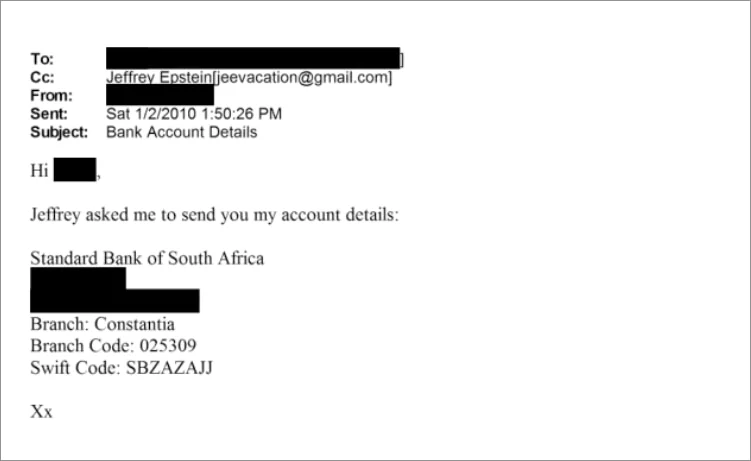
The documents, commonly referred to as the Epstein Files, include hundreds of internal emails and bank statements. On 2 January 2010, a redacted email was sent to Epstein’s staff stating, “Jeffrey asked me to send you my account details,” followed by a specific Standard Bank account held at the Constantia branch.
Payment instructions from Epstein’s accountant, Harry Beller, confirm that these transfers were not isolated incidents. The files highlight a pattern:
-
Initial Payment: $4,000 to a Constantia-based account.
-
Recurring Transfers: Generally $5,000 per month.
-
High-Value Transfers: At least one recorded payment of $10,000 following the same pattern.
-
Historical Ties: Bank statements from J.P. Morgan show $500 monthly payments to a Wynberg-based account dating as far back as 2003.
Standard Bank, Gabon, and Business in Africa
The Standard Bank mentioned in the Epstein Files discovery goes beyond personal transfers. The records reveal that Sultan Ahmed bin Sulayem, CEO of DP World, forwarded correspondence between himself and a former Standard Bank director for Africa solutions directly to Epstein.
In these emails, a Standard Bank official petitioned the Sultan for introductions to the President of Gabon and other government officials to discuss high-level business deals, including:
-
Loan Conversions: Converting non-functional foreign currency loans to protect against interest rate fluctuations.
-
Sovereign Revenue Protection: Helping Gabon and the Ivory Coast protect oil revenue streams.
-
Infrastructure Funding: Providing capital for various pan-African projects.
These emails suggest that Epstein was positioning himself as a “conduit” for retail innovation and institutional finance across the continent, using his elite network to gain a foothold in sovereign financial planning.
Standard Bank’s Response and Legal Compliance
When questioned about being Standard Bank mentioned in the Epstein Files, the financial institution declined to comment on specific client affairs. In a formal statement, the bank noted:
“Standard Bank does not comment on the financial affairs, banking relationships, or transactions of any individual or entity, whether past or present. This principle reflects our unwavering commitment to client confidentiality and our adherence to legal and regulatory obligations.”
The bank further emphasized that it operates under a comprehensive global framework for anti-money-laundering (AML) and fully cooperates with law enforcement. Despite this, the lack of specific answers regarding the purpose of Epstein’s monthly R81,000 payments has left many South Africans calling for a deeper probe into how these funds were utilized on local soil.
Summary of Known Payments
| Date Period | Branch Location | Average Amount | Known Purpose |
| 2003 – 2004 | Wynberg | $500 | Unclear |
| 2010 – 2012 | Constantia | $5,000 | Monthly Stipend |
| Misc. | Centurion | Various | African Tribal Art |
Self-Checkout South Africa and Financial Scrutiny
The exposure of Standard Bank in these files highlights the ongoing challenge of monitoring illicit financial flows. While South Africa has made strides in financial reporting, the Epstein case proves that even high-profile offenders can find “blind spots” in the system. As more pages of the 3.5 million-file cache are unredacted, the pressure on South African regulators to investigate the identities of the “redacted” account holders continues to mount.