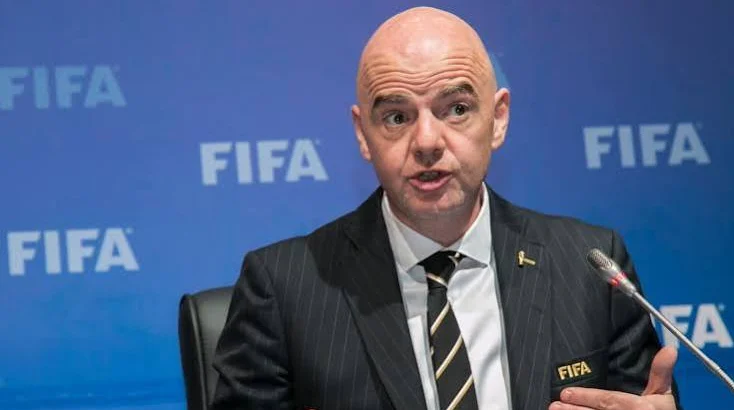
Gianni Infantino has opened the door to further expanding the World Cup to 64 teams.
Breaking: Gianni Infantino opens door to 64-team World Cup after the FIFA president confirmed that football’s governing body will consider expanding the tournament from 48 to 64 participating nations following the success of the current competition. The announcement has reignited debate over the future of international football, with supporters praising greater global inclusion while critics warn that further expansion could dilute the quality of the world’s biggest sporting event.
The proposal comes as the first-ever 48-team World Cup format has exceeded many expectations, providing opportunities for emerging football nations to compete on the global stage while delivering competitive matches throughout the tournament. Although no formal decision has been made, FIFA is expected to evaluate the possibility ahead of the 2030 FIFA World Cup, which will be jointly hosted by Spain, Portugal and Morocco.
Gianni Infantino says FIFA will examine further expansion
FIFA president believes more countries deserve an opportunity
Speaking to Swiss broadcaster Blue Sport, Gianni Infantino confirmed that FIFA will study whether expanding the World Cup to 64 teams is feasible.
When asked directly about the proposal, Infantino explained that the governing body intends to assess all available options once the current tournament concludes.
“These are all issues that we will be examining after the World Cup,” he said.
Infantino stressed that the World Cup should represent every continent rather than remain dominated by traditional football powers.
According to him, allowing more countries to qualify gives developing football nations greater motivation to invest in infrastructure, coaching and player development.
He argued that every nation should have the opportunity to dream of competing on football’s biggest stage.
FIFA World Cup expansion has transformed global football
Growth from 32 to 48 teams already reshaped the tournament
The current FIFA World Cup expansion began after the FIFA Council approved increasing the competition from 32 to 48 teams in 2017.
The decision initially attracted widespread criticism from football experts, who feared that expanding the tournament would reduce overall quality and create more one-sided matches.
However, the first edition using the larger format has largely exceeded expectations.
Many debutant nations have performed competitively while producing several memorable moments throughout the tournament.
The expanded format has also increased global representation, giving more countries the chance to compete at football’s highest level.
48-team World Cup format delivers unexpected success
Smaller nations seize their opportunity
The 48-team World Cup format has enabled several countries to make history.
Curacao became the smallest nation ever to qualify for a FIFA World Cup, while Jordan and Uzbekistan also celebrated their first appearances on football’s biggest stage.
Cape Verde emerged as one of the tournament’s biggest surprises after reaching the knockout rounds and pushing defending champions Argentina into extra time.
Although many initially viewed tournament expansion as lowering competitive standards, performances from several smaller nations have challenged that belief.
Infantino believes these achievements demonstrate that expanding qualification opportunities encourages football development across every continent.
“Every team played at a high level,” he said.
He also highlighted the growing competitiveness of African football.
According to FIFA statistics, nine of the ten African representatives advanced to the knockout stage, compared to only five African teams reaching that phase at the previous tournament.
64-team World Cup proposal gains momentum
South America supports further growth
Discussion surrounding a 64-team World Cup intensified after South American football confederation CONMEBOL formally proposed additional expansion during 2025.
Supporters argue that increasing participation would strengthen football globally while allowing more emerging nations to experience World Cup competition.
A larger tournament could also significantly increase broadcasting revenue, sponsorship income and commercial opportunities for FIFA.
Infantino’s latest comments suggest the governing body remains open to examining the proposal rather than dismissing it outright.
No official decision has yet been announced.
Any expansion would require approval from FIFA’s governing bodies following consultations with continental confederations and member associations.
Critics warn against expanding the World Cup further
European and Asian leaders express concerns
Despite growing discussion, several football leaders remain firmly opposed to further expansion.
UEFA president Alexander Ceferin has previously described the idea as a “bad idea” for both the tournament and qualification process.
Leaders within the Asian Football Confederation (AFC) also expressed reservations.
AFC president Sheikh Salman bin Ibrahim Al Khalifa warned that expanding beyond 48 teams could create organisational “chaos.”
Similarly, CONCACAF president Victor Montagliani argued that excessive expansion risks damaging football’s broader competitive ecosystem.
Critics believe increasing the number of participants could reduce the prestige associated with qualifying for the World Cup.
Others fear an already crowded international calendar would become even more difficult for players and clubs.
2030 FIFA World Cup could become historic
Spain, Portugal and Morocco preparing to host
The 2030 FIFA World Cup is already expected to be historic.
Spain, Portugal and Morocco will jointly host the competition, marking one of the largest multinational sporting events ever organised.
If FIFA eventually approves expansion to 64 teams, tournament organisers would face significantly greater logistical challenges.
Additional stadiums, accommodation facilities, transportation infrastructure and security planning would all become necessary.
However, supporters argue that modern tournament hosts possess sufficient resources to manage larger competitions successfully.
The decision is expected only after FIFA completes a comprehensive review following the current World Cup.
Hydration breaks continue generating debate
Infantino also addressed criticism surrounding hydration breaks introduced during matches.
Some observers argued the additional stoppages primarily benefited television broadcasters by creating more advertising opportunities.
The FIFA president rejected that interpretation.
He explained that cooling breaks were implemented during previous tournaments whenever temperatures became dangerously high.
According to Infantino, approximately 60 percent of matches at last year’s FIFA Club World Cup required cooling breaks because of extreme weather conditions.
He acknowledged that opinions remain divided but maintained player welfare remains the primary consideration.
Ticket prices defended by FIFA
Another topic raised during Infantino’s interview involved ticket pricing.
Some supporters criticised FIFA after tickets for several World Cup matches reached record prices.
Infantino defended the pricing strategy by pointing to exceptionally high attendance figures.
According to FIFA, stadium occupancy throughout the tournament has reached approximately 99.7 percent.
He added that many tickets have since been resold on secondary markets for several times their original purchase price.
Infantino argued that such demand demonstrates strong global interest despite complaints regarding affordability.
Financial success exceeds expectations
The expanded tournament has also delivered major financial rewards.
Infantino revealed that FIFA expects total revenue of between 13 and 14 billion Swiss francs from the 39-day competition.
The income comes from broadcasting rights, sponsorship agreements, ticket sales, hospitality packages and commercial partnerships.
The financial success strengthens FIFA’s argument that expanding international competitions benefits football’s long-term sustainability.
Greater revenues can also support development programmes across emerging football nations.
Football community divided over expansion
Reactions from players, coaches, supporters and football administrators remain mixed.
Many developing football nations strongly support expansion because it creates realistic opportunities to qualify for future World Cups.
Supporters also enjoy seeing new countries compete against traditional football giants.
Opponents, however, argue that excessive expansion risks reducing competitive intensity while making qualification less meaningful.
Some believe FIFA should focus instead on improving existing tournaments rather than increasing participant numbers.
The debate is expected to continue long after the current World Cup concludes.
YOU MAY LIKE:
Jayden Adams’ father breaks silence on cause of death rumours
Conclusion
The announcement that Breaking: Gianni Infantino opens door to 64-team World Cup has once again placed the future of international football under global scrutiny. While no formal decision has been taken, Gianni Infantino believes the success of the 48-team World Cup format provides strong evidence that further FIFA World Cup expansion deserves serious consideration.
With the 2030 FIFA World Cup approaching and proposals for a 64-team World Cup gaining attention, FIFA faces one of its most significant strategic decisions in modern football history. Whether the governing body ultimately embraces further expansion or maintains the current format, the outcome will shape the future of the world’s biggest sporting event for generations to come.
Mainstream Media References
- The Independent – Gianni Infantino hints at expanding the World Cup again to 64 teams
https://www.independent.co.uk/sport/football/world-cup-64-teams-gianni-infantino-b3013639.html - The Guardian – Gianni Infantino hints at expansion to 64-team World Cup before 2030 event
https://www.theguardian.com/football/2026/jul/12/gianni-infantino-expansion-64-team-world-cup-2030-fifa - Reuters (via Cyprus Mail) – Infantino opens door to 64-team World Cup
https://cyprus-mail.com/2026/07/13/infantino-opens-door-to-64-team-world-cup - The Independent – How would a 64-team World Cup work?
https://www.independent.co.uk/sport/football/world-cup-64-teams-expansion-fifa-gianni-infantino-b3013795.html
Keep the News Flowing – Buy the Team a Coffee! ☕

Love the updates? Help us stay on the beat! Whether it’s a quick one-time donation or a monthly subscription, your support keeps the eKayNews lights on and the stories flowing.
-
Secure & Simple: We use PayFast for total transaction peace of mind.
-
Make an Impact: Every “coffee” you send directly supports our newsroom.
Your Brand, Our Audience: Let’s Make Headlines Together! 🚀

Looking for real engagement? At eKayNews, we don’t just share news—we build connections. Whether you’re a local startup or a growing business, our advertising packages are designed to put your brand in front of a loyal, highly engaged audience.
Choose Your Spotlight:
-
Link Booster (R2,500): Dominate the feed with 7 links across 7 days.
-
Permanent Feature (R4,000): Your story, hosted on our site for a lifetime.
-
Prime Visibility (R5,000): Claim the top spot with a 30-day homepage banner.
Ready to grow? 📩 Email us: info@ekaynews.co.za 💬 WhatsApp us: +27 71 096 1185
Get Connected:
-
Facebook & X (Twitter) : Follow us for real-time updates and community debates.
-
WhatsApp Channel: Get exclusive alerts sent directly to your phone.