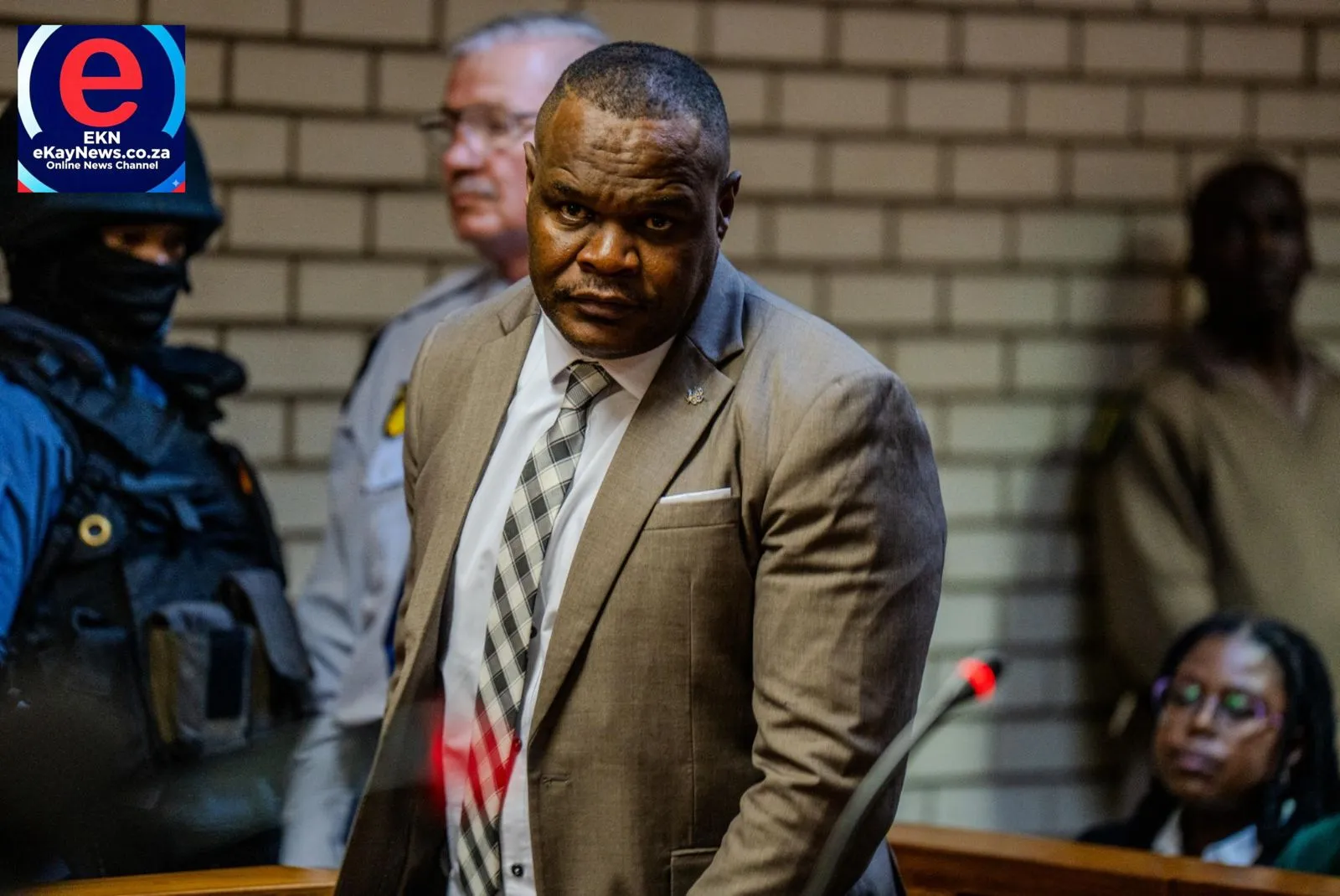
State moves to centralise criminal cases against suspended cop Fannie Nkosi
Fannie Nkosi case postponed & centralised as the disgraced sergeant’s legal woes continue to mount across multiple jurisdictions. The highly publicised saga took another dramatic turn in the Pretoria North Magistrates Court on Thursday, where the State officially requested a postponement to 22 July. The delay is primarily intended to allow the National Prosecuting Authority (NPA) to formally consolidate the charges originating from both Pretoria and Thohoyandou into a single, comprehensive trial.
As a suspended member of the South African Police Service (SAPS) Organised Crime Unit, Fannie Nkosi finds himself at the centre of one of the most explosive police corruption scandals in recent history. His downfall, which began shortly after his explosive testimony at the ongoing Madlanga commission, has exposed alleged deep-rooted connections between law enforcement officials, political figures, and notorious criminal cartels. With the State moves to centralise criminal cases against suspended cop Fannie Nkosi, prosecutors are aiming to present a unified narrative of alleged systemic corruption and abuse of police power.
The Thohoyandou Connection and Fresh Charges
To understand why the State moves to centralise criminal cases against suspended cop Fannie Nkosi, one must look at the diverse geographic spread of his alleged crimes. Recently, law enforcement added fresh charges of defeating and obstructing the course of justice related to an incident in Limpopo.
The Thohoyandou matter dates back to a highly suspicious intervention in 2022. According to the charge sheet, a suspect was arrested in the Thohoyandou area for the unlawful possession of dagga (marijuana), unlicensed firearms, and explosives. Nkosi, allegedly acting far outside his jurisdiction and mandate, travelled to Limpopo and intervened in the case.
Prosecutors allege that he removed the confiscated dagga from police custody under completely false pretences. It is believed that he misrepresented his rank and falsely claimed to local police authorities that he had been officially dispatched by SAPS Head Office to take over the investigation. Furthermore, he is accused of confiscating the original case docket. This brazen interference forms the core of the Thohoyandou docket, which the NPA now seeks to bring to Pretoria.
Understanding the Centralisation Process
In South African law, centralisation is a procedural mechanism used by the prosecution to merge multiple criminal cases into one trial, provided they share similar evidence, witnesses, or modus operandi. Because the State moves to centralise criminal cases against suspended cop Fannie Nkosi, they must apply to the National Director of Public Prosecutions (NDPP) for a directive.
If approved, the Thohoyandou case will be officially transferred to the Pretoria courts. This strategy not only saves the State immense time and financial resources—preventing the need for multiple trials in different provinces—but it also allows the court to view the full spectrum of Nkosi’s alleged criminality. It paints a broader picture of a rogue SAPS officer allegedly using his badge to systematically subvert the justice system across the country.
The Pretoria North Raid: Dockets, Cash, and Weapons
The primary anchor for the prosecution’s case is the dramatic raid that occurred at Nkosi’s private residence in April. This raid, executed by a special investigative task team emanating directly from the Madlanga commission’s findings, yielded a shocking haul of illicit items.
Upon searching his Pretoria home, police officers discovered an alarming cache of state property and high-calibre weaponry. The seizure included:
-
An R5 assault rifle, a revolver, and a 9mm pistol stored haphazardly in a drawer.
-
Over 100 rounds of live ammunition and a police-issued stun grenade concealed under a mattress.
-
R52,700 in hard cash, also hidden beneath a mattress, which the State believes to be the proceeds of unlawful activities.
-
Six official, highly sensitive police case dockets.
The discovery of the dockets is particularly damning. These files related to violent crimes, including cash-in-transit heists and car hijackings in Roodeport and Musina. Alarmingly, these dockets had been marked as “undetected” and were supposed to be archived and securely stored, far out of circulation. Instead, they were found in the personal possession of a suspended Organised Crime Unit member. The sheer volume of evidence recovered during this raid acts as the foundational pillar for why the State moves to centralise criminal cases against suspended cop Fannie Nkosi.
The Fight for Bail
Following the raid, Nkosi’s immediate legal battle has been focused entirely on securing his release from custody. However, the courts have thus far shown little sympathy. Last month, Pretoria Magistrate Thandi Theledi flatly denied his bail application.
In her ruling, the magistrate stated that Nkosi had utterly failed to convince the court that he would return to stand trial if released. Given his extensive connections within both the police force and the criminal underworld, he was deemed a significant flight risk. Furthermore, the court found that granting him bail would severely undermine public trust and would not serve the interests of justice, especially considering the severity of the charges—which include the unlawful possession of explosives and defeating the ends of justice.
Initially, Nkosi had requested to be housed in the hospital wing of the Kgosi Mampuru II Correctional Facility, citing extreme fears for his personal safety and claiming he was feeling unwell. As the legal pressure mounts, his original legal team abruptly withdrew from the case. A newly appointed defence team is now actively preparing to challenge the magistrate’s decision. His bail appeal is scheduled to be heard on 26 May at the Pretoria High Court. Whether the new legal counsel can secure his freedom remains to be seen, but the fact that the State moves to centralise criminal cases against suspended cop Fannie Nkosi strongly indicates that the prosecution is actively tightening the net around him.
The Shadow of the Madlanga Commission
It is impossible to fully comprehend the gravity of Fannie Nkosi’s legal predicament without examining his explosive involvement in the Madlanga commission. Established to probe deep-seated criminality and political interference within the criminal justice system, the commission heard some of its most shocking testimony from Nkosi himself.
Initially appearing under the pseudonym “Witness F” to protect his identity, Nkosi’s testimony sent shockwaves through the SAPS hierarchy. He took the stand for two weeks, detailing extensive, systemic corruption. However, instead of emerging as a whistleblower, Nkosi quickly found himself heavily implicated in the very crimes he was exposing.
The commission heard evidence suggesting that Nkosi acted as a crucial middleman and facilitator between highly placed police executives, municipal officials in Tshwane, and notorious organized crime syndicates. Most notably, he was touted as the primary link between certain top cops and Vusimuzi ‘Cat’ Matlala, the alleged boss of the feared “Big Five” cartel.
The Big Five Cartel and Municipal Tenders
During his extensive time on the witness stand, investigators presented evidence of Nkosi’s deeply intertwined relationship with Matlala. Nkosi controversially admitted to facilitating meetings between the cartel boss and senior police officials. In one highly publicized instance, it was revealed that Nkosi received R25,000 from Matlala, which he dubiously claimed was payment for providing a “motorbike escort” to a wedding.
Furthermore, the Madlanga commission exposed how Nkosi allegedly utilized his connections to influence recruitment and tender processes within the City of Tshwane. Testimony suggested he worked closely with city officials and various political party members. Notably, it was revealed that his brother currently holds a lucrative security contract with the city worth nearly R3-million, a contract that was heavily flagged by the commission for potential irregularities. While Nkosi claimed he merely “knocked on doors” to help job seekers, the evidence painted a picture of an influential information and kickback peddler.
The fallout from his testimony was immediate and severe. Shortly after concluding his time on the stand—a period marked by intense scrutiny and glaring contradictions in his narrative—Nkosi was suspended from the SAPS and subsequently arrested. The raid on his home was a direct consequence of the intelligence gathered by the commission’s special investigative task team.
A Critical Test for SAPS Integrity
The unfolding legal drama surrounding Fannie Nkosi is more than just the trial of a single rogue officer; it is a profound litmus test for the integrity of the South African Police Service as a whole. For years, public confidence in law enforcement has been steadily eroded by allegations of police collusion with organized crime syndicates, particularly in sectors related to cash-in-transit heists and drug trafficking.
The fact that an Organised Crime Unit sergeant could allegedly harbor high-calibre weapons, explosives, and active case dockets in his bedroom speaks to a catastrophic failure of internal controls and oversight within the SAPS. It highlights a culture of impunity where officers entrusted with dismantling cartels instead become integral components of their operations.
By ensuring the State moves to centralise criminal cases against suspended cop Fannie Nkosi, the prosecution is signaling a zero-tolerance approach. A consolidated trial will prevent the fragmentation of evidence, ensuring that the full scope of Nkosi’s alleged betrayal of his oath is presented to a single judge. It represents a critical opportunity for the justice system to demonstrate that no one, not even those who wear the badge, is above the law.
YOU MAY LIKE:
Looking Ahead to July
As the 22 July court date approaches, all eyes will be on the NPA’s progress in officially securing the centralisation directive. Simultaneously, the outcome of his upcoming bail appeal at the Pretoria High Court on 26 May will dictate whether Nkosi faces his impending mega-trial from a jail cell or as a free man.
The Madlanga commission continues its vital work, and Nkosi’s arrest may very well be just the first domino to fall. As investigators meticulously comb through the confiscated dockets and trace the origins of the weapons found in his possession, further arrests of both police personnel and underworld figures remain highly likely.
Ultimately, the assertion that the State moves to centralise criminal cases against suspended cop Fannie Nkosi serves as a stark warning. It is a clear declaration that the era of fragmented investigations and jurisdictional loopholes is coming to an end for corrupt officials. As the various threads of extortion, drug tampering, and cartel collusion are woven together into a single, comprehensive indictment, Sergeant Fannie Nkosi prepares to face the full, unmitigated force of the South African justice system.
References:
-
Daily Maverick. (2026, May 15). “While Fannie Nkosi faces fresh charges, his brother keeps Tshwane tender.” Daily Maverick.
https://www.dailymaverick.co.za/article/2026-05-15-while-fannie-nkosi-faces-fresh-charges-his-brother-keeps-tshwane-tender-/ -
eNCA. (2026, May 21). “Disgraced cop Fannie Nkosi back in the dock.” eNCA.
https://www.enca.com/news-top-stories/disgraced-cop-fannie-nkosi-back-dock
Keep the Headlines Fresh!

Quality news takes time, effort, and a whole lot of coffee. If you value what we do at eKayNews, consider “buying a round” for the team!
-
Join the Inner Circle: Set up a custom subscription.
-
The Instant Jolt: Send a one-time “coffee” donation.
Why trust us? We use PayFast for 100% secure, encrypted transactions. Your data stays yours; the news stays ours.
To our amazing readers: You’re the reason we’re first on the scene. Thanks for being part of the family!
Feel the Pulse of the News with eKayNews!

Join the ever-growing eKayNews community and stay connected to the stories that matter. Follow us on Facebook, X, and WhatsApp for real-time updates, breaking news, and exclusive alerts straight to your feed. Your support keeps us digging deeper and sharing the news you can trust.
Stay Connected:
-
Facebook: [eKayNews on Facebook]
-
X (Twitter): [eKayNews on X]
-
WhatsApp: [Join the eKayNews WhatsApp Channel]
Become part of our inner circle and get instant news alerts as events unfold across South Africa and beyond!
Promote Your Brand with eKayNews
Looking to reach a wide, engaged audience? Explore our advertising packages:
-
Link Booster: 7 links to 7 articles over 7 days – R2,500
-
Permanent Feature: Sponsored blog article hosted permanently – R4,000
-
Prime Visibility: Home page banner ad for 30 days – R5,000
Don’t miss your chance to connect with our audience. Book your package today via email at info@ekaynews.co.za or WhatsApp us on +27710961185.
Be part of a platform where news meets community—stay informed, stay ahead, stay with eKayNews!