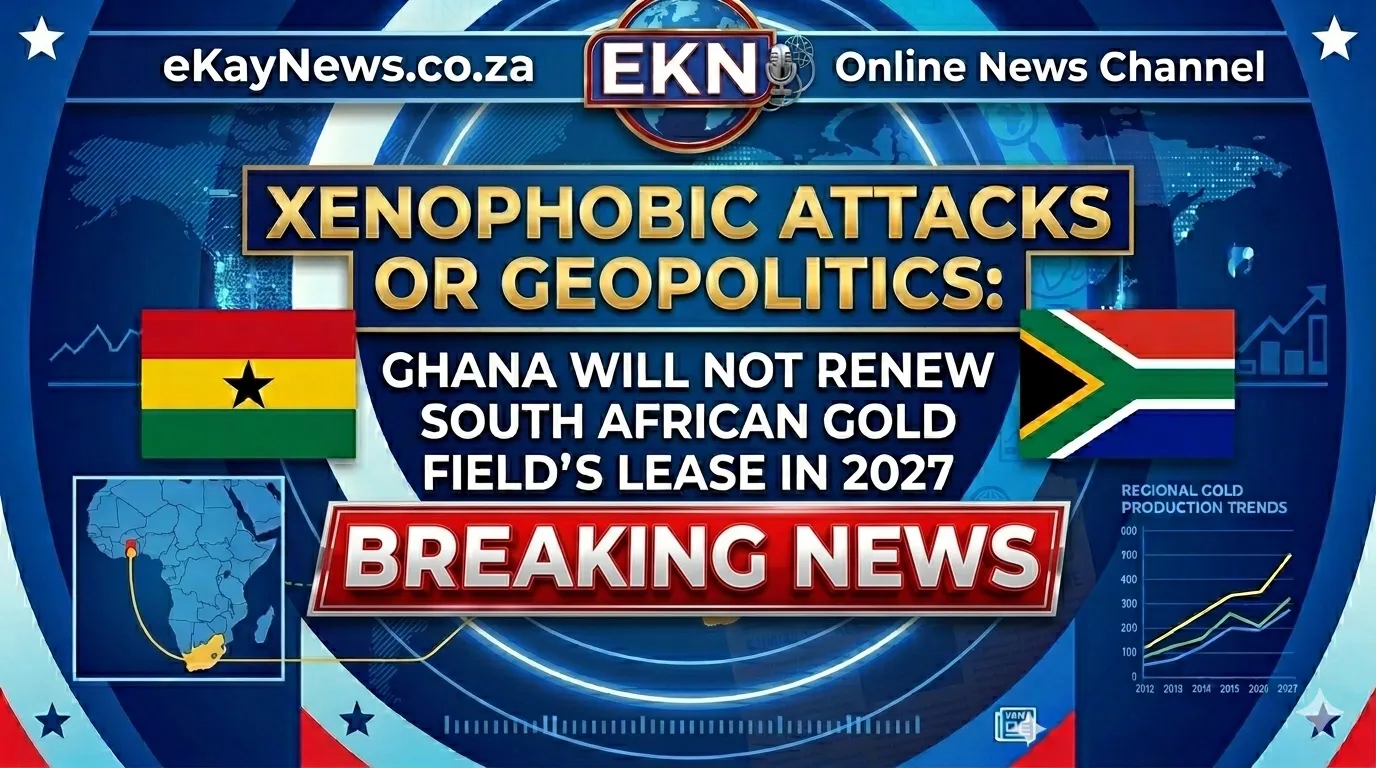
Ghana Gold Fields Lease: Xenophobia and geopolitics collide as Accra blocks automatic renewal of the $1 billion annually Tarkwa mine.
Ghana Gold Fields Lease negotiations have taken a dramatic turn as tectonic shifts in West African resource diplomacy collide with deep continental grievances. The government of Ghana has officially signaled that the status quo for foreign extraction corporations is permanently over. With the looming 2027 expiration of the mining concession for the massive Tarkwa asset, Accra is charting a bold, unapologetic course that emphasizes sovereign leverage, community equity, and structural accountability over historical precedent.
Ghana Gold Fields Lease
For three decades, international mineral conglomerates operating within the borders of West Africa have grown accustomed to predictable, friction-free contract continuations. However, the current atmosphere in Accra represents an entirely different paradigm. Driven by an active, highly mobilized electorate and severe regional economic realities, Ghanaian authorities are deploying unprecedented scrutiny toward external balance sheets, demanding that domestic human capital receive structural equity in exchange for access to finite subterranean gold reserves.
Ghana Gold Fields Lease: A Geopolitical Flashpoint
The upcoming evaluation of the Ghana Gold Fields Lease is no longer confined to the quiet boardroom dynamics of corporate lawyers and regulatory compliance officers; it has evolved into an explicit national security and macroeconomic priority. As bilateral channels between Accra and Pretoria undergo visible strain, this commercial negotiation serves as a high-stakes arena where resource governance directly converges with national honor.
Sovereign governments throughout the global south are closely watching Ghana’s strategic maneuvers, recognizing that the terms established during this specific regulatory cycle will set a foundational precedent for resource-rich nations demanding a rebalancing of transnational economic relationships. The historic era of yielding long-term extraction rights with minimal local processing demands is officially drawing to a close as West African states rewrite the legal templates of corporate engagement.
The Massive Tarkwa Mine Asset Value at $1 billion dollar yearly revenue
To truly understand the profound scale of this developing situation, one must fully comprehend the immense financial and industrial footprint of the Tarkwa mine asset. As one of the crown jewels of global precious metal mining, this single operation generates well over $1 billion in gross revenue annually, turning it into a vital economic pillar for its parent enterprise and a fundamental contributor to global gold supply liquidity.
The vast infrastructure, encompassing deep surface operations and state-of-the-art processing complexes, has long relied on the predictability of long-term legal frameworks to guarantee stable operating environments for international institutional investors. If this massive revenue stream experiences prolonged regulatory friction or operational pauses due to state-level lease revisions, the financial tremors will register across major international stock exchanges from Johannesburg to London, altering corporate credit risk formulas throughout sub-Saharan Africa.
Xenophobic Attacks on Ghanaian and African Migrants in South Africa
Compounding these intense commercial anxieties is a dark, recurring cloud of social instability originating within South Africa’s urban centers. Over consecutive cycles, targeted, systemic outbreaks of violence directed explicitly against foreign African nationals have created widespread anger across the continent, severely damaging the long-term vision of pan-African integration and open-border commercial treaties.
Migrants seeking legitimate entrepreneurial opportunities, employment, and academic growth in South African neighborhoods have instead encountered coordinated hostility, asset destruction, and physical targeting. These periodic structural collapses in local security frameworks have fundamentally degraded South Africa’s diplomatic authority, transforming historic pan-African solidarity into deep bilateral mistrust, as neighboring states look on with growing alarm at the apparent normalization of anti-migrant rhetoric within mainstream political discourses.
Xenophobic attache – The Tragic Cost of Continental Intolerance
The human toll of these structural failures reached a tragic breaking point when a prominent Ghanaian national lost their life during the latest wave of anti-migrant violence, turning abstract diplomatic concerns into an active national crisis for the Ghanaian public. This senseless loss of life unleashed deep societal outrage across Accra, prompting direct state-level interventions, emergency legislative debates, and the immediate, coordinated evacuation of vulnerable Ghanaian citizens from South African jurisdictions.
When a sovereign state is forced to actively evacuate its workforce from a sister republic due to direct safety concerns, the underlying diplomatic agreements are severely compromised. This profound loss of life removed all abstract nuance from the bilateral relationship, igniting an intense public demand within Ghana for tangible, proportional state actions to prove that the life of a West African citizen cannot be cheapened without significant, structured consequences for external corporate interests.
Ghana Gold Fields Lease: The Shift Toward Resource Nationalism
Against this highly charged socio-political backdrop, the ongoing management of the Ghana Gold Fields Lease has naturally become an open instrument for asserting resource nationalism. Lawmakers, civil society organizations, and local labor unions are actively questioning why a foreign corporate entity should expect frictionless, multi-billion dollar contract continuations while domestic citizens face physical vulnerability within that corporation’s home territory.
This systematic shift toward aggressive resource nationalism reflects a wider continental trend where African administrations refuse to decouple the commercial prosperity of foreign firms from the basic dignity and security of their own diaspora populations. The historic era of viewing corporate concessions through a strictly isolated economic lens has officially fractured, giving rise to an environment where sovereign extraction rights are firmly anchored to comprehensive national security and geopolitical leverage.
The Minerals Commission Rules Out Automatic Extension
Taking definitive structural action, Ghana’s Minerals Commission has explicitly eliminated any possibility of an automatic extension for the Tarkwa mining concession when the current 30-year operational term formally concludes in 2027. The regulatory authority has stated with absolute legal clarity that long-term corporate tenures will never again be granted on a purely administrative basis or through passive renewal processes.
The era of automatic transitions is formally over; instead, any future operations require a comprehensive, ground-up regulatory review that forces multinational entities to renegotiate from a baseline of absolute transparency. This strategic regulatory posture ensures that the state maintains supreme sovereign command over its underlying mineral wealth, compelling foreign capital to actively justify its industrial presence through demonstrable, ongoing contributions to the national treasury and local workforce development.
Leveraging Commercial Assets in Diplomatic Disputes
This firm position by the Minerals Commission highlights a significant evolution in West African foreign policy: the deliberate, calculated deployment of high-value commercial assets as structural leverage within complex international disputes. While traditional corporate analysts often argue that commercial agreements must remain entirely isolated from diplomatic volatility, modern statecraft dictates that a nation’s sovereign mineral wealth is inherently political.
By implementing strict regulatory standards on prominent South African corporate operations, Ghana is demonstrating its capacity to utilize its natural resource base to defend its broader national interests. This calculated use of regulatory pressure sends an unmistakable signal to foreign capitals that access to West Africa’s premium mineral belts is directly contingent upon maintaining reciprocal, dignified, and safe bilateral environments for all regional citizens.
Demanding Local Value Creation and Technology Transfer
Under the revised regulatory parameters enforced by Accra, any prospective operational pathway forward requires the submission of an exhaustive, verifiable development plan centered on profound domestic value creation. Ghana is no longer satisfied with serving as a mere source of raw unrefined ore; the state is mandating that the complete gold processing cycle, tech infrastructure, and industrial supply chains be systematically anchored within local communities.
Furthermore, these rigorous standards require genuine, enforceable pathways for technology transfer and the structural elevation of Ghanaian engineers, geologists, and executives into the highest echelons of corporate decision-making. International operators must invest heavily in local educational institutions, establish domestic refining capabilities, and ensure that a substantial portion of procurement capital is redirected into domestic engineering firms, thereby ensuring that the extraction of national wealth builds permanent, diversified industrial capacity within the host nation.
Ghana Gold Fields Lease: Navigating the 2027 Expiry Crisis
As the definitive 2027 calendar deadline rapidly approaches, the operational management of the Ghana Gold Fields Lease represents a complex corporate crisis requiring urgent, highly adaptive corporate strategy. Global institutional investors, hypersensitive to regulatory uncertainty, are closely analyzing every official press release from Accra, calculating the profound financial risk associated with a potential structural shift in ownership structures or a prolonged interruption at the Tarkwa mine.
The corporate leadership faces the immense task of reassessing its regional strategy, balanced between meeting the robust, non-negotiable demands of the Ghanaian state and satisfying the profit metrics of international equity markets. Navigating this delicate regulatory landscape requires a total departure from traditional corporate public relations; it demands an authentic commitment to sharing structural power, rewriting revenue split formulas, and acknowledging that sovereign states possess the absolute legal authority to realign extraction rights to serve the public good.
The Future of South African Corporate Footprints in West Africa
The unfolding structural showdown over the Tarkwa asset is a clear indicator of a much broader systemic shift facing the entirety of South African corporate footprints across the West African region. Major telecommunications providers, retail giants, and financial institutions that have long viewed the wider continent as an open market for unhindered corporate expansion must now adapt to a brand-new historical era defined by active, vigilant resource sovereignty.
As host nations increasingly connect corporate operating access to the geopolitical behavior and internal social environments of their home states, the cost of continental isolation and systemic urban inequality will be directly felt on corporate balance sheets. The future of pan-African trade depends entirely on a baseline of deep mutual respect, comprehensive safety for all migrant communities, and an authentic corporate governance model that prioritizes the structural empowerment of host nations, ensuring that continental prosperity is equitably shared by all who inhabit it.
Support Independent journalism– eKayNews.co.za is your hub for local and international news that keeps you informed.
Support the mission:
✅ Follow eKayNews on all socials
✅ eKayNews.co.za – get the latest news
✅ Subscribe to keep independent journalism alive: https://ekaynews.co.za/subscribe-form/