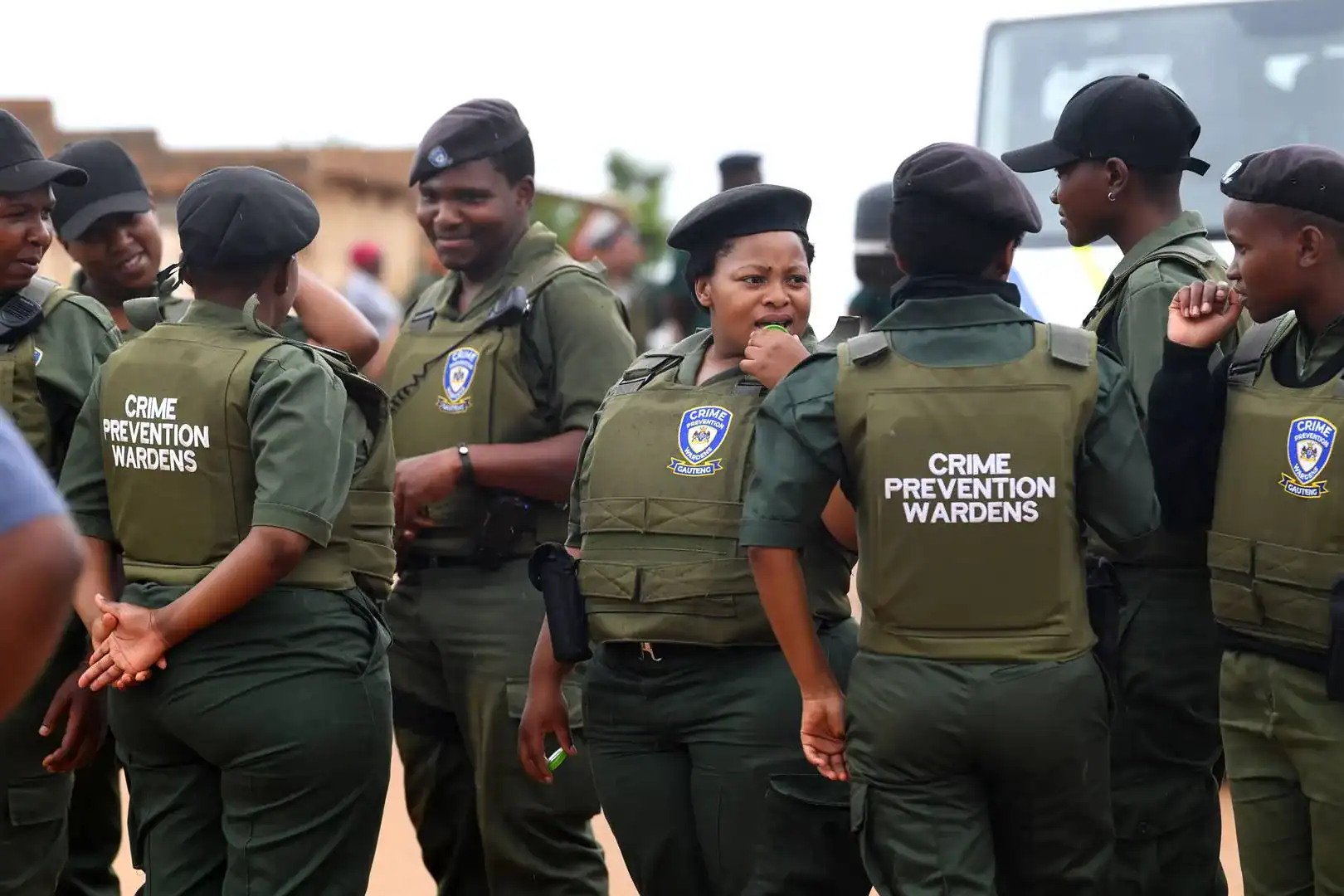
Legality of AmaPanyaza wardens in South Africa
The legality of AmaPanyaza wardens in South Africa has once again come under intense national scrutiny following statements made in Parliament. Lieutenant General Mkhwanazi, addressing Parliament’s Ad Hoc Committee investigating corruption in the South African police service, declared that the entity of wardens, commonly referred to as AmaPanyaza, is illegal.
This revelation has sparked widespread debate on whether the formation of these wardens aligns with existing policing laws and constitutional mandates.
Mkhwanazi declares AmaPanyaza wardens illegal
During his address, Mkhwanazi firmly stated that AmaPanyaza wardens have no legal standing within the country’s law enforcement framework. He explained that the creation and operation of the group were not approved under any national policing legislation or formal security structure.
“From the police service perspective, the AmaPanyaza do not have legislative grounding. They were not established through legal channels and cannot be recognized as part of the South African police service,” Mkhwanazi told the committee.
This statement adds fuel to ongoing tensions between provincial and national authorities over who holds legitimate power to establish auxiliary law enforcement bodies.
Background on AmaPanyaza and their creation
The AmaPanyaza wardens were introduced as a community safety initiative by the Gauteng provincial government. Their primary role was to assist law enforcement agencies in maintaining safety, controlling traffic, and preventing crime in urban areas.
In December 2023, then Justice Minister Ronald Lamola officially designated the wardens as peace officers, a decision meant to grant them limited authority to assist in enforcing certain laws. The announcement was initially welcomed by some communities who viewed the wardens as an additional force against crime.
However, legal experts and opposition parties raised concerns over whether the move respected national policing laws and the Constitution.
Ronald Lamola’s peace officers designation questioned
The peace officers designation by Ronald Lamola is at the center of the current legal debate. Lamola’s designation gave AmaPanyaza wardens certain powers, including the ability to issue fines and assist in municipal bylaw enforcement.
But according to Mkhwanazi’s testimony, Lamola’s designation does not automatically legitimize the entire structure. While the minister can confer limited powers under specific conditions, the establishment of a new policing entity falls outside his legal jurisdiction.
“Designation as peace officers does not mean that an entirely new law enforcement body can operate independently of the South African Police Service,” Mkhwanazi added.
This interpretation suggests that while individual members might hold limited authority, the AmaPanyaza as an organized entity may still lack full legal recognition.
Parliament investigates police corruption and legality
The ongoing Parliamentary inquiry into corruption within the South African police service has now expanded to include questions about governance, oversight, and the legality of auxiliary policing structures.
The legality of AmaPanyaza wardens in South Africa has emerged as one of the committee’s most pressing concerns. Some members argued that the creation of the wardens without explicit legislative approval undermines the rule of law and could lead to accountability issues.
Others, however, defended the program as a necessary intervention to address safety challenges in Gauteng’s high-crime areas.
Public reaction and political division
The debate over the AmaPanyaza wardens has divided public opinion. Many South Africans see them as a visible presence in communities that need stronger policing. Supporters claim the wardens have helped reduce petty crimes and improve safety in densely populated areas.
Critics, however, argue that their operations blur the line between community policing and formal law enforcement. Human rights organizations have also raised concerns about potential abuses of power and the lack of training and oversight.
Political parties have used the controversy to score points ahead of upcoming elections, with opposition groups demanding clarity on whether provincial governments have the authority to establish such bodies.
Legal experts weigh in
Legal analysts have stepped forward to unpack the constitutional and legislative dimensions of the legality of AmaPanyaza wardens in South Africa.
Professor Nomusa Dlamini from the University of Pretoria explained that while the Criminal Procedure Act allows for the designation of peace officers, it does not create a framework for independent policing structures outside of the South African Police Service (SAPS) and municipal police departments.
“Unless there’s specific enabling legislation, a group like the AmaPanyaza cannot be fully recognized as lawful law enforcement,” Dlamini said.
This means that even with Ronald Lamola’s designation, the group’s existence may still rest on uncertain legal grounds.
Impact on community policing and safety
The controversy could have broader implications for community policing models across South Africa. The AmaPanyaza wardens were introduced as a response to increasing crime rates and slow police response times in Gauteng.
If declared illegal, their removal might leave a security gap in communities that have grown reliant on their presence. On the other hand, formalizing them through proper legislation could set a precedent for other provinces seeking to create similar initiatives.
Policing experts suggest that rather than disbanding such programs, government should work to align them with national policing laws to ensure proper training, accountability, and oversight.
The role of the South African police service
The South African police service (SAPS) remains the country’s primary law enforcement body, constitutionally mandated to prevent and investigate crime. Mkhwanazi’s firm stance on the legality of AmaPanyaza wardens in South Africa underscores the importance of maintaining clear boundaries between official police structures and provincial initiatives.
He warned that without proper legal clarity, overlapping jurisdictions could lead to confusion, corruption, or conflict among law enforcement agencies.
“We cannot have parallel policing structures that are not recognized under national law,” Mkhwanazi emphasized.
Future of AmaPanyaza wardens
As Parliament continues to deliberate, the future of the AmaPanyaza wardens remains uncertain. Lawmakers are expected to call on Ronald Lamola and other officials to provide clarification on the 2023 peace officers designation and whether it was consistent with legal frameworks.
Possible outcomes include legislative reform to formally recognize the wardens or a directive for their disbandment if found unconstitutional.
Until then, the debate over the legality of AmaPanyaza wardens in South Africa is expected to remain a contentious issue in both political and legal circles.
Conclusion
The ongoing discussion about the legality of AmaPanyaza wardens in South Africa highlights the complex balance between public safety needs and adherence to the rule of law. While Ronald Lamola’s peace officers designation attempted to empower local safety initiatives, questions about legitimacy, authority, and accountability persist.
As Parliament, the South African police service, and legal experts continue to evaluate the matter, one thing is clear — any effort to strengthen community safety must align with the Constitution and uphold transparent governance.
You May Like:
Concerns grow over Palestinian arrivals in SA amid allegations of forced migration by Israelis