Trump administration WHO withdrawal: US leaves World Health Organization
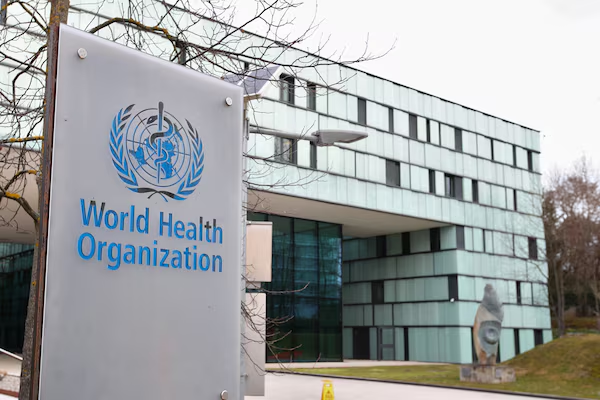
The United States has officially completed its withdrawal from the World Health Organization, finalizing a move long pursued by President Donald Trump. The Trump administration announced the completion of the split through the US Department of Health and Human Services (HHS) on Thursday, confirming that all personnel, funding, and official participation have ceased.
This historic exit marks a major shift in global health governance, with critics warning that it could jeopardize US and worldwide preparedness for future pandemics.
Background of the US Withdrawal
Trump initially attempted to leave WHO during his first term but delayed formal action. On the first day of his second term, he issued an executive order giving notice of the US withdrawal. Legally, the United States was required to provide WHO a one-year notice and settle all outstanding fees, which currently amount to roughly $260 million. Legal experts, however, have indicated that the US may not pay this debt, leaving WHO with limited options.
“As a matter of law, the United States cannot officially withdraw from WHO unless it pays its outstanding financial obligations,” said Dr. Lawrence Gostin, global health law expert at Georgetown University. “But WHO has no power to force the US to pay what it owes.”
While WHO could technically pass a resolution blocking the withdrawal until payments are made, experts say the organization is unlikely to escalate the dispute.
Why Trump Left the World Health Organization
According to HHS, the decision was based on the US not “getting sufficient return on investment” from the organization. Officials pointed to perceived failures during the COVID-19 pandemic, including delays in declaring a global public health emergency and early underreporting of human-to-human transmission.
“During that period, WHO leadership echoed and praised China’s response despite evidence of early underreporting, suppression of information, and delays in confirming human-to-human transmission,” the agency said.
HHS also criticized WHO’s reluctance to acknowledge airborne spread and the potential for asymptomatic transmission. A senior official said the withdrawal ensures that US health policies are “no longer constrained by unaccountable foreign bureaucrats.”
Global Health Policy Impact
The withdrawal has raised serious concerns among public health experts. Critics argue that leaving WHO isolates the US from critical epidemiological data, virus samples, and global surveillance networks essential for early detection and response to infectious diseases.
“The U.S. withdrawal from the World Health Organization is a shortsighted and misguided abandonment of our global health commitments,” said Dr. Ronald Nahass, president of the Infectious Disease Society of America. “Global cooperation and communication are critical to keep our own citizens protected because germs do not respect borders.”
Dr. Michael Osterholm, director of the Center for Infectious Disease Research and Policy at the University of Minnesota, echoed the warning: “We will experience more deadly worldwide outbreaks. They will occur because the experts in the US public health community won’t be at the table to lead the global response. These outbreaks will spread to the US and do us great harm.”
US Plans Post-WHO
Despite the withdrawal, the Trump administration emphasized that the United States will continue to lead in global health through alternative partnerships. The US will collaborate directly with individual countries, NGOs, and religious organizations to monitor infectious diseases, share data, and develop response strategies.
This effort is expected to be coordinated by the US Centers for Disease Control and Prevention’s (CDC) Global Health Center. Officials said that the new approach allows for “strategic, country-level collaborations” while reducing reliance on multilateral institutions perceived as ineffective.
However, some experts warn this could create a fragmented system with gaps in surveillance and coordination. A former CDC official noted, “It doesn’t allow the same level of partnership and surveillance as working with WHO. There’s not enough funding to replace it all.”
Financial and Political Considerations
HHS officials also highlighted the financial implications, noting that the US had been the largest funder of WHO yet never had an American serve as Director-General. The administration maintains that the funds used were disproportionate to the benefits received and that WHO failed to act in the US interest during the COVID-19 pandemic.
Experts argue that withholding funding and leaving WHO may undermine US influence over global health policy and reduce its ability to shape vaccine development, pandemic preparedness, and other initiatives that protect Americans abroad and at home.
Global Reactions
WHO Director-General Dr. Tedros Adhanom Ghebreyesus described the US withdrawal as a “lose-lose” scenario. “The US loses, and the rest of the world, we know for sure, loses,” he stated. International health officials warn that this move could lead to delays in outbreak response, weaker coordination for future pandemics, and higher global mortality rates.
Critics argue that the decision could set a precedent for other countries to disengage from WHO, further weakening international cooperation on public health threats.
YOU MAY LIKE:
Trump says Canada ‘lives’ because of U.S.: ‘Remember that, Mark’
Conclusion
The Trump administration’s WHO withdrawal represents a significant departure from decades of US participation in global health governance. While officials argue that the move allows for strategic, country-level partnerships and greater autonomy in health policy, the decision has drawn widespread criticism from health experts and policymakers around the world.
As the US seeks to redefine its role in global health without WHO, questions remain about its ability to respond rapidly to emerging threats, share data effectively, and maintain influence over international health standards. The world watches closely as this policy shift unfolds, with potential implications for pandemic preparedness and global public health for years to come.
Mainstream Media Sources
- The Associated Press – US completes withdrawal from World Health Organization
https://www.apnews.com/article/b6e0be566c7db9aece0334e987d516f1 - NBC Philadelphia – U.S. completes withdrawal from World Health Organization
https://www.nbcphiladelphia.com/news/national-international/trump-world-health-organization-withdrawal/4337702/
Kindly consider to support eKayNews, Buy Us a Coffee & Keep the News Flowing!

Love what we do? You can now support eKayNews directly! Your contributions empower us to deliver the breaking news, sports, and local updates you trust.
Ways to Support:
-
Subscribe: Choose any amount (cancel anytime).
-
Virtual Coffee: A quick, once-off donation to say thanks.
Note: Payments are 100% secure via PayFast. We never see your banking details.
To our amazing readers: Your support fills us with gratitude. You are the reason we can keep doing this every day. Thank you for being a vital part of the eKayNews family!
We’re feeling the love at eKayNews!

Facebook: [eKayNews on Facebook] X (Twitter): [eKayNews on X] WhatsApp: [Follow the eKayNews WhatsApp Channel] Join our inner circle for real-time news alerts!
📢 Advertising Packages on www.eKayNews.co.za
Package 1. Link Booster: We add 7 links to 7 articles over 7 days – R2,500
Package 2. Permanent Feature: Sponsored Blog Article (hosted permanently) – R4,000
Package 3. Prime Visibility: Home Page Banner Ad (30 days) – R5,000
Book now: Email info@ekaynews.co.za or WhatsApp us on +27710961185