UK bans goods from Israeli West Bank settlements: What that really means
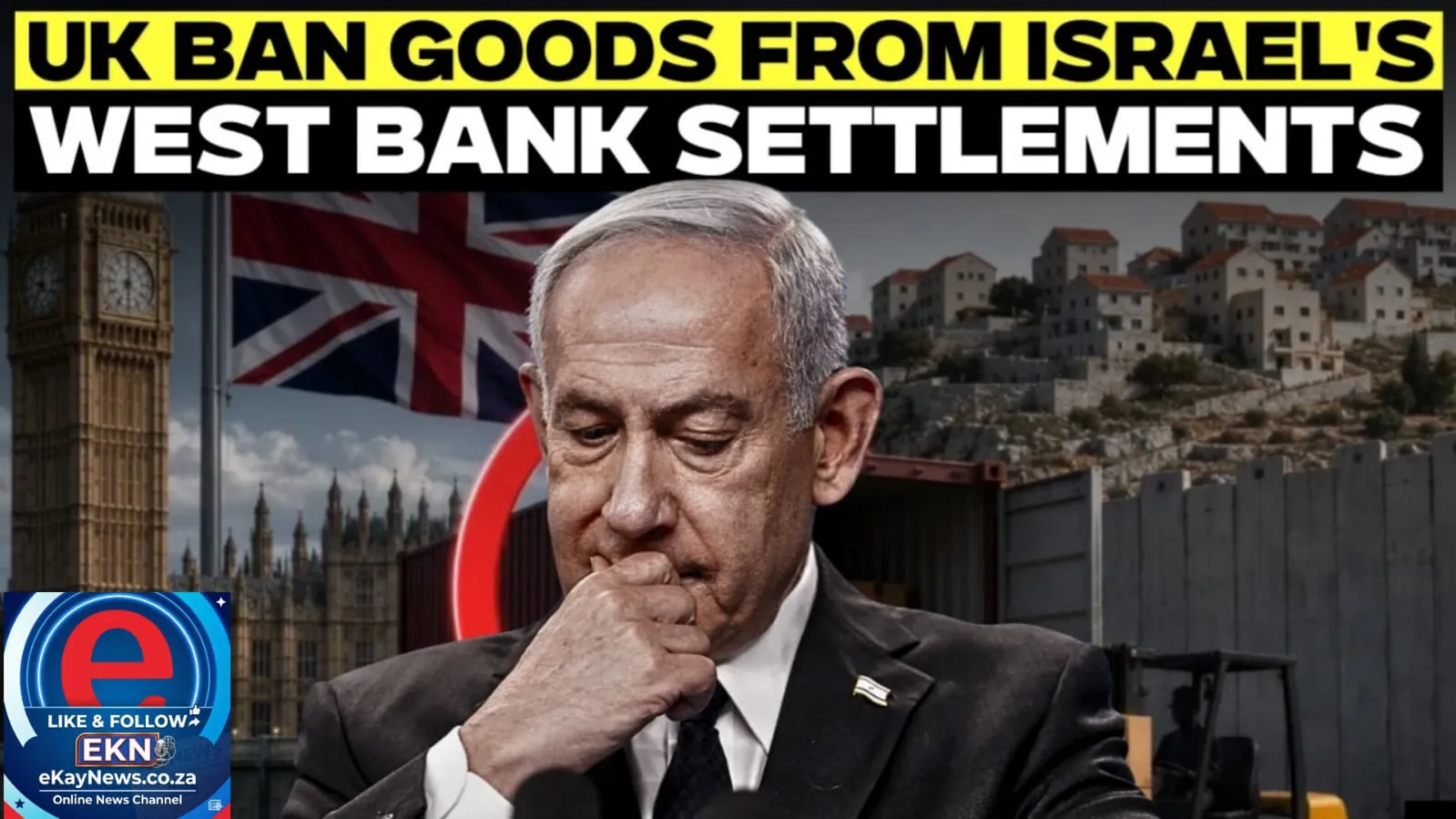
UK bans goods from Israeli West Bank settlements in a major change to Britain’s approach to the Israeli-Palestinian conflict, with the government announcing restrictions on imports, settlement-related activity and certain arms exports.
The announcement was made by UK Foreign Secretary Ed Miliband in Parliament, where he described the measures as a “comprehensive reset” of Britain’s policy towards Israel.
The decision represents one of the strongest UK policy responses to Israeli settlement activity in the occupied West Bank and comes amid continuing international debate over the Israeli-Palestinian conflict.
Miliband stressed that the measures are directed at Israeli settlements and settlement expansion rather than Israeli citizens as a whole.
The announcement has triggered a strong reaction from Israel, while Palestinian representatives and several human rights organisations have welcomed the move.
UK West Bank settlement ban targets settlement goods
The UK West Bank settlement ban will prevent the import of goods produced in Israeli settlements in the occupied West Bank.
The British government has long distinguished between products originating in Israel and those produced in Israeli settlements in territories occupied since 1967.
The new measures go further by imposing a direct ban on goods produced in the settlements.
The government will also introduce sanctions against organisations, companies and individuals involved in construction, infrastructure, financing and real estate activities connected to settlement expansion.
Another significant measure is a ban on advertising in Britain for the sale of properties located in Israeli settlements in the occupied West Bank.
The government also announced sanctions against extremist settlers accused of supporting or inciting violence against Palestinians.
These measures are intended to increase pressure on settlement activity while maintaining Britain’s broader diplomatic relationship with Israel.
Ed Miliband announces policy reset
Ed Miliband told Parliament that Britain needed an approach that did more than condemn developments in the occupied Palestinian territories.
He described the new measures as a policy that would “call out” what the government considers injustice while also taking practical action.
Miliband said the UK considers Israeli settlements in the occupied West Bank unlawful and argued that British consumers should not be supporting the occupation by purchasing products originating from settlements.
He also criticised settler violence against Palestinian communities and said the government considers some of the violence and intimidation to amount to ethnic cleansing.
Miliband reaffirmed Britain’s support for a two-state solution and criticised political rhetoric that rejects the possibility of an independent Palestinian state.
At the same time, he emphasised that the measures were not directed against Jewish people or the Israeli population.
The foreign secretary also announced additional measures involving Hezbollah and Iran, placing the settlement policy within a wider UK foreign-policy strategy concerning the Middle East.
Israeli settlements at centre of dispute
The issue of Israeli settlements has remained one of the most contentious aspects of the Israeli-Palestinian conflict.
Settlements have expanded across parts of the occupied West Bank over decades, while Palestinians and their supporters argue that continued expansion makes the creation of a viable Palestinian state increasingly difficult.
The proposed E1 settlement area has been specifically highlighted by the UK government.
Miliband warned that development in E1 could divide the West Bank and undermine prospects for a two-state solution.
The British government therefore plans to extend its existing human rights sanctions regime to allow quicker action against individuals and entities involved in settlement expansion.
The UK says its policy is designed to target settlement activity rather than Israel’s economy as a whole.
How much trade is affected?
The economic impact of the policy is expected to be relatively limited compared with Britain’s overall trade relationship with Israel.
UK-Israel trade was worth approximately £6 billion in 2025, according to figures cited from the House of Commons.
By comparison, an estimated £38 million worth of goods from the occupied territory was imported by the UK in 2025.
That means goods associated with settlements account for a relatively small proportion of overall UK-Israel trade.
Nevertheless, supporters of the policy argue that its significance goes beyond the value of the goods affected.
They say the decision sends a political and diplomatic message that Britain will not treat settlement expansion in the same way as ordinary commercial activity inside Israel.
West Bank trade sanctions and arms restrictions
The new West Bank trade sanctions form part of a broader package of measures announced by the British government.
The UK will refuse new export licences for weapons and other exports that could materially contribute to the occupation.
Britain had already suspended more than 30 arms export licences connected to Israel because of concerns over its actions in Gaza.
However, some exemptions have applied, including arrangements involving components for F-35 fighter aircraft supplied through international partners.
The government has indicated that restrictions on exports contributing to the occupation will remain while the occupation continues.
The measures therefore extend beyond consumer products and into Britain’s defence and foreign-policy relationships with Israel.
UK Israel relations face new pressure
The latest announcement is likely to put additional pressure on UK Israel relations.
Israel responded by announcing several countermeasures.
Israeli Foreign Minister Gideon Saar said Britain would face restrictions including the closure of the British Consulate in Jerusalem.
Israel also announced that British representatives would be removed from the International Gaza Support Center in Kiryat Gat.
British training of Palestinian Authority forces in the West Bank is also set to be terminated under the announced Israeli response.
In addition, 12 British MPs have reportedly been banned from entering Israel.
Israeli officials accused the British government of interfering in domestic Israeli politics because of the timing of the announcement.
Other Israeli politicians called for even stronger diplomatic measures against Britain.
The developments illustrate how quickly economic and diplomatic disagreements over settlement policy can affect bilateral relations.
Does Britain still support Israel?
Despite the tougher measures, UK Israel relations have not been completely abandoned.
Miliband stressed that Britain continues to recognise Israel’s right to security and existence.
He also condemned the Hamas-led attacks of 7 October 2023 and said Hamas should have no role in the future governance of Gaza.
The foreign secretary said Britain’s disagreement is with the conduct and policies of the Israeli government rather than with Israeli people.
He also rejected the broader Boycott, Divestment and Sanctions campaign against Israel.
This distinction is central to the government’s argument that its policy is designed to target settlements and occupation-related activities rather than impose a comprehensive boycott on Israel.
United States criticises Britain’s approach
The British decision has also drawn criticism from some US officials.
US Ambassador to Israel Mike Huckabee accused the British government of adopting measures he described as discriminatory.
US Secretary of State Marco Rubio also indicated that Washington would not adopt the same approach as Britain.
The disagreement highlights differences between the two countries over how pressure should be applied to Israel and how the conflict should be addressed diplomatically.
While Britain has moved towards sanctions targeting settlement activity, the United States has maintained a different position.
The split could become increasingly significant if other European countries adopt similar trade restrictions.
Other countries support settlement restrictions
Following Britain’s announcement, a group of countries expressed support for the two-state solution and called for an end to settlement expansion.
France, Canada, Denmark, Spain, Finland, Ireland, Iceland, Norway, Poland, Portugal and Sweden joined Britain in calling on Israel to halt settlement expansion.
Several of these countries indicated that they were considering or pursuing restrictions on trade linked to Israeli settlements.
The coordinated position increases diplomatic pressure on Israel and could encourage additional European governments to introduce similar measures.
Supporters argue that collective action would have a greater impact than measures taken by Britain alone.
Human rights groups welcome the move
The Human rights organisations have broadly welcomed the new British measures.
Human Rights Watch described the import ban and sanctions as a significant change in Britain’s approach.
Amnesty International UK also welcomed the announcement, suggesting that stronger action could represent an important shift in government policy.
Palestinian representatives similarly welcomed the decision.
Palestine’s ambassador to the UK, Husam Zomlot, described the measures as long overdue and portrayed them as a move from condemnation towards consequences.
However, some Jewish organisations strongly criticised the announcement.
The Jewish Leadership Council argued that the government’s approach could increase risks for British Jews.
Chief Rabbi Ephraim Mirvis also criticised the policy and warned that it could contribute to increased tensions and extremist threats.
The contrasting reactions demonstrate the highly sensitive political and social implications of Britain’s decision.
Will the UK settlement ban make a difference?
The effectiveness of the UK West Bank settlement ban will depend heavily on implementation.
One challenge is ensuring that products manufactured in settlements cannot simply enter Britain with labels claiming that they originated in Israel.
Critics of previous arrangements have raised concerns about the ability to accurately identify the origin of products produced in occupied territory.
The financial impact may also remain relatively small because settlement goods represent less than one percent of overall UK-Israel trade.
However, supporters argue that the political significance of the policy could be greater than its immediate economic effect.
If other European governments introduce similar measures, settlement businesses could face broader restrictions on trade, finance and investment.
YOU MAY LIKE:
Iran warns US of ‘more intense’ response after latest strikes
A major shift in Britain’s Middle East policy
The decision that UK bans goods from Israeli West Bank settlements marks a significant development in Britain’s Middle East policy.
The government has attempted to draw a clear distinction between Israel itself and Israeli settlement activity in the occupied West Bank.
At the same time, Britain has maintained its support for Israel’s security while continuing to call for a two-state solution.
For Ed Miliband, the measures represent a “comprehensive reset” of the UK’s approach.
For Israel, however, the decision has already produced diplomatic retaliation and warnings of further consequences.
The coming months will show whether Britain’s actions remain largely symbolic or become part of a wider international effort to restrict settlement activity.
If additional European countries follow Britain’s lead, the economic and diplomatic pressure could increase significantly.
For now, the UK West Bank settlement ban represents one of Britain’s clearest attempts to translate its opposition to settlement expansion into concrete trade and sanctions policy.
Mainstream Media References
- Reuters — “Israel to close British consulate in East Jerusalem after UK, France and Canada ban imports from settlements”
Covers the UK’s settlement trade ban, Ed Miliband’s policy announcement and Israel’s diplomatic retaliation.
Read the Reuters report - Associated Press (AP) — “UK government bans goods from Israeli settlements and accuses settlers of ‘ethnic cleansing’”
Reports on the UK ban on settlement goods and services, as well as the reaction from Israel, France and Canada.
Read the AP report - The Guardian — “UK to adopt tougher stance on Israel with illegal settlements trade ban”
Provides detailed background on the UK’s policy reset, the settlement trade ban and its implications for UK-Israel relations.
Read The Guardian report - The Guardian — “Will UK sanctions have any impact on Israel’s ‘settler terrorists’ in West Bank?”
Examines the potential economic and political impact of the new UK sanctions targeting Israeli settlements.
Read The Guardian analysis
Support Independent Journalism with eKayNews! 📰✨

At eKayNews, we are dedicated to bringing you honest, independent, and reliable news. But we can’t do it alone—independent journalism relies on the strength and generosity of its community.
If you value our work, please consider supporting us today! You can help keep us going by choosing a subscription or simply buying us a one-off virtual coffee:
👉 Support us here: ekaynews.co.za/subscribe-form/
You can also support our mission by visiting our main site at www.ekaynews.co.za and following @eKayNews on all social media platforms.
Thank you so much for your incredible generosity and for being part of our journey! 🙏💙