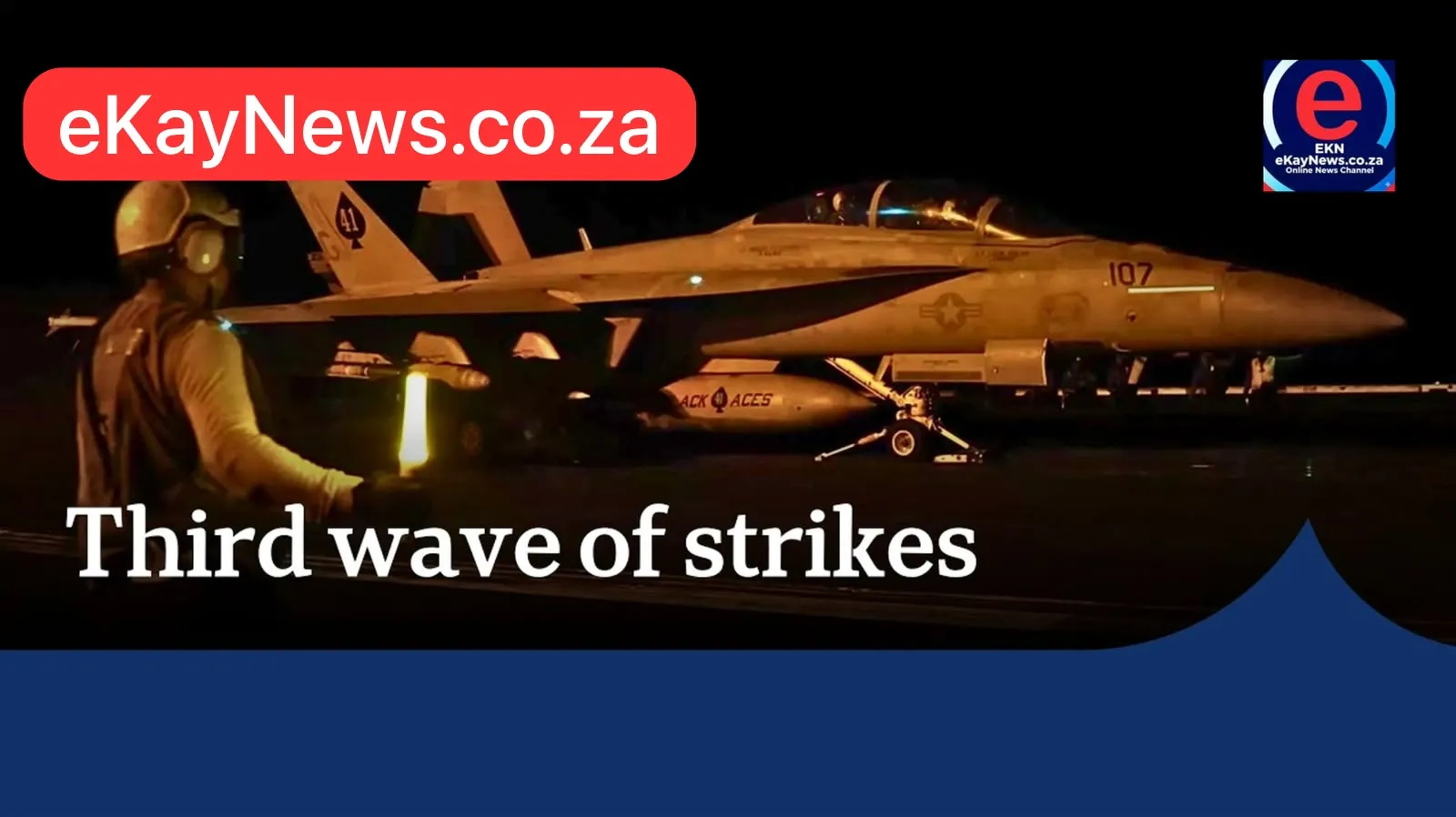
US launches new wave of strikes against Iran as Tehran says diplomacy has proven ‘futile’
US launches new wave of strikes against Iran as military tensions between Washington and Tehran intensified dramatically following fresh American airstrikes targeting Iranian military positions linked to the Strait of Hormuz. The latest escalation comes after the United States accused Iran of threatening international shipping and regional security, while Iranian officials declared that diplomatic efforts had become “futile” in the face of continued military action.
The renewed conflict has raised fears of a broader regional war, disrupted global energy markets, and renewed concerns about the security of one of the world’s busiest maritime trade routes. The latest exchange of missile and drone attacks has also placed additional strain on an already fragile ceasefire agreement negotiated only weeks earlier.
US strikes on Iran intensify conflict
The US launches new wave of strikes against Iran following orders from President Donald Trump, according to the United States Central Command (CENTCOM). The military said the operation was aimed at weakening Iran’s ability to threaten commercial shipping and civilian vessels travelling through the Strait of Hormuz.
CENTCOM announced that strikes began shortly after 9pm GMT on Sunday, targeting what it described as military infrastructure linked to Iranian operations in the strategic waterway.
President Trump defended the military campaign, saying American forces were holding Iranian forces accountable for attacks on international shipping.
“We’re beating them up,” Trump told reporters while discussing the latest military operations.
According to US officials, the strikes are intended to ensure freedom of navigation through the Strait of Hormuz, one of the world’s most strategically important energy corridors.
Donald Trump Iran conflict enters dangerous phase
The latest military action represents another major escalation in the ongoing Donald Trump Iran conflict, which has steadily intensified over recent months.
American officials argue that Iran has repeatedly threatened international commerce by attempting to control passage through the Strait of Hormuz.
Iran, however, insists it is defending its territorial waters and national security while accusing Washington of violating international law.
The exchange of attacks has effectively placed diplomatic negotiations on hold, with both sides hardening their public positions.
Iran’s Foreign Ministry accused Washington of destroying months of diplomatic progress.
Officials in Tehran said the latest American strikes had “rendered futile all efforts of the past few months to reduce tension and establish peace in the West Asian region.”
Iran Strait of Hormuz remains centre of crisis
Why the Strait of Hormuz matters
The Iran Strait of Hormuz remains one of the most strategically important waterways in the global economy.
Before the conflict escalated earlier this year, roughly one-fifth of the world’s oil and liquefied natural gas shipments passed through the narrow maritime corridor connecting the Persian Gulf to international markets.
Any disruption to shipping immediately impacts global energy prices.
Iran has recently attempted to establish new regulations governing vessel movements through the strait, insisting that ships obtain permission before entering certain waters.
The newly established Persian Gulf Strait Authority announced that passage through parts of the waterway had become temporarily impossible because of ongoing military operations.
Authorities said permits would only resume once stability returned.
Iran responds with missile and drone attacks
Following the American strikes, Iran launched retaliatory missile and drone attacks targeting countries hosting US military installations across the Gulf region.
Jordan confirmed that its military intercepted four Iranian missiles.
Kuwait’s armed forces also reported responding to multiple aerial threats after detecting hostile drones and missiles entering regional airspace.
The United Arab Emirates confirmed that its air defence systems intercepted additional Iranian projectiles, while Qatar also came under renewed pressure despite its role as a mediator in earlier ceasefire discussions.
Iranian state media reported explosions around Bandar Abbas, Sirik and nearby Qeshm Island, all of which are strategically located near military facilities overlooking the Strait of Hormuz.
US-Iran military escalation raises global concern
Growing fears of wider conflict
The latest US-Iran military escalation has significantly increased fears that the confrontation could expand beyond the Gulf region.
Military analysts warn that repeated strikes and counterstrikes increase the risk of accidental clashes involving additional regional powers.
CENTCOM stated that nearly 140 strikes were conducted during Saturday night’s operations alone.
American officials also claimed more than 300 Iranian military targets had been hit over three consecutive nights.
Iran’s Revolutionary Guards responded by claiming responsibility for attacks against US-linked targets in Jordan, Kuwait, Oman and Qatar, although several of those claims could not immediately be independently verified.
The rapid pace of military operations suggests neither side is prepared to back down.
Tehran says diplomacy has failed
Iranian officials placed responsibility for the collapse of negotiations squarely on Washington.
The Foreign Ministry accused the United States of deliberately undermining peace efforts while interfering with regional diplomatic initiatives involving Oman.
Officials confirmed that talks held in Muscat over arrangements governing shipping through the Strait of Hormuz failed to reach agreement because of what Tehran described as overt and covert American pressure.
Iran’s senior negotiator, Mohammad Bagher Ghalibaf, declared that “the era of one-sided deals is over,” warning that Iran would respond forcefully if agreements were not respected.
His comments reflected growing frustration within Tehran over the breakdown of recent negotiations.
Oil prices react to military tensions
The renewed fighting has once again shaken international financial markets.
Oil prices climbed sharply after news of the latest attacks emerged.
US benchmark West Texas Intermediate (WTI) crude rose above $74 per barrel during early trading in Asia.
Energy analysts say continued instability around the Strait of Hormuz could trigger further increases in fuel prices worldwide.
Higher oil prices may also contribute to rising inflation, affecting consumers and businesses globally.
For the United States, increased fuel costs present an additional political challenge ahead of the upcoming congressional elections.
International shipping faces renewed uncertainty
Shipping companies continue monitoring developments closely as military activity intensifies.
Although the US Navy-led Joint Maritime Information Centre confirmed that an expanded southern shipping route near Oman remains open, security threats throughout the region remain exceptionally high.
Commercial operators have been advised to remain alert while travelling through Gulf waters.
Insurance premiums for vessels operating in the area are also expected to rise if the conflict continues.
Many shipping companies have already adjusted routes or delayed cargo movements due to concerns over missile and drone attacks.
Middle East tensions 2026 continue to deepen
Regional stability under pressure
The latest conflict has become another major chapter in the ongoing Middle East tensions 2026, which have increasingly involved multiple countries and international powers.
Several Gulf nations now find themselves balancing their security partnerships with Washington while attempting to avoid direct involvement in the conflict.
Diplomatic observers warn that every new military exchange makes future negotiations more difficult.
Despite repeated calls for restraint from international organisations, neither Washington nor Tehran has signalled any immediate willingness to reduce military operations.
Impact on global diplomacy
The renewed conflict has complicated diplomatic efforts across the Middle East.
Countries including Oman and Qatar, which have played significant mediation roles, now face increasing pressure to revive negotiations before the conflict spirals further.
International leaders continue urging both sides to return to dialogue rather than military confrontation.
However, public statements from both governments indicate that trust between Washington and Tehran has deteriorated significantly.
YOU MAY LIKE:
Outlook for the conflict
While American officials insist military operations are focused solely on protecting international shipping, Iran maintains that US actions amount to unlawful aggression.
With missile attacks, drone strikes and military deployments continuing across the Gulf, the possibility of further escalation remains high.
Analysts believe the coming days will prove critical in determining whether diplomatic channels can be reopened or whether the confrontation develops into a wider regional conflict involving additional countries.
For now, US launches new wave of strikes against Iran remains the defining development in one of the most volatile geopolitical crises of 2026. As both nations continue exchanging military action and increasingly hostile rhetoric, the future of regional stability, international energy supplies and global diplomatic relations hangs in the balance.
References from mainstream media
- Reuters – US-Iran conflict, Strait of Hormuz developments, and international response.
https://www.reuters.com/world/middle-east/ - BBC News – Coverage of the escalating US-Iran military tensions and regional security updates.
https://www.bbc.com/news/world/middle-east - The Guardian – Analysis of US strikes on Iran, Strait of Hormuz tensions, and diplomatic developments.
https://www.theguardian.com/world/iran - Associated Press (AP News) – Breaking news on US military operations and Iran’s response.
https://apnews.com/hub/iran
Keep the News Flowing – Buy the Team a Coffee! ☕

Love the updates? Help us stay on the beat! Whether it’s a quick one-time donation or a monthly subscription, your support keeps the eKayNews lights on and the stories flowing.
-
Secure & Simple: We use PayFast for total transaction peace of mind.
-
Make an Impact: Every “coffee” you send directly supports our newsroom.
Your Brand, Our Audience: Let’s Make Headlines Together! 🚀

Looking for real engagement? At eKayNews, we don’t just share news—we build connections. Whether you’re a local startup or a growing business, our advertising packages are designed to put your brand in front of a loyal, highly engaged audience.
Choose Your Spotlight:
-
Link Booster (R2,500): Dominate the feed with 7 links across 7 days.
-
Permanent Feature (R4,000): Your story, hosted on our site for a lifetime.
-
Prime Visibility (R5,000): Claim the top spot with a 30-day homepage banner.
Ready to grow? 📩 Email us: info@ekaynews.co.za 💬 WhatsApp us: +27 71 096 1185
Get Connected:
-
Facebook & X (Twitter) : Follow us for real-time updates and community debates.
-
WhatsApp Channel: Get exclusive alerts sent directly to your phone.