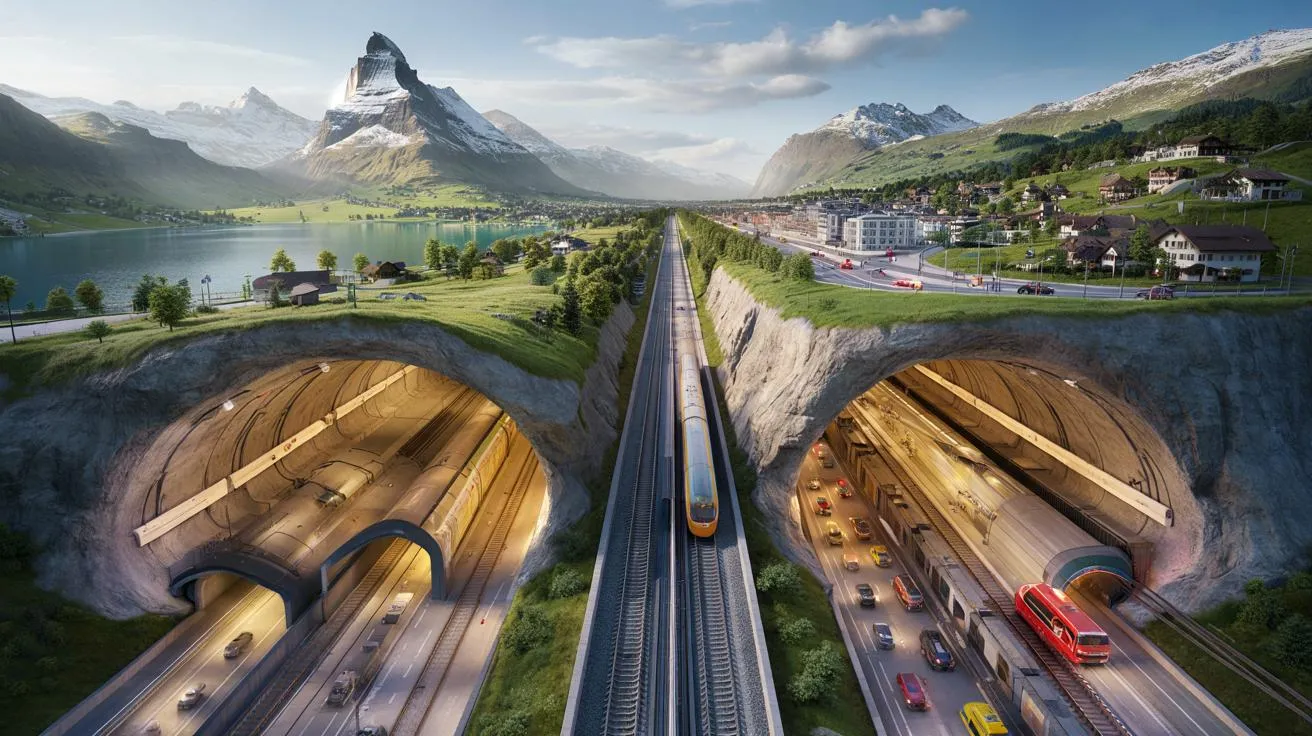
Switzerland’s massive underground city carved through rock
Switzerland’s massive underground city carved through rock is a feat of engineering that has transformed the very soul of the Alps. For nearly 30 years, Swiss engineers have drilled, blasted, and ground their way through some of the toughest geological formations on Earth, creating an invisible world that rivals the scale of many major urban centers. As of 2026, the Swiss Tunnelling Society reports a staggering 1,852 tunnels stretching across 2,544 kilometers. To put that in perspective, if you laid these tunnels end-to-end, they would stretch nearly halfway across the Atlantic Ocean.
Switzerland’s massive underground city carved through rock: The Hidden Empire
The sheer scale of Switzerland’s massive underground city carved through rock is difficult to fathom from the surface. While tourists admire the snowy peaks and mirror-like lakes of the Central Plateau, a “second Switzerland” hums with activity beneath their feet. Under cities like Zurich, Geneva, and Lausanne, intricate networks of rail, service shafts, and data cables criss-cross like a subterranean nervous system.
This infrastructure wasn’t built for the sake of novelty. It was born from a collision of brutal geography and forward-thinking politics. Switzerland sits at the heart of Europe, hemmed in by the Alps. To stay connected to the continent while protecting its fragile mountain ecosystems from the noise of millions of heavy trucks, the Swiss chose to go under. This led to the creation of Switzerland’s massive underground city carved through rock, ensuring that the surface remains a postcard-perfect landscape while the industrial “heavy lifting” happens in the dark.
Swiss tunneling engineering 2026: Innovations in the Dark
The year 2026 marks a turning point for Swiss tunneling engineering 2026. The industry has moved beyond simple excavation into an era of “Intelligent Underground” solutions. Today, Tunnel Boring Machines (TBMs)—monstrous earthworms longer than four football pitches—are equipped with AI-assisted sensors that “read” the rock ahead.
These innovations are critical because building Switzerland’s massive underground city carved through rock is not just about brute force; it is a delicate negotiation with a mountain. Engineers often face rock temperatures reaching 44°C and pressures that could crush standard concrete. In 2026, new robotic systems are being deployed for “autonomous tunneling,” allowing TBMs to operate with minimal human intervention in the most dangerous zones, significantly increasing safety and precision.
Alpine underground infrastructure projects: Beyond the Gotthard
While the 57-kilometer Gotthard Base Tunnel remains the crown jewel, several other Alpine underground infrastructure projects are defining the landscape in 2026.
-
Lötschberg Base Tunnel Expansion: Following a federal decision in 2024, work is now underway in 2026 to fully upgrade the second tube of this 34-kilometer tunnel. This project, costing CHF 1.7 billion, is essential for a continuous half-hourly intercity service between Bern and Valais.
-
The Alpine Hydrogen Corridor: In late 2025, this project was designated as a “Project of Mutual Interest” by the EU. It involves repurposing existing pipelines and digging new ones through the Alps to facilitate hydrogen imports from North Africa into Central Europe.
-
Urban “Cargo Sous Terrain”: In Swiss cities, work continues on underground automated logistics tunnels, designed to take 40% of delivery trucks off the surface roads by 2030.
Switzerland’s massive underground city carved through rock is thus not just a transit network; it is a multi-layered utility and logistics hub that secures the nation’s energy and supply chains for the next century.
The New Rail Link through the Alps (NRLA): A European Legacy
The New Rail Link through the Alps is the largest construction project in Swiss history. It has fundamentally shifted the European freight corridor, linking Rotterdam in the north to Genoa in the south via a “flat-track” railway. By eliminating the steep gradients of the old mountain passes, the NRLA allows trains to travel at speeds up to 250 km/h, cutting travel times between Zurich and Milan by nearly an hour.
The success of the NRLA has inspired a new generation of cross-border tunnels. The Brenner Base Tunnel, currently under construction between Austria and Italy, is set to surpass the Gotthard to become the longest underground rail link in the world at 64 kilometers. This highlights how Switzerland’s massive underground city carved through rock serves as a blueprint for a carbon-neutral, connected Europe.
Key Takeaways: The Swiss Subterranean Model
| Feature | Description | Impact |
| Scale | 2,500+ km of tunnels | Rivals the size of major global cities. |
| Sustainability | Shifting freight to rail | Removes 1 million trucks/year from Alpine roads. |
| Technology | Autonomous TBMs | Safer, faster excavation through 40°C+ rock. |
| Future | NRLA Completion | Connects Europe’s north and south in record time. |
YOU MAY LIKE:
FAQ: Understanding the Hidden Switzerland
1. Is Switzerland really “hollow”? Not literally, but the density of its underground network is a global record. Over 10% of the entire motorway and railway network now runs underground.
2. How long did it take to build Switzerland’s massive underground city carved through rock? The major “Base Tunnels” (Gotthard, Ceneri, Lötschberg) took nearly 30 years of continuous work, with the Gotthard alone taking 17 years.
3. Are these tunnels safe from earthquakes? Yes. Modern Swiss tunneling engineering 2026 includes “Tunnel of Improved Seismic Behavior” (TISB) concepts, using concentric tubes and movable bearings to withstand geological shifts.
4. Can tourists see this underground city? While most of it is functional, certain stations (like Zurich HB’s underground platforms) and exhibition centers at tunnel portals offer a glimpse into this massive infrastructure.
Switzerland’s massive underground city carved through rock is a reminder that the most radical transformations often happen out of sight. As you glide under the Alps at 200 km/h with a coffee in hand, you are witnessing the quiet triumph of three decades of human persistence.
Mainstream Media References
-
The Times of India (January 2026):
-
SWI swissinfo.ch (January 2026):
Kindly consider to support eKayNews, Buy Us a Coffee & Keep the News Flowing!

Love what we do? You can now support eKayNews directly! Your contributions empower us to deliver the breaking news, sports, and local updates you trust.
Ways to Support:
-
Subscribe: Choose any amount (cancel anytime).
-
Virtual Coffee: A quick, once-off donation to say thanks.
Note: Payments are 100% secure via PayFast. We never see your banking details.
To our amazing readers: Your support fills us with gratitude. You are the reason we can keep doing this every day. Thank you for being a vital part of the eKayNews family!
We’re feeling the love at eKayNews!

Facebook: [eKayNews on Facebook] X (Twitter): [eKayNews on X] WhatsApp: [Follow the eKayNews WhatsApp Channel] Join our inner circle for real-time news alerts!
📢 Advertising Packages on www.eKayNews.co.za
Package 1. Link Booster: We add 7 links to 7 articles over 7 days – R2,500
Package 2. Permanent Feature: Sponsored Blog Article (hosted permanently) – R4,000
Package 3. Prime Visibility: Home Page Banner Ad (30 days) – R5,000
Book now: Email info@ekaynews.co.za or WhatsApp us on +27710961185