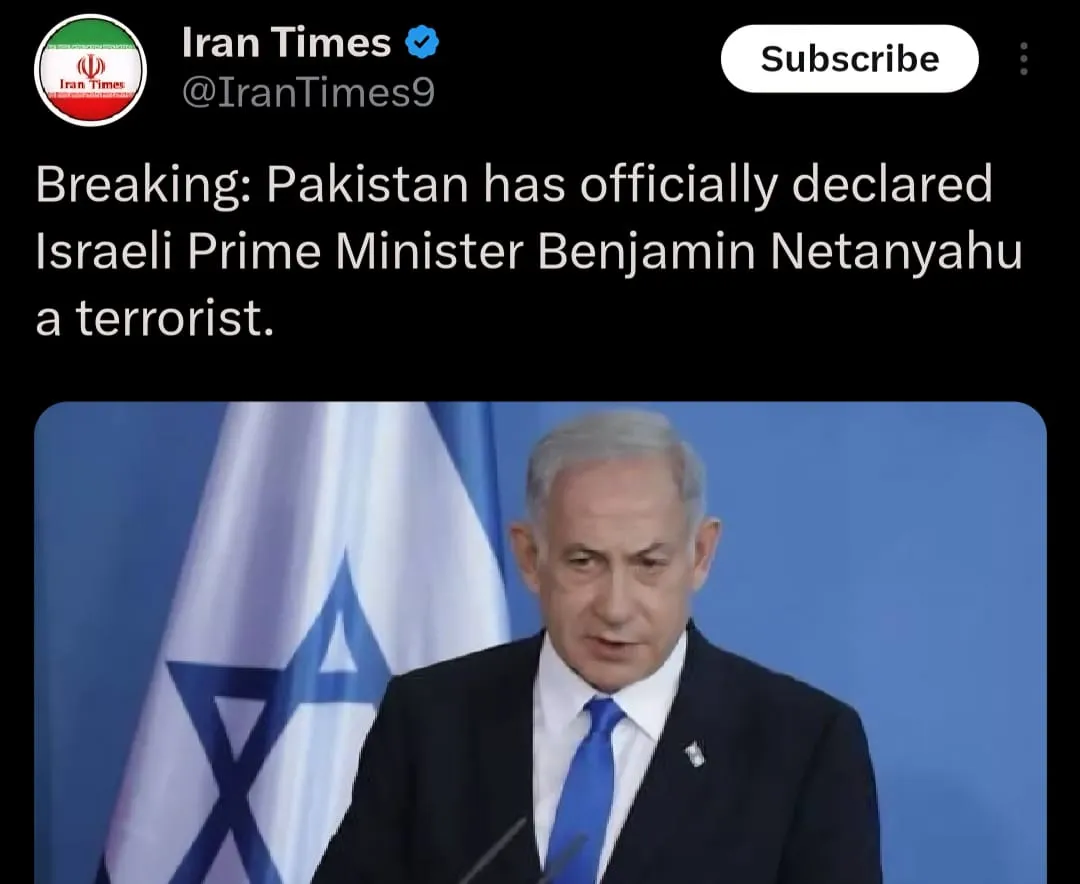
Pakistan officially declares Netanyahu a terrorist
Pakistan officially declares Netanyahu a terrorist, marking a dramatic escalation in diplomatic tensions amid the ongoing Israel–Gaza conflict. The announcement has drawn widespread international attention, highlighting Pakistan’s firm political stance on the Palestinian issue and its sharp criticism of Israeli military operations in Gaza.
The decision places Pakistan at the center of renewed diplomatic debate in the Muslim world and beyond. By formally labeling Israeli Prime Minister Benjamin Netanyahu as a terrorist, Pakistan has taken one of its strongest rhetorical positions yet regarding the Israel–Gaza conflict. The move reflects longstanding policy positions but elevates the language and symbolism to a new level.
Pakistan’s Official Announcement and Political Context
Pakistan officially declares Netanyahu a terrorist during a period of heightened tensions in the Middle East. Government officials described the decision as a response to what they view as grave humanitarian concerns arising from the Israel–Gaza conflict. The statement emphasized solidarity with Palestinians and condemned Israeli military actions in Gaza.
Pakistan has historically maintained that it does not recognize Israel as a state and has consistently supported the creation of an independent Palestinian state based on pre-1967 borders with East Jerusalem as its capital. The declaration targeting Benjamin Netanyahu personally signals frustration over what Pakistani leaders describe as continued escalation in Gaza.
The announcement also reflects domestic political dynamics within Pakistan. Public opinion in the country has strongly favored Palestinian rights, and protests have taken place in major cities calling for stronger action against Israel. By officially adopting this position, Pakistan’s government appears to align itself firmly with public sentiment.
Impact on Diplomatic Tensions
The phrase “Pakistan officially declares Netanyahu a terrorist” has rapidly circulated in international media, intensifying diplomatic tensions between Pakistan and Israel’s allies. Although Pakistan and Israel do not have formal diplomatic relations, the statement may affect Pakistan’s broader foreign policy engagements, especially with Western nations that support Israel.
Diplomatic tensions may rise as allies of Israel view the declaration as inflammatory. However, Pakistan maintains that its stance is rooted in principles of international humanitarian law and human rights. Officials argue that strong language reflects the severity of the humanitarian situation in Gaza during the Israel–Gaza conflict.
At the same time, the move may strengthen Pakistan’s ties with countries and organizations that share similar views on the conflict. Several nations in the Muslim world have expressed strong criticism of Israeli policies, and Pakistan’s declaration reinforces its position within that bloc.
The Israel–Gaza Conflict and Pakistan’s Position
The Israel–Gaza conflict has been a central issue in global politics for decades. Pakistan has consistently voiced support for Palestinians in international forums such as the United Nations and the Organization of Islamic Cooperation (OIC). By stating that Pakistan officially declares Netanyahu a terrorist, Islamabad underscores its belief that Israeli leadership bears responsibility for military actions in Gaza.
Pakistan’s leadership argues that civilian casualties and destruction in Gaza require strong condemnation. Officials have framed their declaration as a moral and political statement rather than a legal action with immediate international consequences.
The Israel–Gaza conflict remains deeply polarizing worldwide. While Israel maintains that its operations target militant groups and are necessary for national security, critics—including Pakistan—argue that the scale of military action has led to unacceptable humanitarian consequences.
Benjamin Netanyahu at the Center of Controversy
Benjamin Netanyahu, one of Israel’s longest-serving prime ministers, has been a central figure in shaping Israeli security policy. Pakistan officially declares Netanyahu a terrorist as part of a broader critique of his leadership during the Israel–Gaza conflict.
Netanyahu has defended Israel’s military strategy as essential to protect Israeli citizens from militant threats. However, critics in Pakistan and elsewhere argue that his policies have escalated violence and hindered peace negotiations.
By naming Benjamin Netanyahu directly, Pakistan personalizes its criticism rather than limiting condemnation to Israeli state policy. This approach intensifies diplomatic tensions because it targets an individual head of government rather than addressing the conflict in general terms.
Domestic Reaction in Pakistan
Within Pakistan, the declaration has received significant support from political groups and civil society organizations advocating for Palestinian rights. Religious and political parties have long called for stronger language and more decisive action regarding Israel.
Public rallies in several cities have reflected widespread anger over the Israel–Gaza conflict. For many Pakistanis, the statement that Pakistan officially declares Netanyahu a terrorist symbolizes moral solidarity with Palestinians facing hardship.
However, some analysts caution that such rhetoric could complicate Pakistan’s diplomatic relations globally. While Pakistan does not maintain official ties with Israel, its relationships with Western countries could face strain due to rising diplomatic tensions.
International Implications
The international community’s response to Pakistan officially declaring Netanyahu a terrorist has been mixed. Some governments have refrained from commenting directly, while others emphasize the need for de-escalation and dialogue in the Israel–Gaza conflict.
Diplomatic tensions may not immediately translate into concrete policy consequences, but the language used by Pakistan signals a deepening divide in global narratives surrounding the conflict. The move may influence debates in international forums where Pakistan advocates for Palestinian statehood and humanitarian relief.
At the same time, experts note that such declarations are largely symbolic unless accompanied by coordinated international legal action. While Pakistan’s stance is politically significant, it does not automatically alter diplomatic or legal frameworks governing the conflict.
Broader Regional Consequences
Pakistan officially declares Netanyahu a terrorist at a time when the Middle East faces broader instability. The Israel–Gaza conflict has already impacted regional security, global markets, and humanitarian conditions.
Pakistan’s statement reinforces its identity as a vocal advocate for Palestinian rights in South Asia. It may also strengthen cooperation with other countries that share similar positions on the conflict. However, the potential for increased diplomatic tensions with Israel’s allies remains a factor that policymakers must navigate carefully.
The declaration underscores how deeply interconnected global politics have become. Even countries geographically distant from the Middle East, like Pakistan, are directly engaged in shaping narratives and diplomatic responses to the Israel–Gaza conflict.
YOU MAY LIKE:
Iran Launches Counterattack With Missiles on Israel and US Bases
Israel also Launches Attack on Iran as Explosions Hit Tehran
Conclusion
Pakistan officially declares Netanyahu a terrorist in a move that underscores its unwavering support for Palestinians and sharp criticism of Israeli leadership during the Israel–Gaza conflict. The decision intensifies diplomatic tensions and highlights the deep divisions in international perspectives on the crisis.
While largely symbolic in immediate legal terms, the declaration sends a strong political message. Pakistan positions itself firmly on one side of a highly contentious global issue, reinforcing its historical stance on Palestine and challenging Israeli policy under Benjamin Netanyahu.
As the Israel–Gaza conflict continues to evolve, the diplomatic repercussions of Pakistan’s statement may unfold gradually. What remains clear is that Pakistan’s announcement represents one of its most forceful expressions of opposition to Israeli leadership, further shaping the global conversation surrounding one of the world’s most enduring conflicts.
References from mainstream media.
-
Pakistan’s government declared Israeli Prime Minister Benjamin Netanyahu a terrorist — Voice of America reported that Pakistan’s government under pressure from protesters declared Netanyahu a terrorist and urged he be brought to justice for alleged war crimes. Pakistan calls Israel’s Netanyahu a ‘terrorist’ — VOA News
-
Pakistan recognizes Israeli Prime Minister Netanyahu as a terrorist — Daily Sabah (a major international news outlet) covered Islamabad’s official move to recognize Benjamin Netanyahu as a “terrorist”, including details of the government’s press conference and calls on the international community. Pakistan recognizes Israeli Prime Minister Netanyahu as ‘terrorist’ — Daily Sabah
Kindly consider to support eKayNews, Buy Us a Coffee & Keep the News Flowing!

Love what we do? You can now support eKayNews directly! Your contributions empower us to deliver the breaking news, sports, and local updates you trust.
Ways to Support:
-
Subscribe: Choose any amount (cancel anytime).
-
Virtual Coffee: A quick, once-off donation to say thanks.
Note: Payments are 100% secure via PayFast. We never see your banking details.
To our amazing readers: Your support fills us with gratitude. You are the reason we can keep doing this every day. Thank you for being a vital part of the eKayNews family!
We’re feeling the love at eKayNews!

Facebook: [eKayNews on Facebook] X (Twitter): [eKayNews on X] WhatsApp: [Follow the eKayNews WhatsApp Channel] Join our inner circle for real-time news alerts!
📢 Advertising Packages on www.eKayNews.co.za
Package 1. Link Booster: We add 7 links to 7 articles over 7 days – R2,500
Package 2. Permanent Feature: Sponsored Blog Article (hosted permanently) – R4,000
Package 3. Prime Visibility: Home Page Banner Ad (30 days) – R5,000
Book now: Email info@ekaynews.co.za or WhatsApp us on +27710961185