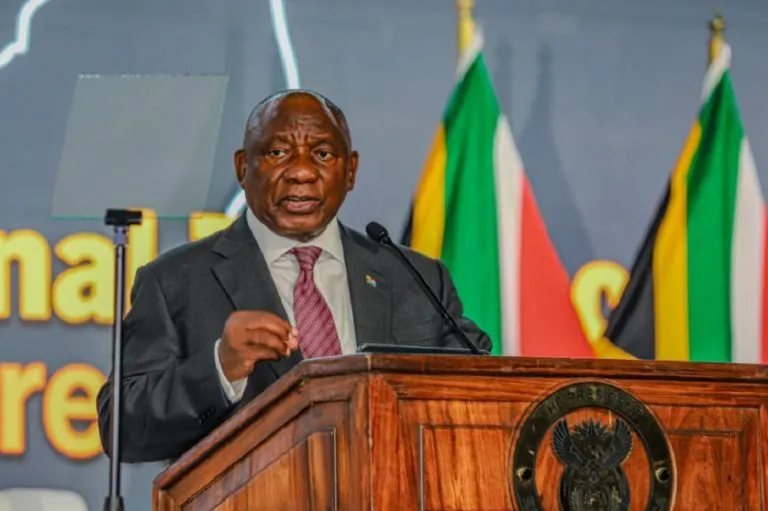
Cyril Ramaphosa reacts to ConCourt Phala Phala judgment
Ramaphosa reacts to ConCourt Phala Phala judgment with a measured and deeply diplomatic response, signaling a critical turning point in South African politics. Following a bombshell ruling by the highest court in the land, the nation’s political landscape has been fundamentally altered. The Constitutional Court found that Parliament’s vote on the Phala Phala matter was influenced by a material error of law and was therefore unconstitutional. This ruling, handed down by Chief Justice Mandisa Maya, has effectively resurrected the Section 89 inquiry, ordering that the independent panel’s report be referred to a formal impeachment committee.
For a presidency that has navigated numerous political storms, this judgment represents one of the most significant constitutional tests of the modern democratic era. The court ruled decisively in favour of the Economic Freedom Fighters (EFF) and the African Transformation Movement (ATM), two opposition parties that have relentlessly pursued accountability regarding the undisclosed foreign currency stolen from the President’s Limpopo game farm in 2020. As the news broke, the immediate question on the minds of citizens and investors alike was how the head of state would respond to this unprecedented legal mandate.
The Constitutional Court and the Phala Phala Saga
The origins of this constitutional crisis trace back to the initial revelations of the farm theft, which ultimately led to the establishment of an independent panel led by retired Chief Justice Sandile Ngcobo. When that panel found prima facie evidence that the President may have violated the Constitution, the National Assembly was tasked with voting on whether to adopt the report and initiate an impeachment process. However, the African National Congress (ANC) used its parliamentary majority at the time to block the report.
It is this specific parliamentary maneuver that the Constitutional Court has now declared invalid. Chief Justice Maya’s ruling articulated that the National Assembly’s decision to halt the Section 89 process was fundamentally flawed due to a “material error of law.” This means that the legislative branch failed in its constitutional duty to properly hold the executive accountable, acting on incorrect legal interpretations rather than the factual merits of the independent panel’s findings.
Why Ramaphosa reacts to ConCourt Phala Phala judgment calmly
Despite the gravity of the ruling, the reaction from the Union Buildings has been characterized by a calm reiteration of democratic principles. Ramaphosa reacts to ConCourt Phala Phala judgment not with defensiveness, but by emphasizing his ongoing cooperation with state institutions. The Presidency swiftly released a statement confirming that it has noted the judgment. Crucially, the statement articulated that Cyril Ramaphosa respects the Constitutional Court’s judgment and reaffirms his unwavering commitment to the Constitution, the independence of the judiciary, and the rule of law.
“President Ramaphosa has been consistent in providing his full assistance to the various enquiries into this matter,” The Presidency noted in its official communication. This consistency is vital for the President’s political brand, which was largely built on a platform of anti-corruption and institutional renewal. By leaning into the judicial process rather than attacking it, the President is attempting to separate himself from the historical precedent of politicians who have vilified the courts when faced with unfavorable rulings.
Cyril Ramaphosa, the Presidency, and the Rule of Law
The concept of the rule of law is the bedrock of South Africa’s constitutional democracy, and it has taken center stage in the wake of this judgment. Presidential spokesperson Vincent Magwenya elaborated on the President’s stance, ensuring the public that the office of the President is not actively seeking to subvert the impending parliamentary procedures.
Magwenya stated, “The Presidency has noted the judgment of the Constitutional Court in the case brought by the Economic Freedom Fighters challenging the National Assembly’s decision with respect to Section 89 proceedings against the President. President Ramaphosa respects the Constitutional Court’s judgment and reaffirms his commitment to the Constitution, the independence of the judiciary and the rule of law.”
Upholding the Impeachment Process
For the impeachment process to possess ultimate legitimacy, the executive must submit to the legislative oversight mechanisms designed by the drafters of the Constitution. Ramaphosa reacts to ConCourt Phala Phala judgment by publicly declaring his submission to these very mechanisms. Magwenya continued, “President Ramaphosa has been consistent in providing his full assistance to the various enquiries into this matter. President Ramaphosa maintains that no person is above the law and that any allegations should be subjected to due process without fear, favour or prejudice.”
Furthermore, the President has actively called on all South Africans to respect the Constitutional Court judgment and all judicial institutions. This call for public calm and institutional respect is a strategic move to prevent the political discourse from deteriorating into factional violence or institutional distrust. By framing his subjection to the impeachment process as a victory for the rule of law, Cyril Ramaphosa is attempting to maintain his moral authority even as he faces a rigorous parliamentary inquiry.
Parliament Grapples with the Constitutional Court Directive
While the President’s response has been carefully curated, the institution that must now execute the court’s orders—Parliament—faces a monumental logistical and procedural challenge. The legislative branch has formally weighed in on the matter, acknowledging that it has noted and respects the Constitutional Court’s judgment. Parliament has correctly identified this as a significant, landmark ruling that will require incredibly careful legal and procedural consideration.
The institution has publicly stated that it will take time to thoroughly study the judgment. The implications for the rules and processes of the National Assembly are vast. Parliament cannot simply rubber-stamp an impeachment committee; it must design a framework that adheres strictly to the directives outlined by Chief Justice Maya to avoid any further legal challenges from either the Presidency or the opposition parties.
Moloto Mothapo on the Phala Phala Procedures
Parliament spokesperson Moloto Mothapo provided immediate context to the media shortly after the ruling was handed down. He explained that the judgment will now be subjected to a detailed internal assessment to guide how Parliament proceeds in line with the court’s directives. The formation of an impeachment committee is not an everyday occurrence, and the procedural integrity of this committee is paramount.
“As Parliament, we note and respect the judgment of the Constitutional Court,” Mothapo explained. “It is important that we take some time to carefully study the judgment, particularly insofar as its implication on the procedures of the National Assembly is concerned. So, that is exactly what we’ll be doing because it just came out now and we will have an opportunity to go through it and also make a determination, as I’m saying.”
As Ramaphosa reacts to ConCourt Phala Phala judgment, the pressure heavily shifts to the Speaker of the National Assembly and the parliamentary legal advisors. They must rapidly construct an impeachment process that allows for fair cross-examination, evidence gathering, and transparent public broadcasting, ensuring that the material errors of law that plagued the 2022 vote are permanently rectified.
The ANC’s Position on the Rule of Law and Phala Phala
Beyond the state institutions of the Presidency and Parliament, the political machinery of the African National Congress (ANC) is deeply entangled in this crisis. Historically, the ANC has used its parliamentary majority to shield its leaders, a tactic that the Constitutional Court has now heavily penalized in the context of the Phala Phala matter.
Ramaphosa’s party has subsequently come out to state that it, too, is committed to the rule of law. The optics of the governing party rejecting a Constitutional Court ruling would be catastrophic for its electoral standing, particularly in a political climate where coalition governance and the Government of National Unity (GNU) demand heightened accountability.
Internal Ventilation of the Impeachment Process
ANC spokesperson Mahlengi Bhengu-Motsiri provided the party’s initial reaction, treading a cautious line between defending the party’s President and respecting the apex court. “All that we can say at this point is we respect the decisions of our judiciary, and we will make sure that which needs to be done correctly is done correctly,” said Bhengu-Motsiri.
She further noted, “This judgment must be transmitted to the ANC for a proper ventilation including on the work that we do in Parliament.” This “ventilation” refers to the internal discussions within the ANC’s National Executive Committee (NEC) and its parliamentary caucus. The ANC must now decide how its members will conduct themselves within the newly mandated impeachment committee. Will they actively interrogate the facts of the Phala Phala theft, or will they adopt a defensive posture to protect Cyril Ramaphosa? The party’s adherence to the rule of law will be tested not in their press statements, but in their parliamentary conduct in the weeks to come.
The EFF, ATM, and the Victory for Constitutional Accountability
It is impossible to analyze this moment without acknowledging the role of the Economic Freedom Fighters and the African Transformation Movement. These parties pursued the Phala Phala matter through the highest courts when many political commentators believed the issue had been successfully buried by the 2022 parliamentary vote. Their victory at the Constitutional Court is a testament to the resilience of South Africa’s legal opposition mechanisms.
For the EFF and ATM, the fact that Ramaphosa reacts to ConCourt Phala Phala judgment by accepting the impending impeachment process is a massive political triumph. They have successfully forced the head of state to submit to an inquiry regarding the undeclared foreign currency, the alleged bypassing of the South African Police Service (SAPS), and the secretive cross-border pursuit of the alleged thieves. The impeachment process will provide these opposition parties with a highly publicized platform to question the President’s ethics and adherence to the Prevention and Combating of Corrupt Activities Act.
Preparing for the Impeachment Process
As the dust settles on the Constitutional Court ruling, the mechanics of the impeachment process will begin to take shape. An impeachment committee, composed of Members of Parliament from various political parties, will be established. Unlike the Section 89 independent panel, which only assessed whether there was enough evidence to warrant a broader inquiry, this new committee will possess the power to subpoena witnesses, demand classified documents, and conduct extensive hearings.
Cyril Ramaphosa will likely be called to testify under oath regarding the events that transpired at his farm in Limpopo. Questions regarding the origin of the funds, the reason for the cash storage in furniture, and the instructions given to the head of the Presidential Protection Unit, Major General Wally Rhoode, will be scrutinized under the unforgiving lights of parliamentary oversight.
YOU MAY LIKE:
Conclusion: The Ultimate Test of the Rule of Law
The upcoming months will be a defining period for South Africa’s constitutional democracy. Ramaphosa reacts to ConCourt Phala Phala judgment by publicly embracing the principles of judicial independence and accountability, setting a crucial tone for the nation. However, the true test lies in the execution of the impeachment process.
Will Parliament conduct a thorough, unbiased investigation free from the material errors of law that previously derailed the Phala Phala inquiry? Will the ANC allow its parliamentary caucus to vote according to their conscience and the facts presented? And will Cyril Ramaphosa continue to support the rule of law if the impeachment committee’s findings are ultimately damning?
The Constitutional Court has reminded the nation that no individual, not even a sitting President, is above the Constitution. As the Section 89 report is finally referred to an impeachment committee, South Africans are witnessing the robust, albeit turbulent, functioning of their democratic institutions. The Phala Phala saga is far from over, but the path forward is now dictated by the rule of law, rather than the arithmetic of political majorities.