Trump arrives in Beijing for talks with China’s Xi on Iran war, trade and US arms sales to Taiwan
Trump arrives in Beijing for talks with China’s Xi on Iran war, signaling the start of a high-stakes diplomatic marathon that could determine the trajectory of global stability for the next decade. As Air Force One touched down in the Chinese capital this Wednesday, the atmosphere was a complex blend of rigid protocol and palpable geopolitical tension. With the world currently reeling from the economic aftershocks of the conflict in the Middle East, this summit represents the most significant meeting between the two superpowers in recent history.
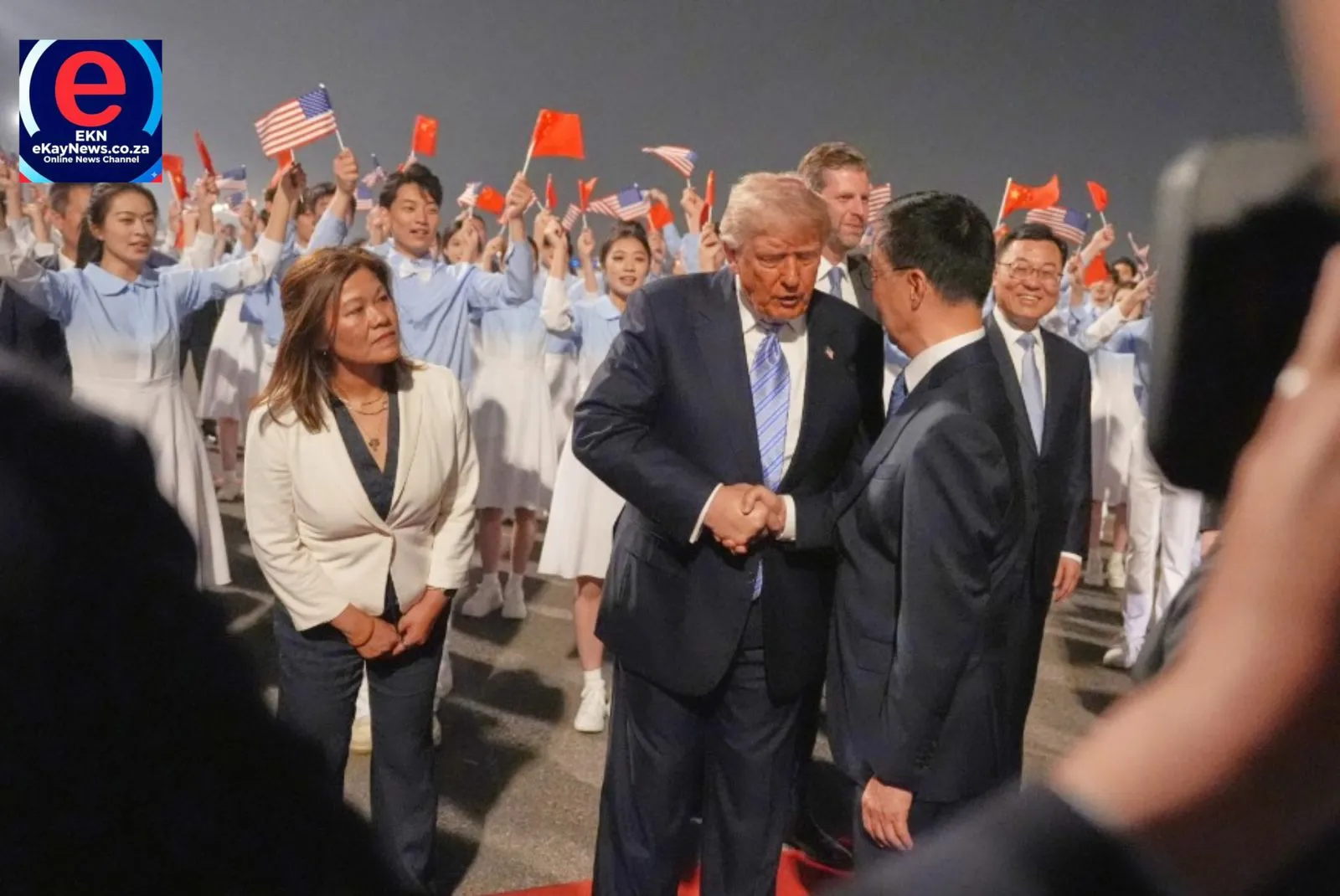
President Donald Trump was greeted with an elaborate “state visit-plus” welcome, featuring a red carpet, a military honor guard, and hundreds of chanting youths. However, beneath the ceremonial surface lies a heavy agenda dominated by a looming energy crisis, a massive $11 billion arms package for Taiwan, and a desperate need to stabilize US-China trade relations. For observers in South Africa and across the globe, the outcome of these discussions is not merely academic—it is a matter of global economic survival.
A Red Carpet Welcome in a Time of Global Turmoil
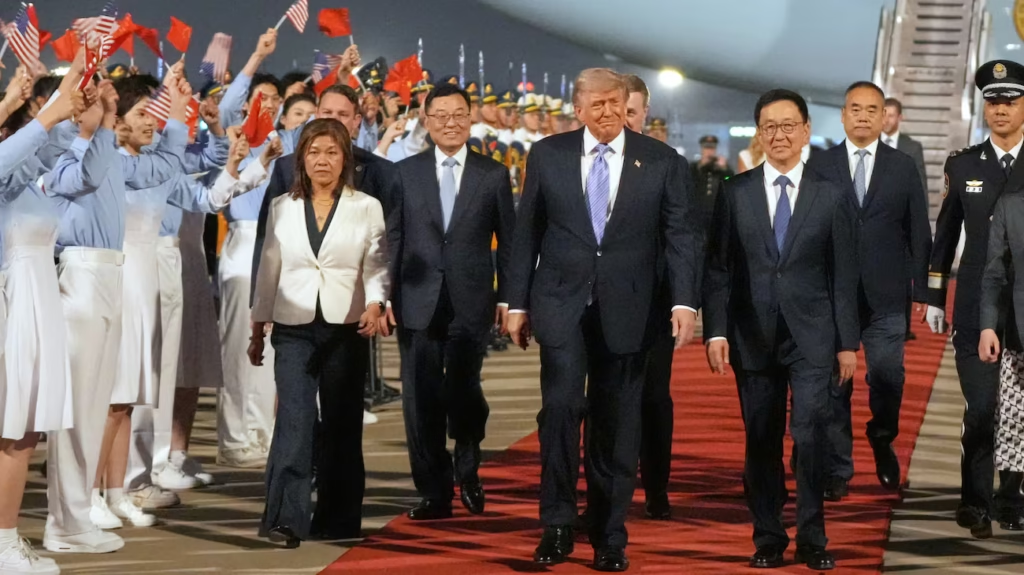
The welcoming ceremony was a masterclass in Chinese diplomatic theater. Trump was met on the tarmac by high-ranking officials including Vice President Han Zheng and the U.S. envoy to Beijing, David Perdue. The presence of some 300 youths waving American and Chinese flags provided a vibrant backdrop to an otherwise somber geopolitical landscape.
“We’re the two superpowers,” Trump told the traveling press corps shortly before landing. “We’re the strongest nation on Earth in terms of military. China’s considered second.” This characteristic projection of strength comes at a delicate time. Back in Washington, the Trump administration is navigating the domestic fallout of the Iran war, characterized by surging inflation and a polarized electorate. For the President, this trip to meet Xi Jinping is an opportunity to secure a significant “win”—one that could be measured in soybean exports, aircraft contracts, and a cooling of the regional fires in the Middle East.
The Iran War: A Shadow Over the Summit
While the ceremonial aspects of the visit are focused on bilateral friendship, the Iran war is the inescapable shadow over every conversation. The conflict has led to the effective closure of the Strait of Hormuz, a vital maritime artery through which a significant portion of the world’s oil and natural gas flows. With tankers stranded and energy prices spiking to record levels, the global economy is facing a potential “lost year” of growth.
Trump arrives in Beijing for talks with China’s Xi on Iran war issues despite his public insistence that the situation is “under control.” To reporters, the President maintained a posture of nonchalance, stating that he didn’t necessarily need Xi’s assistance in resolving the conflict. However, the reality on the ground tells a different story. Iranian Foreign Minister Abbas Araghchi was in Beijing only last week, seeking to bolster China’s support as a diplomatic counterweight to the U.S.-led coalition.
For South Africans, who have felt the pinch of rising fuel costs at the pump from Benoni to Cape Town, the resolution of the Hormuz blockade is the most critical outcome of this summit. The “energy shock” is no longer a distant news headline; it is a daily reality affecting transport, manufacturing, and food security.
US-China Trade: The Quest for a New “Board of Trade”
A primary objective for the American delegation is the establishment of a formal “Board of Trade” to manage the ongoing friction between the two economies. Following a series of tariff hikes and China’s retaliatory control over rare earth minerals last year, the two nations have been living under a fragile truce.
Trump is accompanied by a “Who’s Who” of the American business world, including:
-
Elon Musk (Tesla/SpaceX): Seeking to expand the presence of American high-tech manufacturing in China.
-
Jensen Huang (Nvidia): Addressing the critical issue of semiconductor supply chains and AI development.
-
Agricultural Titans: Looking to finalize massive deals for soybeans and beef to appease the American farm belt.
The goal is to move away from the “trade war” mentality of 2025 and toward a more structured, albeit competitive, framework. Trump’s “first request” to Xi, posted on social media en route, was for China to “open up” even further to American firms. Whether Beijing is willing to grant this access while the U.S. continues to restrict Chinese tech remains the multi-billion dollar question.
Taiwan: The “First Red Line” of Diplomacy
The status of Taiwan remains the most volatile point of friction. China has expressed deep displeasure over U.S. plans to fulfill an $11 billion weapons package for the self-governing island. This package, the largest ever authorized for Taiwan, includes advanced defensive systems that Beijing views as a direct threat to its sovereignty.
Before Trump arrives in Beijing for talks with China’s Xi on Iran war and trade, the People’s Daily published a blistering editorial. It described Taiwan as the “first red line that cannot be crossed.” The tension is compounded by Taiwan’s role as the world’s leading chipmaker. In the age of Artificial Intelligence, control over—or at least stable access to—Taiwanese semiconductors is a matter of national security for both the U.S. and China.
Trump’s own stance on Taiwan has been described as “ambivalent.” While his administration authorized the arms sale, he has signaled a willingness to use the issue as a bargaining chip in broader negotiations. This “transactional diplomacy” has left officials in Taipei and Beijing equally on edge, as neither side is entirely sure where the President’s ultimate loyalty lies.
The Nuclear Ambition: A Three-Way Arms Pact
In addition to trade and regional wars, Trump intends to pitch a “new, improved, and modernized” nuclear arms deal. With the New START treaty between the U.S. and Russia having expired in February, the world is currently without a formal cap on the two largest atomic arsenals for the first time in over fifty years.
Trump’s vision involves a three-way pact that includes China. Currently, the Pentagon estimates that China possesses over 600 operational nuclear warheads and is on track to exceed 1,000 by 2030. While this is still a fraction of the 5,000+ warheads held by both the U.S. and Russia, the pace of China’s expansion has alarmed Washington.
Beijing has historically been cool toward such a pact, arguing that their arsenal is purely defensive and not on parity with the other two powers. Trump, however, believes that a superpower cannot be “half-in” on global security, and he expects China to take a seat at the nuclear table.
The “Business World Titans” and the AI Race
The presence of Jensen Huang and Elon Musk in the delegation highlights the underlying theme of the summit: the race for technological supremacy. As Trump arrives in Beijing for talks with China’s Xi on Iran war and trade, he is keenly aware that the 21st-century economy will be built on silicon and software.
China wants a reduction in tech restrictions, particularly those targeting high-end computer chips used for AI. The U.S., conversely, wants to bring more “chipmaking to America” while ensuring that American firms can “work their magic” within the Chinese market without the risk of intellectual property theft. The intersection of US-China trade and the AI revolution is perhaps the most complex puzzle the two leaders have to solve.
What This Summit Means for the Global South
While the headlines focus on the two superpowers, the “Edu-Entertainment” perspective of eKayNews recognizes the profound impact on nations like South Africa. The job crisis we face in Gauteng and beyond is directly tied to global trade flows.
-
Commodity Prices: China is South Africa’s largest trading partner. Stability in Beijing means stability for our mining and manufacturing sectors.
-
Energy Costs: A breakthrough in the Iran war discussions would lead to a cooling of oil prices, providing immediate relief to the South African transport industry.
-
Geopolitical Alignment: South Africa continues to navigate its role within the BRICS+ framework, making the U.S.-China relationship a critical axis for our own foreign policy.
YOU MAY LIKE:
Conclusion: A Turning Point in Beijing
Trump arrives in Beijing for talks with China’s Xi on Iran war, trade, and the future of Taiwan at a moment when the world feels more fractured than ever. The pomp and ceremony of the Temple of Heaven and the formal banquets cannot fully mask the reality that these two men hold the keys to global peace and prosperity.
If Trump can secure a “Board of Trade” and a roadmap for the reopening of the Strait of Hormuz, he will return to Washington with the domestic “win” he so desperately needs. If Xi Jinping can secure a reduction in tech sanctions and a de-escalation of U.S. support for Taiwan, he will further cement China’s status as a co-equal superpower.
The dream of a “great relationship for many, many decades” is on the table. Whether it becomes a reality or a footnote in a new Cold War depends on what happens behind closed doors over the next 48 hours.
Mainstream Media References
-
The Associated Press (AP News)
-
Los Angeles Times
Kindly consider to support eKayNews, Buy Us a Coffee & Keep the News Flowing!

Love what we do? You can now support eKayNews directly! Your contributions empower us to deliver the breaking news, sports, and local updates you trust.
Ways to Support:
-
Subscribe: Choose any amount (cancel anytime).
-
Virtual Coffee: A quick, once-off donation to say thanks.
Note: Payments are 100% secure via PayFast. We never see your banking details.
To our amazing readers: Your support fills us with gratitude. You are the reason we can keep doing this every day. Thank you for being a vital part of the eKayNews family!
We’re feeling the love at eKayNews!

Facebook: [eKayNews on Facebook] X (Twitter): [eKayNews on X] WhatsApp: [Follow the eKayNews WhatsApp Channel] Join our inner circle for real-time news alerts!
📢 Advertising Packages on www.eKayNews.co.za
Package 1. Link Booster: We add 7 links to 7 articles over 7 days – R2,500
Package 2. Permanent Feature: Sponsored Blog Article (hosted permanently) – R4,000
Package 3. Prime Visibility: Home Page Banner Ad (30 days) – R5,000
Book now: Email info@ekaynews.co.za or WhatsApp us on +27710961185