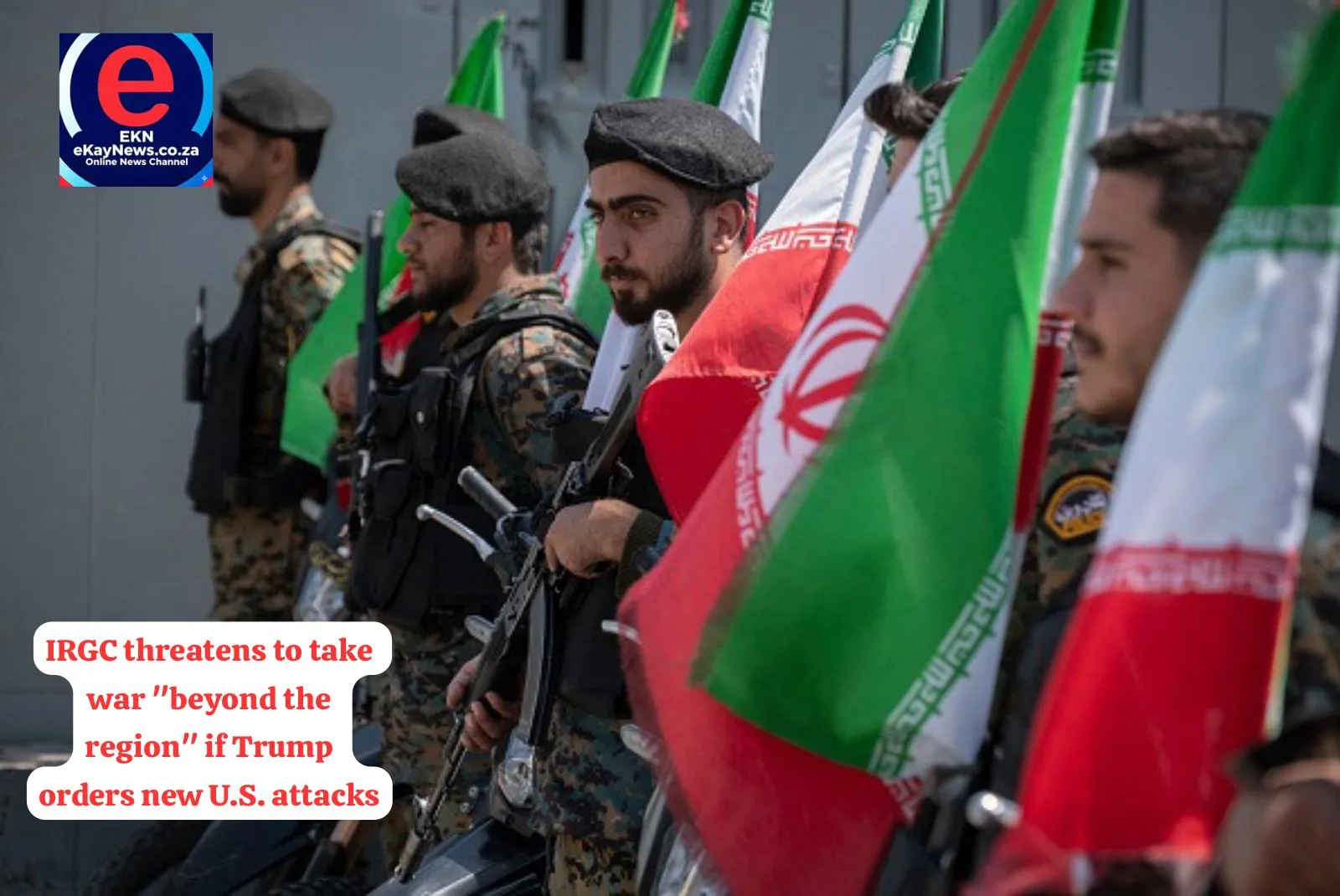
Iran threatens to take war “beyond the region” if Trump orders new U.S. attacks
Iran threatens to take war “beyond the region” if Trump orders new U.S. attacks, elevating the ongoing conflict into a dangerously unpredictable new phase. The Islamic Revolutionary Guard Corps (IRGC) delivered a chilling warning on Wednesday, making it clear that any resumption of hostilities by the United States or Israel would trigger a retaliatory campaign unlike anything seen thus far. In a robustly worded statement broadcast across state media, the powerful paramilitary group promised “crushing blows … in places you cannot even imagine,” suggesting a willingness to target global interests well outside the traditional Middle Eastern theater.
The immediate catalyst for this alarming declaration was an admission from President Donald Trump that he had been “an hour away” from launching a massive new wave of strikes against the Islamic Republic on Monday evening. However, the President abruptly halted the operation after receiving urgent pleas from allied nations in the Persian Gulf. These regional partners cited fragile but tangible progress in back-channel peace talks and expressed deep concern over the catastrophic consequences of a broader war.
IRGC issues stern threats amid stalled diplomacy
The fiery rhetoric from Tehran underscores the incredibly high stakes of the current geopolitical standoff. The IRGC’s statement emphasized that the military apparatus in Iran has not yet deployed all of its strategic “capacities.” This ominous phrasing serves as a reminder to Western powers that despite previous rounds of bombardment, Iran retains a formidable arsenal of ballistic missiles, drone swarms, and a vast network of proxy militias capable of striking assets across multiple continents.
“But if aggression against Iran is repeated, the regional war that had been warned of will this time spread beyond the region,” the IRGC communiqué stated, explicitly challenging the Trump administration’s strategy of maximum pressure. “We are men of war, and you will witness our power on the battlefield,” the document added, dismissing any notion that their warnings were mere bluster or hollow social media posturing.
The declaration that Iran threatens to take war “beyond the region” if Trump orders new U.S. attacks is a strategic calculation designed to fracture the U.S.-led coalition. By threatening global shipping lanes, international energy infrastructure, and potentially allied assets outside the Middle East, Tehran aims to leverage global economic fears to force Washington into a diplomatic retreat. This aggressive posture complicates an already delicate situation, as military planners in the U.S. and Israel must now factor in the possibility of asymmetric attacks globally should they decide to pull the trigger on new strikes.
The vulnerability of the Strait of Hormuz
Central to Iran’s leverage is its control and influence over the Strait of Hormuz, a critical chokepoint for the world’s crude oil supplies. While the U.S. has enforced a blockade on Iranian ports, Iran has retaliated by heavily restricting, and at times blocking, international shipping traffic through the strait. The threat to expand the war “beyond the region” likely implies an escalation of these naval disruptions, which could cripple global energy markets, spike inflation, and trigger a worldwide economic downturn. The IRGC is fully aware that targeting this economic juggernaut is one of the most effective ways to exert pressure on Western economies and force a reevaluation of the military campaign.
Trump delays strikes for regional peace efforts
The revelation that the United States was moments away from a massive escalation has sent shockwaves through international diplomatic circles. President Trump told reporters that the planned attacks, originally scheduled for Tuesday, were called off specifically at the request of Gulf leaders. He noted that these allies had stepped in to provide a “limited period of time” to give diplomacy another shot, citing that “serious negotiations” were currently taking place.
According to sources familiar with the matter, the leaders of the United Arab Emirates, Qatar, and Saudi Arabia directly intervened. Their primary motivation was self-preservation; there is a profound, and historically justified, fear among Gulf nations that any new U.S. strikes would immediately result in their own critical infrastructure being targeted by Iranian missiles or proxy forces. A source noted that Trump told allies the Gulf leaders explicitly stated they didn’t “want their oil and energy facilities blown up” in the inevitable crossfire of Iranian retaliation.
The President appeared confident that this brief pause could yield results, suggesting that a comprehensive agreement was within reach. In the opinion of the Gulf leaders, Trump added, “a Deal will be made, which will be very acceptable to the United States of America, as well as all Countries in the Middle East, and beyond.” He set a remarkably tight deadline for these negotiations, stating the window for diplomacy was “two-three days, maybe Friday or Saturday, early next week.” If a breakthrough is not achieved by then, the threat of devastating military action will once again loom large.
Gulf states push back on renewed attacks
The intervention by the UAE, Qatar, and Saudi Arabia highlights a growing divergence between the immediate tactical goals of the United States and the existential security concerns of its regional partners. While Washington seeks to permanently degrade Iran’s military capabilities and nuclear ambitions, the Gulf states are acutely aware that they share a geographical neighborhood with the Islamic Republic. Any conflict inevitably spills over their borders, threatening their massive investments in civilian infrastructure and their primary source of national wealth: oil exportation.
By successfully lobbying the U.S. President to stand down, these nations have temporarily averted a crisis, but they have also inadvertently highlighted the effectiveness of Iran’s deterrence strategy. The fact that Iran threatens to take war “beyond the region” if Trump orders new U.S. attacks perfectly aligns with the fears of the Gulf states, demonstrating that Tehran’s strategy of holding regional infrastructure hostage is yielding diplomatic dividends by restraining American military action.
Analyzing the demands and the role of diplomacy
While there is cautious optimism among some Gulf intermediaries, the reality on the ground suggests that the two primary combatants remain miles apart on the core issues. Reports indicate that Iran’s latest demands to formally end the war remain largely unchanged from their previous, maximalist positions.
According to Reuters, the Iranian negotiating team is insisting on a complete cessation of hostilities on all fronts, the total exit of U.S. military forces from the entire region, and significant reparations for the immense infrastructural damages sustained during the conflict. Furthermore, Tehran is demanding the immediate lifting of all economic sanctions, the unfreezing of billions in foreign assets, and a permanent end to the U.S. naval blockade of its ports and the Strait of Hormuz.
Unsurprisingly, the wording of these demands is virtually identical to a proposal that President Trump publicly dismissed as “garbage” just last week. The stark contrast between Iran’s uncompromising demands and the Trump administration’s stated objectives makes the prospect of a swift, mutually acceptable peace deal highly unlikely. During a meeting with top national security officials on Monday to discuss the path forward, hawkish allies reportedly observed that the President “is in the mood of cracking their head open to get them to move in the negotiations.” This visceral frustration highlights the fragility of the current pause in the fighting.
Pakistani Interior Minister arrives in Iran for talks
As the clock ticks down on the brief window for negotiations, the burden of diplomacy has largely fallen on regional intermediaries. CBS News reported that Pakistani Interior Minister and Senator Syed Mohsin Reza Naqvi arrived in Tehran on Wednesday. This marks his second high-level visit to the Iranian capital in less than a week, underscoring the extreme urgency of his mission.
Pakistan, which shares a porous border with Iran and maintains complex, albeit sometimes strained, relations with the Islamic Republic, is desperately attempting to broker a framework that can satisfy both Washington and Tehran. The presence of a senior Pakistani official indicates that back-channel communications are operating at maximum capacity. However, bridging the massive chasm between Trump’s requirement for absolute capitulation and Iran’s demand for total vindication and reparations may prove to be an insurmountable diplomatic challenge.
YOU MAY LIKE:
Conclusion: A geopolitical powder keg
The international community is currently holding its breath as the brief pause in hostilities stretches on. The stark reality that Iran threatens to take war “beyond the region” if Trump orders new U.S. attacks has fundamentally altered the calculus of this conflict. It is no longer simply a bilateral military engagement; it is a global crisis with the potential to ignite economic chaos and drag in neighboring nations and international shipping lanes.
The coming days are critical. If the frantic diplomacy led by regional actors and Pakistani officials fails to produce a breakthrough that satisfies the White House, the resumption of attacks seems almost inevitable. And if those strikes occur, the IRGC has made its intentions perfectly clear: the retaliation will not be contained. As threats are exchanged and the specter of a wider war grows, the world watches to see whether the path of diplomacy can ultimately prevail over the devastating promise of military escalation.
References:
-
CBS News. (2026, May 20). “Live Updates: Iran threatens to take war ‘beyond the region’ if Trump orders new U.S. attacks.” CBS News.
https://www.cbsnews.com/live-updates/iran-war-trump-irgc-threatens-attacks-beyond-region/ -
International Business Times. (2026, May 20). “Iran Warns It Will Take The War ‘Beyond The Region’ If It’s Struck Again.” IBTimes.
https://www.ibtimes.com/iran-warns-it-will-take-war-beyond-region-if-its-struck-again-3803081
Kindly consider to support eKayNews, Buy Us a Coffee & Keep the News Flowing!

Love what we do? You can now support eKayNews directly! Your contributions empower us to deliver the breaking news, sports, and local updates you trust.
Ways to Support:
-
Subscribe: Choose any amount (cancel anytime).
-
Virtual Coffee: A quick, once-off donation to say thanks.
Note: Payments are 100% secure via PayFast. We never see your banking details.
To our amazing readers: Your support fills us with gratitude. You are the reason we can keep doing this every day. Thank you for being a vital part of the eKayNews family!
We’re feeling the love at eKayNews!

Facebook: [eKayNews on Facebook] X (Twitter): [eKayNews on X] WhatsApp: [Follow the eKayNews WhatsApp Channel] Join our inner circle for real-time news alerts!
📢 Advertising Packages on www.eKayNews.co.za
Package 1. Link Booster: We add 7 links to 7 articles over 7 days – R2,500
Package 2. Permanent Feature: Sponsored Blog Article (hosted permanently) – R4,000
Package 3. Prime Visibility: Home Page Banner Ad (30 days) – R5,000
Book now: Email info@ekaynews.co.za or WhatsApp us on +27710961185