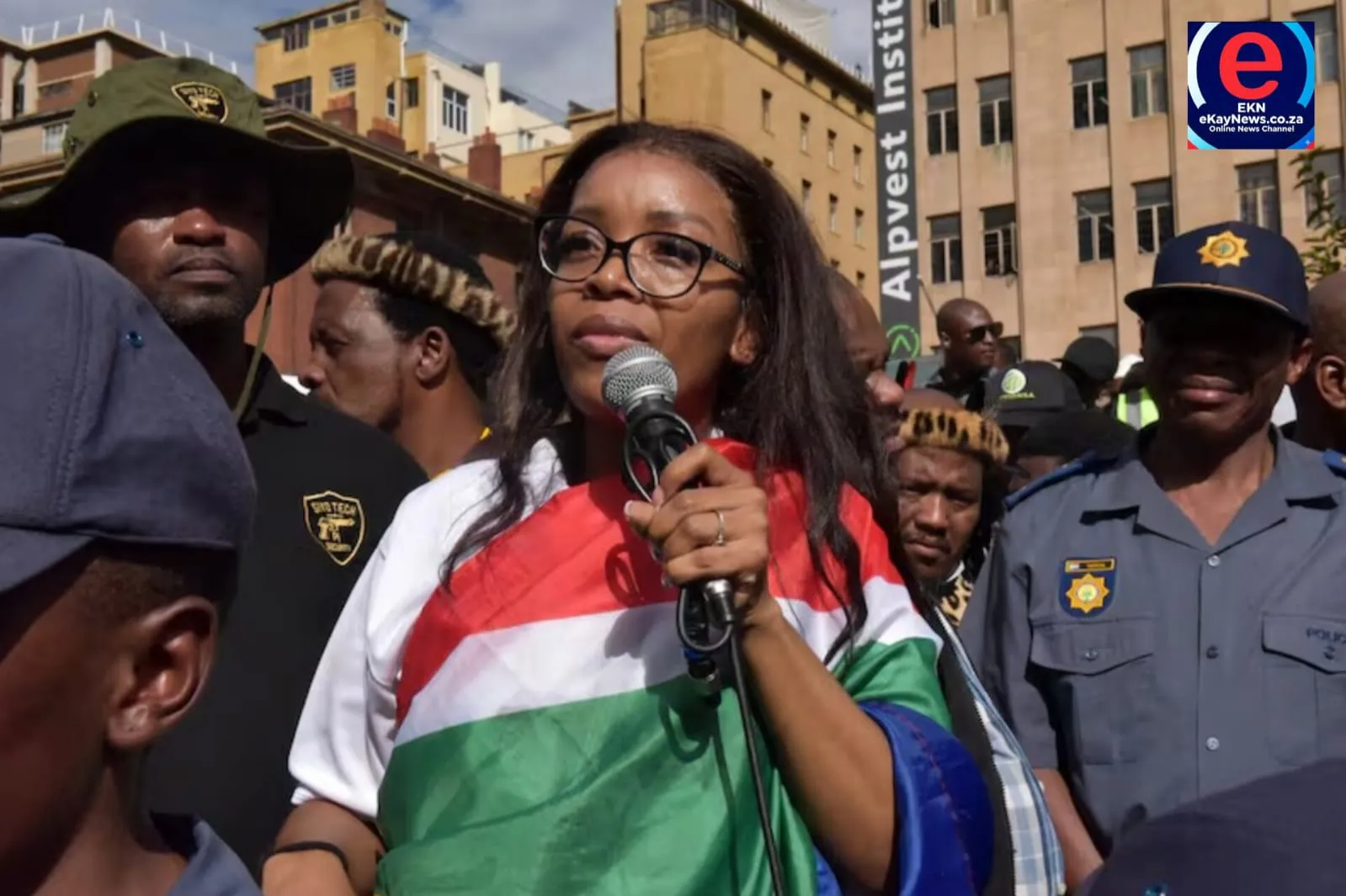
Jacinta Ngobese-Zuma backtracks on ethnic universities proposal after backlash
Ngobese-Zuma backtracks on ethnic universities proposal after facing widespread criticism over comments suggesting South Africa could establish universities organised around ethnic and linguistic communities.
The March and March movement leader has since apologised for the way her comments were expressed, saying they were misunderstood and did not accurately communicate what she intended.
The controversy has placed renewed attention on questions surrounding language, identity, education and national unity in South Africa.
It has also intensified scrutiny of Ngobese-Zuma’s political activism and the recent cooperation between the March and March movement and AfriForum.
Ngobese-Zuma apologises after university comments
During a recent demonstration in Durban, Ngobese-Zuma discussed the possibility of communities establishing universities that use their own languages.
She referred to several South African linguistic groups, including Zulu, Xhosa, Pedi, Tswana and Tsonga, and argued that there was nothing inherently wrong with communities having educational institutions that cater to their languages.
Her comments quickly attracted criticism, with opponents arguing that universities organised along ethnic lines could deepen divisions in a country still dealing with the legacy of apartheid and racial segregation.
The remarks also prompted concerns about whether such an approach could undermine efforts to build a shared South African identity.
Following the backlash, Ngobese-Zuma said she accepted responsibility for the way her comments were received.
She explained that she had not intended to suggest that South Africa should be divided into separate ethnic communities or that only one group should have its own university.
Instead, she said her intention was to highlight the possibility of institutions serving specific languages, drawing a comparison with Afrikaans institutions associated with Afrikaner communities.
March and March leader says comments were misunderstood
Ngobese-Zuma said the discussion had been distorted into a narrative that she was advocating specifically for Zulu-only universities.
She pointed out that she had referred to several linguistic communities rather than a single group.
She also described the interpretation of her remarks as propaganda and stressed that she was not advocating for South Africa to break into separate tribal or ethnic territories.
Nevertheless, she apologised for the way the message came across.
The response effectively marked a retreat from the interpretation that universities should be created as separate institutions for individual ethnic groups.
March and March movement faces growing scrutiny
The controversy comes at a sensitive time for the March and March movement.
The organisation has attracted attention through its activism around issues including community safety, crime, immigration, law enforcement and concerns about government accountability.
Ngobese-Zuma has positioned the organisation as a movement focused on what it regards as the interests and safety of South Africans.
However, its activities have also generated criticism from people who disagree with some of its positions and partnerships.
The latest dispute is particularly significant because it follows the movement’s controversial cooperation with AfriForum.
AfriForum alliance sparks criticism
The AfriForum alliance has attracted considerable attention, with critics questioning why the March and March movement would cooperate with an organisation that has historically been associated with Afrikaner interests.
March and March and AfriForum recently established a working group to cooperate on several issues.
These include community safety, education, legal matters, anti-crime initiatives and illegal immigration.
Ngobese-Zuma has defended the arrangement, arguing that the two organisations do not need to agree on every political issue to work together on areas where they share concerns.
She also rejected the suggestion that the cooperation represented a formal political alliance.
According to Ngobese-Zuma, both organisations remain independent and are not entering into an agreement that dictates national government policy.
South African ethnic tensions return to focus
The debate surrounding the ethnic universities proposal has highlighted the sensitivity of language and identity in South Africa.
The country has 12 official languages, and debates over the role of indigenous languages in education have continued for years.
Supporters of stronger indigenous-language education argue that students should have greater opportunities to learn and study in languages they understand.
Critics of the proposal raised a different concern: whether establishing institutions based on ethnic or linguistic identity could create unnecessary divisions between communities.
South Africa’s history makes the issue particularly sensitive.
During apartheid, education and other public institutions were heavily influenced by racial segregation and separate development policies.
As a result, proposals that appear to divide institutions according to identity can trigger strong political and social reactions.
Vavi warns against ethnic division
South African Federation of Trade Unions general secretary Zwelinzima Vavi was among those who criticised Ngobese-Zuma’s comments.
Vavi argued that establishing universities around specific ethnic or linguistic communities could contribute to the fragmentation of South African society.
He warned against what he described as the danger of “Balkanising” the country along ethnic and linguistic lines.
His criticism reflects a broader concern that language and cultural identity should be recognised without creating institutional structures that permanently separate communities.
Ngobese-Zuma’s subsequent apology has helped clarify her position, although the debate surrounding her comments is likely to continue.
Language and higher education debate
The controversy also raises a broader question about how South Africa can expand the use of indigenous languages in higher education without reinforcing social divisions.
Universities already use multiple languages in different contexts, while English remains dominant across much of higher education.
There have been repeated calls for greater development of African languages in universities, particularly to improve accessibility and preserve linguistic heritage.
However, creating entirely separate universities for individual linguistic communities would raise practical questions about funding, academic standards, student mobility and institutional access.
A multilingual university model could offer another approach, allowing students from different backgrounds to study together while increasing the use of indigenous languages.
The debate therefore extends beyond Ngobese-Zuma’s remarks and touches on the country’s broader education and language policies.
Ngobese-Zuma defends her political approach
Despite the criticism, Ngobese-Zuma has defended her decision to engage with groups that share some of her concerns. March and March is not a political party and is focused on practical issues rather than attempting to establish a comprehensive political programme.
She cited community safety, border management, lawfulness and crime as among the movement’s priorities. She also acknowledged that March and March and AfriForum have significant disagreements on certain issues, including land expropriation without compensation.
However, she argued that these differences do not prevent cooperation in areas where the organisations have common interests. Ngobese-Zuma also said she was prepared to step aside if her efforts did not produce results.
She encouraged people who disagreed with the movement’s decisions to express their dissatisfaction or disassociate themselves from the organisation.
YOU MAY LIKE:
What happens next?
The controversy surrounding the ethnic universities proposal is unlikely to disappear immediately.
Although Ngobese-Zuma has apologised and clarified that she does not support dividing South Africa into separate ethnic communities, the incident has raised difficult questions about language, identity and education.
For the March and March movement, the controversy comes as the organisation attempts to expand its influence and build relationships with other civil society groups.
The AfriForum alliance will likely remain under scrutiny, particularly as the two organisations work together on community safety, legal issues and other areas of shared interest.
At the same time, the debate over indigenous languages in higher education remains legitimate and important.
South Africa faces the challenge of promoting its diverse languages while ensuring that educational institutions remain inclusive and accessible to people from different backgrounds.
For now, Ngobese-Zuma’s apology represents an attempt to move the discussion away from the perception that she is calling for ethnic separation.
The controversy nevertheless demonstrates how quickly debates over language and identity can become politically charged in South Africa.
The key issue going forward will be whether calls for stronger indigenous-language education can be pursued in a way that celebrates cultural diversity without deepening the South African ethnic tensions that have shaped much of the country’s history.
References from mainstream media
- TimesLIVE – TimesLIVE – Vavi warns against ‘Balkanising’ SA
- Sowetan – Sowetan – Ngobese-Zuma backtracks on ethnic universities proposal
- News24 – News24 – Fact-checking March and March’s claims
- TimesLIVE – AfriForum and March and March collaboration
- IOL – IOL – March and March-AfriForum alliance
Support Independent Journalism with eKayNews! 📰✨

At eKayNews, we are dedicated to bringing you honest, independent, and reliable news. But we can’t do it alone—independent journalism relies on the strength and generosity of its community.
If you value our work, please consider supporting us today! You can help keep us going by choosing a subscription or simply buying us a one-off virtual coffee:
👉 Support us here: ekaynews.co.za/subscribe-form/
You can also support our mission by visiting our main site at www.ekaynews.co.za and following @eKayNews on all social media platforms.
Thank you so much for your incredible generosity and for being part of our journey! 🙏💙