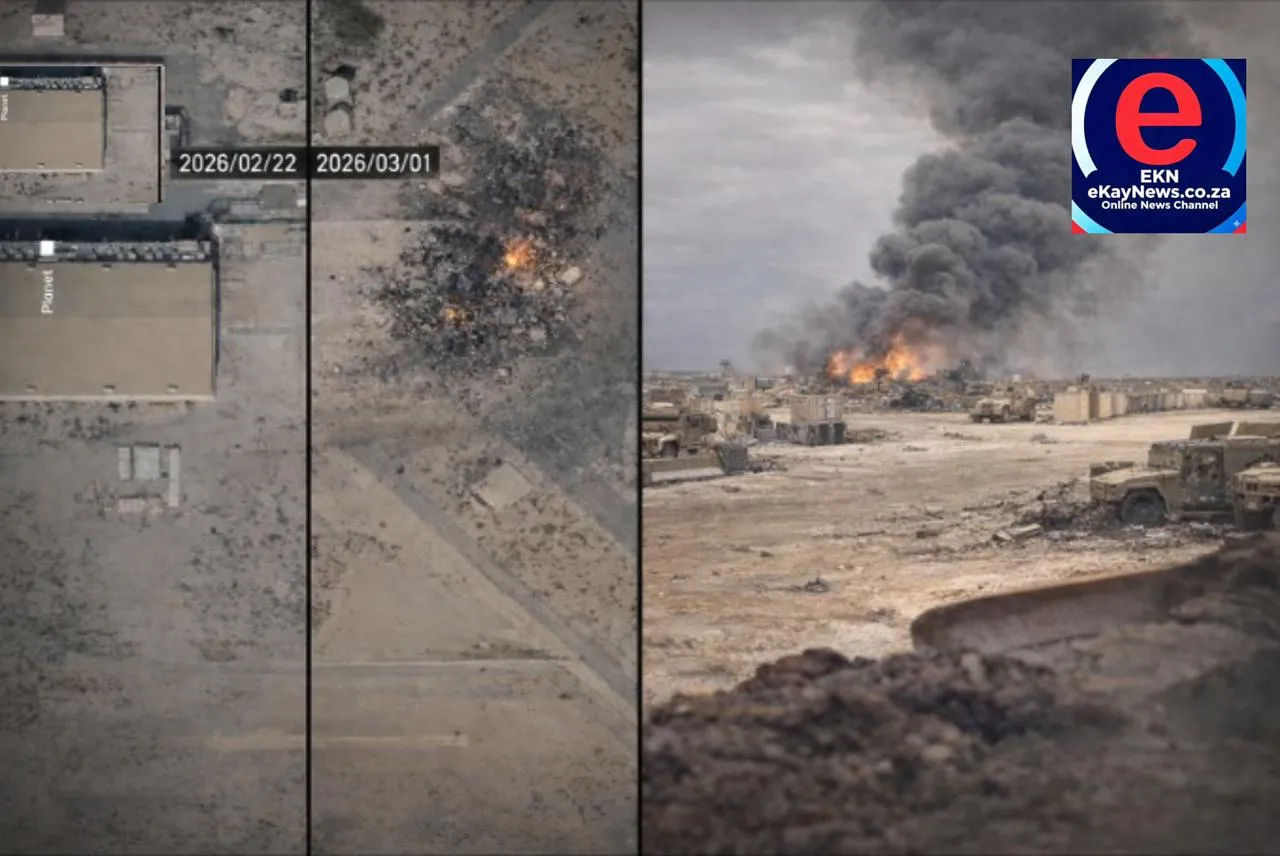
Iran destroyed 16 USA bases beyond repair: CNN Investigation
Iran destroyed 16 USA bases beyond repair in a series of strategic and devastating missile and drone strikes that have fundamentally altered the American military footprint in the Middle East. According to a bombshell CNN investigation led by Tamara Qiblawi, at least 16 American military sites—representing the majority of U.S. positions in the region—suffered significant, and in many cases, total operational failure. These strikes, which took place in the opening months of 2026, targeted high-value infrastructure, leaving the Pentagon scrambling to assess the true financial and strategic cost of a crippled defense network.
The scale of the impact has sent shockwaves through Washington. What was initially reported as “minor damage” has now been revealed through satellite imagery and whistleblower interviews as a systematic dismantling of the U.S. “security umbrella.” From radar systems to communication hubs, the damage is so extensive that it has forced a massive relocation of personnel and hardware across eight different countries.
The CNN Investigation: Mapping the Destruction
The CNN investigation utilized exclusive satellite imagery and interviews with both U.S. and Gulf officials to paint a grim picture of the current state of US military bases. The report indicates that the strikes targeted critical nodes designed to detect and intercept incoming threats, effectively “blinding” the U.S. network before the main payloads hit.
Key Targeted Locations
The strikes were not isolated to a single conflict zone but were coordinated across the following nations:
-
Kuwait: Logistics hubs and storage facilities.
-
Bahrain: Headquarters of the U.S. Fifth Fleet.
-
Saudi Arabia: Major air bases and refueling stations.
-
Jordan: Frontier outposts and THAAD missile battery sites.
-
Iraq: Tactical operations centers.
-
United Arab Emirates: Advanced radar installations.
According to the report, it is now confirmed that Iran destroyed 16 USA bases beyond repair by identifying the most “cost-effective” targets—expensive radar systems that are limited in number and take years to manufacture.
Radar and Defense Systems: The Strategic “Blind Spot”
One of the most alarming revelations from the CNN investigation is the focus on American THAAD (Terminal High Altitude Area Defense) systems. These are the crown jewels of U.S. missile defense. In Jordan and the UAE, Iranian strikes focused heavily on the radar arrays connected to these batteries. Without these eyes, the multi-billion dollar interceptors are effectively useless.
“Our radar systems are our most expensive and our most limited resources in the region,” a congressional aide told CNN. “They identified exactly where the ‘glass jaw’ of our defense was.”
Beyond the radar, the Pentagon has had to deal with the loss of specialized aircraft. Specifically, an American Boeing E-3 Sentry—a sophisticated Airborne Warning and Control System (AWACS)—was confirmed destroyed during a strike on a Saudi air base. These aircraft are essentially flying command centers, and their loss significantly degrades the ability of the US military bases to coordinate air defense over the Middle East.
The Financial Fallout: A $50 Billion Crisis
While the Pentagon has publicly stated that the war cost has reached roughly $25 billion, the CNN investigation suggests this figure is a gross understatement. This “official” number reportedly excludes the massive reconstruction expenses and the cost of replacing high-tech equipment that cannot simply be repaired.
Comparative Cost Assessment
| Category | Official Pentagon Estimate | CNN/Source Real-World Estimate |
| Initial War Operations | $25 Billion | $25 Billion |
| Infrastructure Reconstruction | Not Included | $15 – $20 Billion |
| High-Tech Equipment Replacement | Not Included | $5 – $10 Billion |
| Total Estimated Cost | $25 Billion | $45 – $55 Billion |
Acting Pentagon comptroller Jules Hurst III acknowledged during budget briefings that the department still lacks a “final number” for the damage. However, sources familiar with the matter suggest that the true cost of reconstituting the facilities where Iran destroyed 16 USA bases beyond repair could easily reach $50 billion. To put this in perspective, the repairs to the headquarters of the U.S. Fifth Fleet in Bahrain alone are estimated to cost $200 million.
Operational Consequences: From Bases to Hotels
The physical destruction has led to unprecedented operational shifts. Because Iran destroyed 16 USA bases beyond repair, thousands of U.S. service members have been displaced. Reports indicate that in several countries, personnel have been moved out of military installations and into civilian hotels and office spaces.
This shift creates a “liability” scenario. Moving troops into civilian areas:
-
Increases Vulnerability: Civilian hotels lack the reinforced “T-walls” and bunkers of a standard military base.
-
Complicates Logistics: Coordinating a military response from a Marriott or a Hilton is a nightmare for secure communications.
-
Local Tension: The presence of U.S. troops in civilian hubs has caused friction with local populations, who fear they will become “collateral damage” in future strikes.
The US military bases in the Middle East are no longer the fortresses they once were. The CNN investigation asks the hard question: Is the U.S. presence in the region now a benefit, or has it become a liability?
The Pentagon’s Silence and the “Reconstitution” Plan
During recent congressional hearings, Defense Secretary Pete Hegseth was pressed on whether the official cost estimates included the “reconstitution” of these bases. Hegseth declined to provide specific figures, citing ongoing evaluations. This lack of transparency has frustrated lawmakers, especially as the Pentagon requests an additional $200 billion in military funding connected to the wider conflict.
The reality that Iran destroyed 16 USA bases beyond repair means that “repairing” is not an option. These sites must be completely rebuilt from the ground up, likely with new defensive architectures designed to counter the drone swarms and precision missiles that bypassed current U.S. defenses.
Global Economic Impact: $8 Gas and Inflation
The destruction of these bases is not just a military story; it is an economic one. The instability caused by the strikes, combined with the ongoing blockade of the Strait of Hormuz, has sent energy prices spiraling.
In parts of the United States, gasoline prices have exceeded $8 per gallon. The Middle East conflict has disrupted the flow of oil so severely that inflation concerns have reached a fever pitch. The US military bases that were meant to protect these shipping lanes are now struggling to protect themselves.
Why this matters to you:
-
Supply Chain Disruptions: Damaged communications hubs mean slower response times to piracy or ship seizures.
-
Inflation: Higher military spending ($50B+) often leads to increased national debt and economic pressure on taxpayers.
-
Security: If the U.S. cannot protect its own bases, the “security umbrella” for global trade is effectively gone.
YOU MAY LIKE:
Conclusion: A New Reality in the Middle East
The headline that Iran destroyed 16 USA bases beyond repair is a turning point in modern history. The CNN investigation has pulled back the curtain on a Pentagon that is struggling to maintain its footprint in a region that has become increasingly hostile and technologically capable.
As we move through May 2026, the question is no longer about “winning” or “losing” the initial skirmish, but whether the United States can afford to rebuild what has been lost. With the true cost approaching $50 billion and 16 critical sites lying in ruins, the strategic map of the Middle East has been redrawn.
References
- CNN – Investigation into damage at US military bases in the Middle East
- Reuters – US military operations and regional escalation involving Iran
Kindly consider to support eKayNews, Buy Us a Coffee & Keep the News Flowing!

Love what we do? You can now support eKayNews directly! Your contributions empower us to deliver the breaking news, sports, and local updates you trust.
Ways to Support:
-
Subscribe: Choose any amount (cancel anytime).
-
Virtual Coffee: A quick, once-off donation to say thanks.
Note: Payments are 100% secure via PayFast. We never see your banking details.
To our amazing readers: Your support fills us with gratitude. You are the reason we can keep doing this every day. Thank you for being a vital part of the eKayNews family!
We’re feeling the love at eKayNews!

Facebook: [eKayNews on Facebook] X (Twitter): [eKayNews on X] WhatsApp: [Follow the eKayNews WhatsApp Channel] Join our inner circle for real-time news alerts!
📢 Advertising Packages on www.eKayNews.co.za
Package 1. Link Booster: We add 7 links to 7 articles over 7 days – R2,500
Package 2. Permanent Feature: Sponsored Blog Article (hosted permanently) – R4,000
Package 3. Prime Visibility: Home Page Banner Ad (30 days) – R5,000
Book now: Email info@ekaynews.co.za or WhatsApp us on +27710961185