NSFAS paid 822 dead students: audit finds deep failures
NSFAS paid 822 dead students: audit finds deep failures, exposing one of the most serious breakdowns in public fund management in South Africa’s higher education sector. The shocking findings, revealed in a damning audit by the Auditor-General of South Africa, have sparked national outrage and renewed scrutiny over how billions in student funding are administered.
At the centre of the controversy is the National Student Financial Aid Scheme (NSFAS), a critical institution designed to support students from poor and working-class backgrounds. Instead of fulfilling its mandate efficiently, the scheme is now accused of systemic failures, weak oversight, and alarming lapses in accountability.
Audit exposes shocking failures
The revelation that NSFAS paid 822 dead students: audit finds deep failures is perhaps the most disturbing outcome of the 2024/25 audit. According to the Auditor-General, these payments continued long after beneficiaries had been officially recorded as deceased by the Department of Home Affairs South Africa.
This failure highlights a severe breakdown in data integration and verification systems. In a properly functioning system, beneficiary records should automatically update when linked databases—such as Home Affairs—flag a death. The fact that this did not occur suggests deep-rooted issues in NSFAS’s IT infrastructure and governance.
The Auditor-General’s findings did not stop there. The report painted a broader picture of dysfunction, indicating that the problem extends far beyond a single administrative oversight.
Financial irregularities raise serious concerns
Beyond the headline issue, the audit uncovered widespread financial mismanagement. Thousands of beneficiaries were found to be receiving funding despite clearly exceeding the income eligibility threshold.
Key findings include:
- Over 14,000 students funded despite exceeding income limits
- 822 deceased beneficiaries still receiving payments
- 321 students receiving both NSFAS funding and the Social Relief of Distress Grant simultaneously
These irregularities suggest that NSFAS lacks the ability to effectively cross-check data across government systems such as SARS and social grant databases.
The issue of “double-dipping” is particularly concerning. It indicates that multiple state support systems are operating in silos, without adequate communication or safeguards to prevent abuse.
Systemic governance and compliance failures
The crisis goes deeper than financial misallocation. The Auditor-General identified widespread non-compliance with NSFAS policies, particularly in academic progression and eligibility criteria.
Thousands of students who:
- Already held qualifications
- Failed to meet academic progression requirements
- Exceeded the N+ rule (maximum study duration)
were still funded.
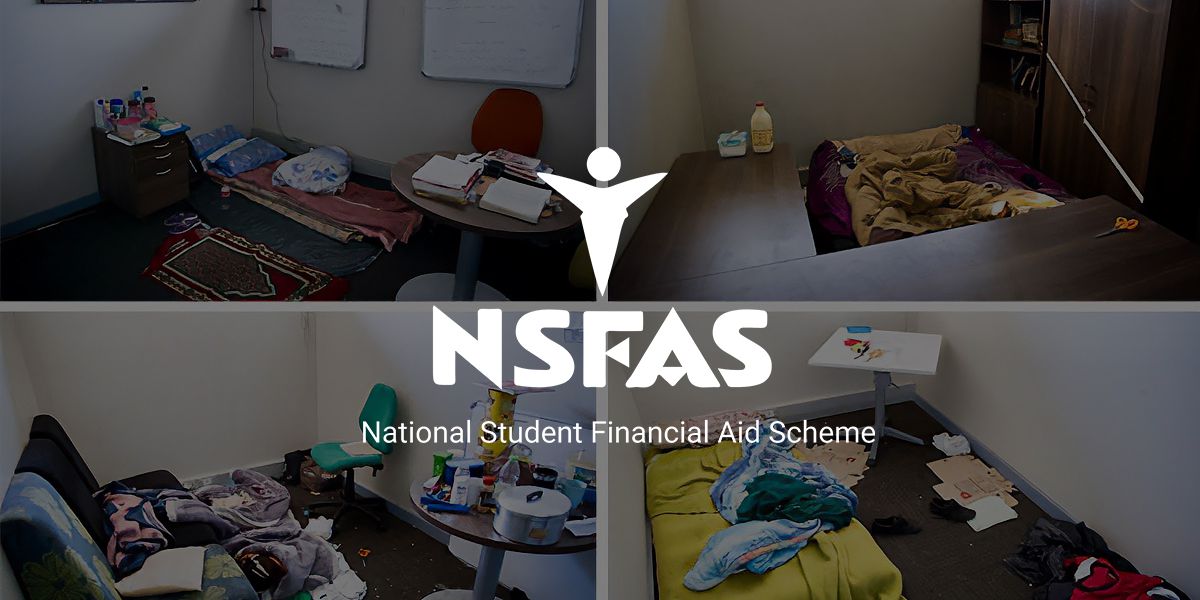
Additionally, the report exposed severe issues in student accommodation funded through NSFAS. Investigations revealed so-called “ghost beds,” where landlords claimed funding for accommodation that either did not exist or was grossly overcrowded.
In some cases, students were found living in unsafe and substandard conditions, raising serious concerns about their well-being and academic performance.
Disclaimer of opinion: the worst audit outcome
As a result of these extensive failures, NSFAS received a “disclaimer of opinion” from the Auditor-General—the most severe audit outcome possible.
A disclaimer of opinion means auditors could not obtain sufficient evidence to verify financial statements. In simple terms, the records were so unreliable that the financial position of NSFAS could not be confirmed.
This outcome places NSFAS in a critical position, alongside other struggling state institutions that have failed to maintain proper financial controls.
In response, Higher Education Minister Buti Manamela issued a directive for urgent intervention, including forensic investigations and collaboration with the Special Investigating Unit (SIU).
How NSFAS is supposed to work
NSFAS plays a vital role in South Africa’s education system by providing funding for tuition, accommodation, and living expenses for qualifying students.
Basic eligibility requirements include:
- South African citizenship or permanent residency
- Household income below R350,000 per year (R600,000 for students with disabilities)
- Enrollment at a public university or TVET college
- Meeting academic progression requirements
The system relies heavily on data verification through multiple institutions, including:
- Department of Home Affairs South Africa
- South African Revenue Service
- Higher Education Information Management System (HEMIS)
However, the audit findings show that these verification processes are either failing or not being implemented effectively.
Impact on students and families
While the headline NSFAS paid 822 dead students: audit finds deep failures highlights financial mismanagement, the real impact is felt by thousands of students who depend on this funding.
Delays in verification and payment have left many students without:
- Food allowances
- Transport money
- Accommodation payments
For students from disadvantaged backgrounds, these delays can mean the difference between continuing their studies and dropping out.
Families who rely on NSFAS support are also affected, as financial uncertainty disrupts long-term educational planning.
Verification delays and system inefficiencies
The NSFAS system relies on complex data matching processes. Applications are verified against multiple databases, which can lead to delays if systems are outdated or poorly integrated.
Many students report their application status being stuck on:
- “Filtering”
- “Evaluation”
for extended periods, sometimes months beyond the expected six-week processing timeline.
These delays are often caused by:
- High application volumes
- Legacy IT systems
- Poor interdepartmental coordination
Ironically, while stricter verification is needed to prevent fraud, inefficiencies in the system are harming legitimate applicants.
Calls for urgent reform
The revelation that NSFAS paid 822 dead students: audit finds deep failures has intensified calls for reform across the higher education sector.
Experts and stakeholders are calling for:
- Full digital integration between government databases
- Stronger internal controls and oversight
- Regular audits and real-time monitoring
- Accountability for officials responsible for failures
There is also growing pressure to modernise NSFAS’s IT infrastructure to prevent similar issues in the future.
The future of NSFAS
Despite its challenges, NSFAS remains a critical tool for expanding access to higher education in South Africa. Millions of students have benefited from the scheme, and its importance cannot be overstated.
However, the latest audit findings highlight a crucial truth: without proper governance and accountability, even well-intentioned programmes can fail.
Rebuilding trust in NSFAS will require decisive action, transparency, and a commitment to reform.
YOU MAY LIKE:
609,403 students approved but why some NSFAS applicants are still waiting
Final thoughts
NSFAS paid 822 dead students: audit finds deep failures is more than just a headline—it is a wake-up call for South Africa. The audit has exposed deep flaws in how public funds are managed, raising serious questions about accountability and efficiency.
For students, families, and taxpayers, the stakes are incredibly high. Ensuring that financial aid reaches those who truly need it is essential for the future of education and economic development in the country.
As investigations continue and reforms are implemented, the hope is that NSFAS can emerge stronger, more transparent, and better equipped to fulfil its mission.
References (Mainstream Media)
- News24
NSFAS audit failures and AG findings: https://www.news24.com/ - TimesLIVE
Coverage on NSFAS irregularities and student funding issues: https://www.timeslive.co.za/
Keep the Headlines Fresh!

Quality news takes time, effort, and a whole lot of coffee. If you value what we do at eKayNews, consider “buying a round” for the team!
-
Join the Inner Circle: Set up a custom subscription.
-
The Instant Jolt: Send a one-time “coffee” donation.
Why trust us? We use PayFast for 100% secure, encrypted transactions. Your data stays yours; the news stays ours.
To our amazing readers: You’re the reason we’re first on the scene. Thanks for being part of the family!
Feel the Pulse of the News with eKayNews!

Join the ever-growing eKayNews community and stay connected to the stories that matter. Follow us on Facebook, X, and WhatsApp for real-time updates, breaking news, and exclusive alerts straight to your feed. Your support keeps us digging deeper and sharing the news you can trust.
Stay Connected:
-
Facebook: [eKayNews on Facebook]
-
X (Twitter): [eKayNews on X]
-
WhatsApp: [Join the eKayNews WhatsApp Channel]
Become part of our inner circle and get instant news alerts as events unfold across South Africa and beyond!
Promote Your Brand with eKayNews
Looking to reach a wide, engaged audience? Explore our advertising packages:
-
Link Booster: 7 links to 7 articles over 7 days – R2,500
-
Permanent Feature: Sponsored blog article hosted permanently – R4,000
-
Prime Visibility: Home page banner ad for 30 days – R5,000
Don’t miss your chance to connect with our audience. Book your package today via email at info@ekaynews.co.za or WhatsApp us on +27710961185.
Be part of a platform where news meets community—stay informed, stay ahead, stay with eKayNews!