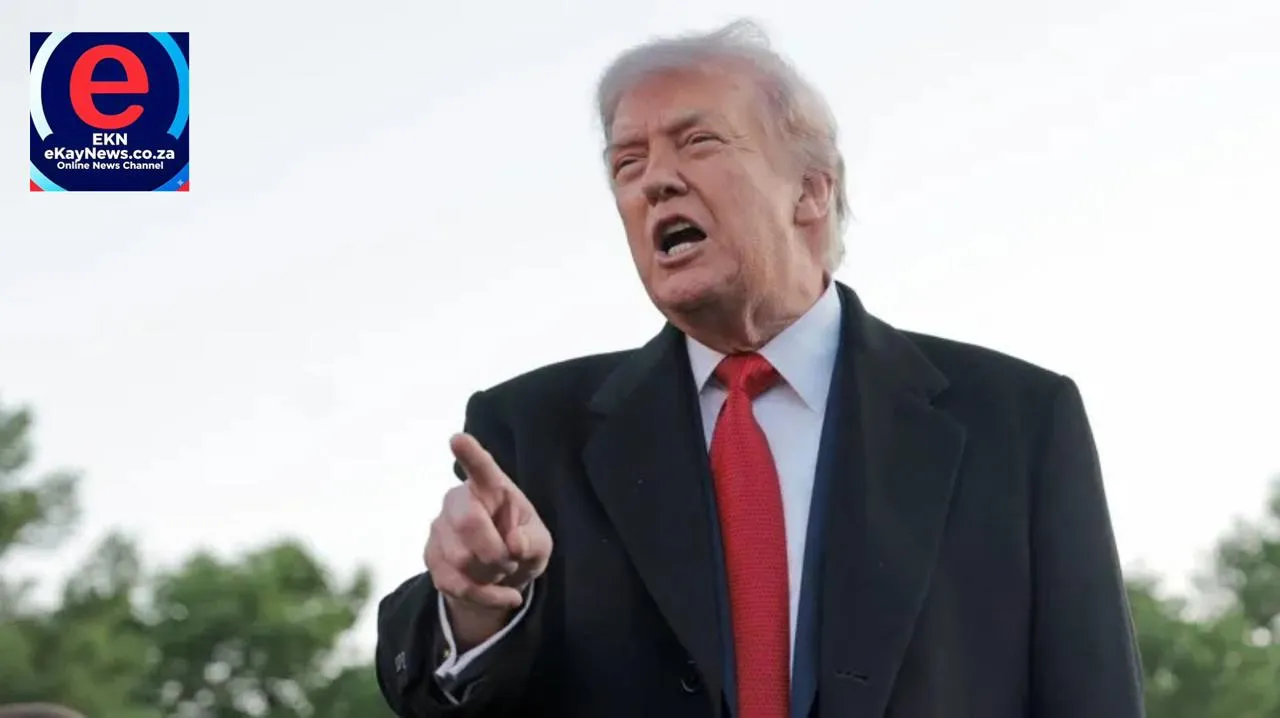
Trump says US-Iran ceasefire still in place after exchange of fire in Strait of Hormuz
Trump says US-Iran ceasefire still in place after exchange of fire in Strait of Hormuz, a statement that comes as a cold comfort to global markets and maritime insurers watching the Persian Gulf bleed. Despite a violent escalation on Thursday that saw U.S. Navy destroyers engaging Iranian drones and missiles in a high-stakes naval clash, the White House is doubling down on the narrative that the diplomatic “skirmish” has not yet devolved back into a full-scale war.
The incident, which both Washington and Tehran are currently using as a springboard for mutual recrimination, represents the most significant threat to the April 8 ceasefire since its inception. While Donald Trump utilizes his social media platform to describe the destruction of Iranian vessels in poetic—if somewhat macabre—terms, the reality on the water suggests that the path to a 14-point peace deal is paved with high-explosive ordnance.
The Battle in the Strait: Drones, Missiles, and “Butterflies”
The naval clash began as U.S. Navy guided-missile destroyers were transiting the vital waterway. According to U.S. Central Command (CENTCOM), Iranian forces launched an “unprovoked attack” featuring a multi-vector swarm of missiles, suicide drones, and fast-attack small boats. The US military response was, by all accounts, clinical. CENTCOM reported that it “eliminated inbound threats” and successfully targeted the Iranian facilities responsible for the launch, including command and control nodes and intelligence centers.
Donald Trump took to Truth Social to offer his own unique assessment of the military engagement. In a post that quickly went viral, he described the sinking of Iranian fast-attack craft with a startling bit of prose:
“The U.S. Navy is the best in the world! We destroyed multiple boats today that dropped ever so beautifully down to the Ocean, very much like a butterfly dropping to its grave! Great damage was done to the Iranian attackers. They trifled with us, and they lost!”
While the President’s “butterfly” analogy raised eyebrows among diplomatic circles, his follows-up was far more traditional. He reiterated that Trump says US-Iran ceasefire still in place after exchange of fire in Strait of Hormuz, but warned that if a final agreement isn’t signed “FAST,” the subsequent bombing campaign would be “violently” more intense than the initial “Operation Epic Fury.”
The Iranian Counter-Narrative: Aerial Attacks and Sovereignty
Across the water, the view from Tehran is radically different. Iran’s top military command did not describe the event as an unprovoked swarm but as a necessary defense of their maritime borders. They alleged that the US military had targeted an Iranian oil tanker and another vessel as they approached the Strait of Hormuz.
Furthermore, Iranian state media reported “aerial attacks” striking coastal areas, specifically naming Bandar Khamir, Sirik, and Qeshm Island. Tehran claimed that its forces responded “immediately” to these violations, inflicting “significant damage” on American vessels. For the Iranian leadership, this was not a “trifle”—it was a blatant “violation of the ceasefire” by Washington.
The local impact in Iran was felt beyond the coast. Explosions were reportedly heard as far inland as Tehran, sparking panic among a civilian population already cynical about the prospects of a lasting peace deal. As the US and Iran trade fire, the distance between a “skirmish” and a total regional conflagration seems to be shrinking by the hour.
The Fragility of the April 8 Ceasefire
The ceasefire that went into effect on April 8 was designed to pause the “Operation Epic Fury” offensive, which had seen weeks of U.S. and Israeli strikes on Iranian infrastructure. Secretary of State Marco Rubio had previously declared the operation a success, suggesting the “active phase” of the war was over. However, the events of this week prove that “over” is a relative term in Middle Eastern geopolitics.
A further sign of the fragility of the truce came early on Friday when the United Arab Emirates’ Ministry of Defence confirmed that its air defenses were “actively engaging” with a missile and drone attack originating from Iran. This suggests that the conflict is once again threatening to spill over into neighboring Gulf states, potentially drawing the UAE and Saudi Arabia back into the direct line of fire.
The 14-Point Memorandum: A “Wish List” or a Framework?
The timing of this naval clash is particularly frustrating for mediators. Just a day prior to the exchange of fire, hopes were soaring that a 14-point memorandum of understanding was within reach. This framework, reportedly brokered through Pakistani mediators, was intended to set the stage for detailed nuclear negotiations and a permanent end to the blockade of the Strait of Hormuz.
However, the internal politics of Iran continue to stymie progress. Ebrahim Rezaei, the spokesperson for the Iranian parliament’s national security and foreign policy commission, took to X to dismiss the U.S. proposal. He labeled the 14 points as a “wish list” rather than a serious diplomatic document.
“Iran has its finger on the trigger,” Rezaei warned, insisting that Tehran would only sign a deal if the U.S. “surrendered” and granted all “necessary conditions,” which presumably include the total lifting of all economic sanctions and the withdrawal of the US military from the region.
Donald Trump and the “Nuclear Sticking Point”
A recurring theme in the President’s rhetoric is the claim that Iran has already agreed to “never have a nuclear weapon.” While Donald Trump has mentioned this several times, Tehran has yet to confirm such a concession. The nuclear program remains the ultimate sticking point.
The White House, via Axios, believes it is closing in on a deal that would remove enriched uranium from Iranian soil. Yet, as Trump says US-Iran ceasefire still in place after exchange of fire in Strait of Hormuz, the actual “ground truth” of the nuclear negotiations remains murky. If the U.S. believes it has a deal and Iran believes it is only looking at a “wish list,” the potential for a catastrophic misunderstanding is at an all-time high.
The Maritime Crisis: 1,500 Ships and 20,000 Crew Trapped
While the world focuses on the missiles and the social media posts, a massive human and economic crisis is unfolding in the Gulf. Following the start of the war on February 28, the Strait of Hormuz has been effectively closed to normal commercial traffic.
According to Arsenio Dominguez, the secretary-general of the UN’s International Maritime Organization, there are currently around 1,500 ships and 20,000 international crew members trapped in the region. These sailors are caught in a literal and figurative crossfire. With the US and Iran trading fire, the risk of these ships being hit by “collateral” missiles or drones is a constant threat.
The economic toll is being felt at gas stations and in grocery stores across the globe. For nations like South Africa, the instability in the Gulf translates directly to higher fuel prices and shipping surcharges. The “Freedom” promised by the Trump administration’s short-lived operation earlier this week remains elusive for these 20,000 mariners.
Israel’s Strategic Silence
Interestingly, an Israeli source told the BBC that there was “no Israeli involvement” in the latest attacks in the Strait of Hormuz. This strategic silence suggests that Israel is content to let the US military handle the maritime escort and deterrence mission for now.
However, given that “Operation Epic Fury” was a joint U.S.-Israeli endeavor, any breakdown in the ceasefire would almost certainly see the Israeli Air Force returning to the skies over Iran. Prime Minister Benjamin Netanyahu’s office has remained in close contact with the White House, ensuring that any 14-point deal aligns with Israel’s security requirements regarding Iranian proxies and nuclear enrichment.
The Role of Pakistani Mediators
Pakistan’s Foreign Minister has been working overtime to convert the current truce into a “permanent end to this war.” Islamabad has a unique position as a mediator that maintains functional relationships with both Washington and Tehran.
The fact that Trump says US-Iran ceasefire still in place after exchange of fire in Strait of Hormuz is, in part, a testament to the cooling effect of Pakistani diplomacy. By providing a neutral channel for the exchange of proposals, Pakistan is preventing the “butterfly” rhetoric from turning into a direct, face-to-face military ultimatum.
YOU MAY LIKE:
Conclusion: A Ceasefire in Name Only?
As we look at the map of the Gulf today, the red dots marking major ports like Kharg Island and Bandar Abbas represent more than just shipping hubs; they are potential flashpoints in a war that won’t quite quit. Donald Trump may insist the ceasefire holds, but a truce that includes drone swarms, “butterfly” ship-sinkings, and coastal aerial attacks is a truce in name only.
The next 48 hours will be critical. If Tehran delivers its response to the 14-point plan through Pakistan, we may see a genuine de-escalation. If, however, the “finger on the trigger” rhetoric from the Iranian parliament translates into another “unprovoked attack” on U.S. destroyers, the “skirmish” will end, and the high-intensity bombing promised by the President will begin.
For the 20,000 crew members trapped in the Strait of Hormuz, and for a global economy teetering on the edge of an energy crisis, the hope is that diplomacy can finally move faster than a missile. But in the words of the President, “we’ll see what happens.”