Trump warns Iran ‘time is running out’ for nuclear deal as US military builds up in Gulf
Trump warns Iran ‘time is running out’ for nuclear deal as US military builds up in Gulf, escalating already rising US–Iran tensions and sparking global concern over the possibility of another major Middle East conflict.
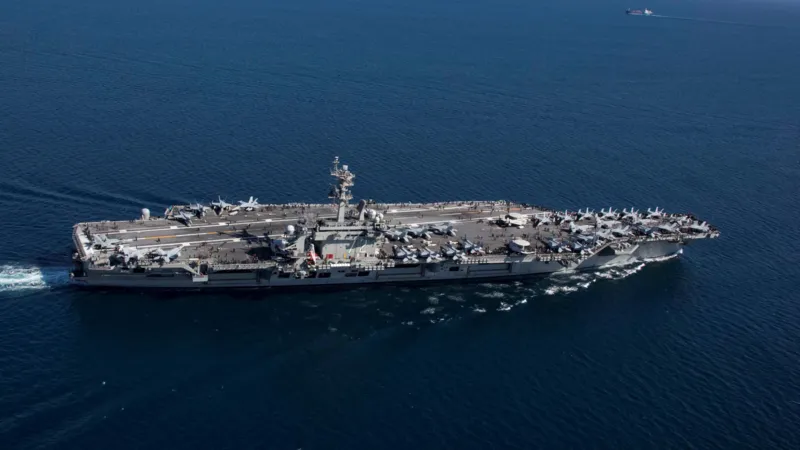
Former US President Donald Trump has issued a stark warning to Iran, saying the country has limited time left to negotiate a nuclear agreement, as the United States rapidly expands its military presence in the Persian Gulf. The warning comes amid reports of a growing naval and aerial deployment led by the USS Abraham Lincoln aircraft carrier, signalling Washington’s readiness to respond militarily if diplomacy fails.
Trump Iran nuclear deal warning escalates pressure
Trump’s latest remarks underline a renewed Trump Iran nuclear deal warning, with the former president framing negotiations as Iran’s final opportunity to avoid confrontation. Writing on his Truth Social platform, Trump said a “massive armada” was moving toward the region “with great power, enthusiasm, and purpose,” reinforcing the seriousness of the US position.
He reiterated that any future agreement must result in “NO NUCLEAR WEAPONS,” while warning that military consequences would be far more severe than past strikes if Iran continued uranium enrichment. Trump also referenced previous US military actions against Iranian nuclear facilities, stating that the “next attack will be far worse” should Tehran ignore American demands.
The warning follows weeks of instability inside Iran, where widespread protests erupted after a sharp decline in the national currency. What began as economic unrest has evolved into a broader political crisis challenging the country’s clerical leadership.
US military buildup in the Gulf intensifies
The US military buildup in the Gulf has been confirmed through satellite imagery and open-source intelligence reviewed by international observers. At the centre of the deployment is the USS Abraham Lincoln naval armada, accompanied by guided missile destroyers, combat ships, and dozens of military aircraft.
According to defence analysts, at least 15 fighter jets have recently arrived at Jordan’s Muwaffaq Air Base, while additional aircraft have been deployed to bases in Qatar, Bahrain, and Diego Garcia in the Indian Ocean. Surveillance drones and P-8 Poseidon spy planes have also been spotted operating near Iranian airspace.
A US defence official confirmed that the Abraham Lincoln carrier strike group is now operating in the Middle East, marking one of the most significant US naval surges in the region in recent years. Analysts say the build-up is designed both as a deterrent and as preparation for rapid military action if necessary.
USS Abraham Lincoln naval armada signals deterrence
The arrival of the USS Abraham Lincoln naval armada sends a clear strategic message. Aircraft carriers are among the most powerful symbols of US military strength, capable of launching sustained air operations without relying on regional bases.
Security experts note that the deployment mirrors previous moments of crisis between Washington and Tehran, where military pressure was used to force diplomatic concessions. The presence of refuelling aircraft, cargo planes, and troop transport systems suggests readiness for extended operations rather than a symbolic show of force.
Iran responds with defiance and warnings
Iran’s Foreign Minister Abbas Araghchi responded sharply to Trump’s comments, saying Iran’s armed forces were ready “with their fingers on the trigger” to respond immediately to any act of aggression by land or sea.
Tehran continues to insist that its nuclear programme is strictly peaceful and that it has never sought to develop nuclear weapons. Iranian officials argue that US sanctions and threats violate international law and undermine diplomatic trust.
Iran’s parliamentary speaker, Mohammad Bagher Ghalibaf, stated that Tehran is open to negotiations, but only if talks are conducted on “equal footing” and without coercion. He warned that while the US may be capable of starting a war, it may not be able to control how such a conflict ends.
Rising US–Iran tensions and human rights concerns
The rising US–Iran tensions are unfolding alongside disturbing reports of human rights abuses inside Iran. According to the US-based Human Rights Activists News Agency (HRANA), more than 6,300 people have reportedly been killed since protests began late last year, with thousands more deaths under investigation.
Another group, Iran Human Rights, based in Norway, has warned that the final death toll could exceed 25,000. These reports have intensified calls from Western governments for accountability and reform, further straining diplomatic relations.
US Secretary of State Marco Rubio told lawmakers that Iran’s leadership is weaker than ever, citing economic collapse and growing public dissent. He said the US military posture in the region is intended to protect American personnel and allies from potential Iranian retaliation.
Nuclear deal history and stalled negotiations
Under the 2015 nuclear agreement, Iran agreed to strict limits on uranium enrichment and international inspections in exchange for sanctions relief. However, Trump withdrew the US from the deal in 2018, arguing it failed to prevent Iran from eventually acquiring nuclear weapons.
Since then, Iran has progressively breached enrichment limits, increasing international alarm. US officials now demand that any new agreement include restrictions on Iran’s missile programme and its support for regional proxy groups.
Iran’s Deputy Foreign Minister Kazem Gharibabadi confirmed that no formal negotiations are currently under way, despite indirect exchanges of messages between the two countries.
YOU MAY LIKE:
“Trump talks too much, he’ll have his response on the battlefield”, IRGC Aerospace Force Commander
Conclusion: A critical moment for diplomacy
As Trump warns Iran time is running out for nuclear deal as US military builds up in Gulf, the situation appears to be approaching a decisive moment. The growing US military presence, combined with Iran’s defiant stance, has heightened fears of miscalculation and conflict.
Whether diplomacy can prevail over confrontation remains uncertain. What is clear is that the coming weeks may shape the future of Middle East security, global energy markets, and international nuclear non-proliferation efforts.
For now, the world watches closely as the clock ticks down.