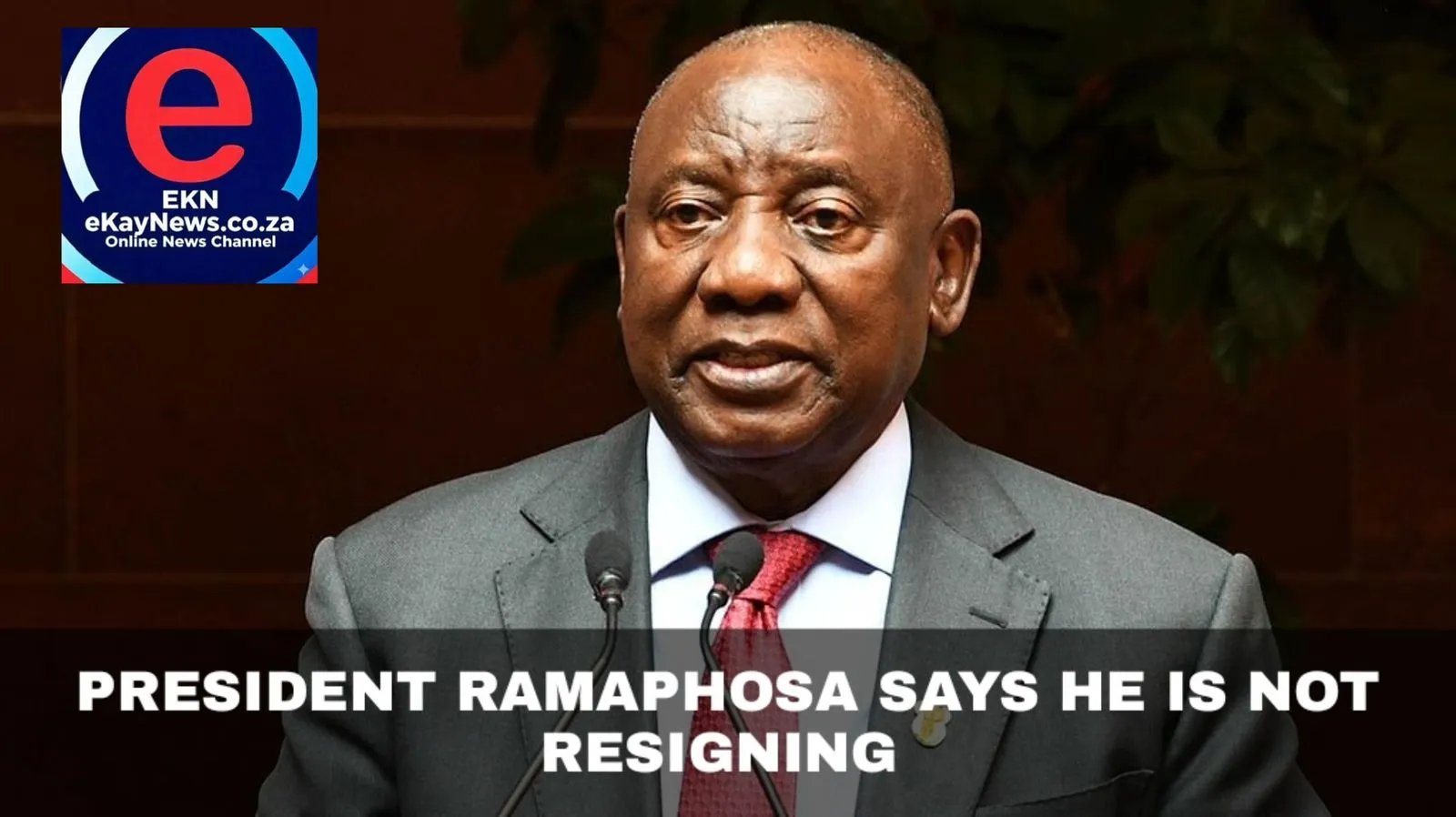
President Cyril Ramaphosa says he will not resign
President Cyril Ramaphosa says he will not resign, putting an end to days of feverish speculation that has gripped South Africa following a seismic judicial blow. In a somber yet defiant national address on Monday night, 11 May 2026, the President made it clear that he intends to finish his term, despite a scathing Constitutional Court ruling that revived the ghost of the Phala Phala scandal. Addressing the nation from the Union Buildings, Ramaphosa asserted that “nothing in the Constitutional Court judgment compels me to resign my office,” setting the stage for a protracted legal and political battle.
The President’s address follows a weekend of high-level meetings within the African National Congress (ANC) and intense pressure from opposition parties like the EFF and ATM. The core of the crisis lies in the Section 89 report, a document authored by a panel chaired by former Chief Justice Sandile Ngcobo, which found prima facie evidence that the President may have violated his oath of office. While the President previously relied on a parliamentary majority to bury the report in 2022, the apex court has now ruled that move unlawful, forcing the National Assembly to look the scandal in the eye once again.
The Landmark Constitutional Court Judgment and its Fallout
The current crisis was ignited on Friday, 8 May 2026, when the Constitutional Court delivered a unanimous judgment that effectively hit the “reset” button on the impeachment process. The court found that Parliament acted irrationally and unlawfully in December 2022 when it used its ANC majority to vote down the Section 89 report instead of referring it to an impeachment committee.
This legal victory for the EFF and the African Transformation Movement (ATM) has significant implications:
-
Invalidation of the 2022 Vote: The court ruled that the National Assembly failed in its constitutional duty to hold the executive accountable.
-
Mandatory Inquiry: The court ordered that the Section 89 report be referred immediately to a formal impeachment committee.
-
Rule of Law: The judgment reinforces the principle that a political majority cannot be used as a shield against constitutional scrutiny.
During his address, President Cyril Ramaphosa says he will not resign because the court made no findings regarding the actual merits of his conduct. He argued that the court focused on parliamentary process rather than his guilt or innocence. However, for the South African public, the optics of the “sofa-cash” saga remaining unresolved for four years have become a point of significant frustration.
Defending the Sofa: Inside the Phala Phala Scandal
To understand why President Cyril Ramaphosa says he will not resign, one must revisit the bizarre details of the Phala Phala scandal. The incident dates back to February 2020, though it only became public in 2022 when former spy chief Arthur Fraser laid criminal charges.
The allegations were straight out of a spy thriller:
-
The Theft: Approximately $580,000 in foreign currency was stolen from the President’s private game farm in Limpopo.
-
The Hiding Place: The money was reportedly stashed inside the cushions of a sofa in a spare bedroom.
-
The “Buffalo Narrative”: Ramaphosa maintains the money was the proceeds of a legitimate sale of buffalo to a Sudanese businessman, Mustafa Mohamed Ibrahim Hazim.
-
The Cover-up Allegations: Critics allege the theft was not properly reported to the police and that suspects were kidnapped and bribed to keep quiet.
While the President has consistently maintained that he has “not stolen public money” and has “not committed any crime,” the Section 89 report raised red flags about the source of the currency and the potential conflict of interest between his private business and his public office.
Key Findings of the Section 89 Independent Panel
| Issue | Panel Finding | President’s Defense |
| Prima Facie Evidence | The President may have committed a serious violation of the Constitution. | The report is based on “hearsay” and “flawed reasoning.” |
| Foreign Currency | Questions regarding the legality of holding large sums of US Dollars. | Proceeds from a legitimate cattle/game auction. |
| Misconduct | Potential conflict of interest and misuse of the Presidential Protection Unit. | Cooperated with all mandated institutions and acted within the law. |
Challenging the Section 89 Report: A Legal Review Strategy
A central theme of the Monday night address was the President’s intent to take the Section 89 report on a “full legal review.” President Cyril Ramaphosa says he will not resign because he believes the findings of the Sandile Ngcobo-led panel are legally unsustainable. He described the report as “flawed” and claimed it relied heavily on hearsay evidence without providing him a fair opportunity to cross-examine his accusers.
“I have therefore decided to proceed to take the independent panel’s report on review on an expeditious basis,” Ramaphosa told the nation. His legal team intends to argue that the panel exceeded its mandate and reached conclusions that were not supported by the evidence provided.
This legal maneuver serves two purposes:
-
Delay: A judicial review can take months, if not a year, to resolve in the courts.
-
Due Process: It allows the President to maintain the narrative that he is a victim of a flawed process rather than a perpetrator of misconduct.
Experts suggest that this legal review could run in parallel with the work of the newly revived impeachment committee. However, the President’s critics see this as a “Stalingrad defense”—a tactic of using every possible legal avenue to delay the inevitable.
The Role of the Impeachment Committee and Speaker Thoko Didiza
With the Constitutional Court ruling now active, the focus shifts back to the National Assembly. Speaker Thoko Didiza has already confirmed that Parliament will move swiftly to establish the impeachment committee. Unlike the previous 2022 vote, the ANC no longer has the legal cover to block this inquiry.
The impeachment committee will have the power to:
-
Subpoena witnesses (including the President himself).
-
Request financial records related to the Phala Phala farm.
-
Interrogate the findings of the Section 89 report.
-
Make a final recommendation to the National Assembly on whether the President should be removed from office.
This is a high-stakes environment. For Cyril Ramaphosa, the committee represents a far greater threat than the initial panel, as the proceedings will likely be televised and subject to intense cross-examination by opposition MPs. The “New Dawn” President, who rose to power on an anti-corruption ticket, now finds his own integrity at the center of the most significant impeachment inquiry in the history of democratic South Africa.
Political Stability vs. Accountability
As President Cyril Ramaphosa says he will not resign, the ANC finds itself in a precarious position. The party’s “Step-Aside” rule usually applies to members charged with crimes, but since the President has not been formally charged by the National Prosecuting Authority (NPA), he remains in a gray area.
Supporters argue that his resignation would trigger a leadership vacuum that could destabilize the economy and the party ahead of future elections. Critics, however, argue that by staying in office, he is damaging the very institutions he promised to fix.
“To resign now would be to give in to those who would reverse our rebuilding of society,” Ramaphosa stated. “I fully intend to continue serving the people of South Africa.”
This sentiment reflects a “Sofa, so good” approach—a belief that as long as he follows the letter of the law and engages in the democratic process, he can weather the storm. However, the political cost is mounting. The EFF and ATM have already indicated they will not let the matter rest, promising to make the impeachment committee a “living nightmare” for the presidency.
YOU MAY LIKE:
Conclusion: The Road Ahead for South Africa
The announcement that President Cyril Ramaphosa says he will not resign marks the beginning of a new chapter in the Phala Phala saga. South Africa is now entering unchartered territory where a sitting President will be subject to a formal impeachment inquiry while simultaneously challenging the basis of that inquiry in court.
The coming months will test the strength of South Africa’s constitutional democracy. Can the National Assembly, under Speaker Thoko Didiza, conduct a fair and transparent inquiry? Will the Constitutional Court eventually have to weigh in again?
For now, the President remains at the helm, promising to “strengthen the institutions that are responsible for safeguarding our democracy.” Whether he can do that while under the shadow of the Section 89 report remains the defining question of his presidency. As the Phala Phala scandal continues to unfold, one thing is certain: the road to accountability in South Africa is long, winding, and filled with sofas.
References
-
News24
-
SABC News
Kindly consider to support eKayNews, Buy Us a Coffee & Keep the News Flowing!

Love what we do? You can now support eKayNews directly! Your contributions empower us to deliver the breaking news, sports, and local updates you trust.
Ways to Support:
-
Subscribe: Choose any amount (cancel anytime).
-
Virtual Coffee: A quick, once-off donation to say thanks.
Note: Payments are 100% secure via PayFast. We never see your banking details.
To our amazing readers: Your support fills us with gratitude. You are the reason we can keep doing this every day. Thank you for being a vital part of the eKayNews family!
We’re feeling the love at eKayNews!

Facebook: [eKayNews on Facebook] X (Twitter): [eKayNews on X] WhatsApp: [Follow the eKayNews WhatsApp Channel] Join our inner circle for real-time news alerts!
📢 Advertising Packages on www.eKayNews.co.za
Package 1. Link Booster: We add 7 links to 7 articles over 7 days – R2,500
Package 2. Permanent Feature: Sponsored Blog Article (hosted permanently) – R4,000
Package 3. Prime Visibility: Home Page Banner Ad (30 days) – R5,000
Book now: Email info@ekaynews.co.za or WhatsApp us on +27710961185