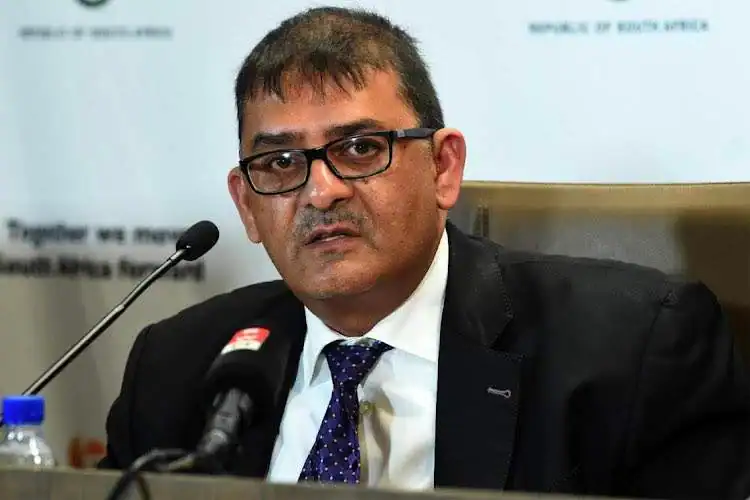
Ramaphosa Suspends Crime Intelligence Watchdog Imtiaz Fazel
Ramaphosa suspends crime intelligence watchdog Imtiaz Fazel with immediate effect, pending the outcome of a formal investigation by Parliament’s Joint Standing Committee on Intelligence (JSCI). The decision, announced by the Presidency on Wednesday night, marks a significant moment for intelligence accountability in South Africa.
Cyril Ramaphosa Acts on Intelligence Oversight Concerns
President Cyril Ramaphosa confirmed that the suspension follows a formal complaint submitted to Parliament’s JSCI regarding the conduct of Imtiaz Fazel, the Inspector-General of Intelligence. In accordance with Section 7(4) of the Intelligence Services Act (Act 40 of 1994), the Committee has the authority to conduct an inquiry into the matter.
The Presidency’s statement noted that the President acted under Section 7(5) of the same Act, granting him the legal authority to suspend the Inspector-General during such an investigation. This action ensures that the inquiry proceeds without undue influence and demonstrates the administration’s commitment to maintaining integrity within the intelligence sector.
Who Is Imtiaz Fazel?
Imtiaz Fazel, appointed as South Africa’s Inspector-General of Intelligence in November 2022, was tasked with monitoring the activities of the country’s intelligence services. His role was to ensure compliance with constitutional and legal standards, making him one of the key figures responsible for promoting transparency and accountability within the intelligence community.
As a crime intelligence watchdog, Fazel’s office functioned as an oversight mechanism, reviewing the conduct of state security and law enforcement agencies. His suspension therefore represents a serious disruption in the ongoing efforts to reform and stabilize South Africa’s intelligence sector — a domain long criticized for secrecy and internal conflict.
Background to the Suspension
The decision to suspend Imtiaz Fazel did not occur in isolation. It comes amid broader government efforts to restore credibility and functionality within the South African intelligence and security services. President Cyril Ramaphosa has been spearheading reforms following years of institutional damage linked to corruption, political interference, and mismanagement.
Recently, the Joint Standing Committee on Intelligence (JSCI) notified the President that it had received a formal complaint against Fazel’s conduct. While the exact nature of the complaint remains confidential, the JSCI has committed to conducting a full investigation in accordance with parliamentary procedures.
Legal Framework and Authority
Under the Intelligence Services Act, the President holds the authority to suspend the Inspector-General of Intelligence if an investigation is underway. Section 7(5) specifically allows such a suspension “pending a decision in such investigation,” ensuring procedural fairness while safeguarding the independence of the inquiry.
Legal analysts note that Ramaphosa’s decision aligns with the principles of due process and oversight. By allowing the JSCI to handle the complaint independently, the President reinforces the separation between the executive branch and parliamentary oversight — a key feature of democratic governance.
Link to Broader Anti-Corruption Measures
This development comes as Cyril Ramaphosa continues to pursue reforms within law enforcement, the judiciary, and intelligence agencies. Earlier, he established a commission of inquiry into alleged corruption within the South African Police Service (SAPS) and other state institutions.
The move followed serious allegations by KZN Police Commissioner Lt-Gen. Nhlanhla Mkhwanazi, who claimed that elements of the police and intelligence sectors were deeply compromised by corruption. The suspension of Imtiaz Fazel therefore signals an ongoing effort to address systemic issues across these critical organs of state.
Political and Public Reactions
Reactions to the announcement have been swift. Political analysts suggest that Ramaphosa’s decision is a calculated step toward restoring confidence in South Africa’s intelligence oversight mechanisms. Opposition parties, meanwhile, are calling for transparency in the investigation process and have urged Parliament to make its findings public once the inquiry is complete.
Civil society organizations have echoed similar sentiments, emphasizing that accountability within intelligence structures is vital for a functioning democracy. Advocacy groups like the Right2Know Campaign have previously criticized the opacity surrounding intelligence operations and welcomed stronger oversight measures.
Intelligence Oversight in South Africa
The Inspector-General of Intelligence plays a pivotal role in maintaining checks and balances within the intelligence system. The position was created to ensure that surveillance, information gathering, and national security operations adhere to legal and constitutional boundaries.
Imtiaz Fazel’s tenure was viewed as part of Ramaphosa’s broader plan to rebuild confidence in institutions weakened by state capture. His suspension, while serious, may also reinforce the principle that no official is above accountability — even those tasked with monitoring others.
Implications for the Intelligence Community
The temporary absence of the Inspector-General raises questions about how ongoing oversight will continue. Analysts suggest that an acting appointment may soon be made to ensure continuity in intelligence monitoring.
The case also underscores the delicate balance between transparency and confidentiality in matters of national security. While the public has a right to accountability, certain information remains classified due to the sensitive nature of intelligence work. Cyril Ramaphosa’s government must therefore manage this investigation carefully to maintain public trust while safeguarding state security operations.
Public Trust and Institutional Integrity
The suspension of Imtiaz Fazel serves as both a challenge and an opportunity for the Ramaphosa administration. On one hand, it risks drawing criticism from those who perceive it as politically motivated. On the other, it reinforces the message that misconduct — alleged or proven — will not be tolerated, regardless of position.
For many South Africans, the incident highlights the importance of institutional integrity and accountability in state structures that historically operated with minimal public scrutiny. The crime intelligence sector, in particular, remains a cornerstone of national stability and public safety.
Looking Ahead
The outcome of the JSCI investigation will determine whether Fazel returns to office or faces further disciplinary action. Regardless of the result, Cyril Ramaphosa’s handling of the matter will likely influence public perception of his leadership in strengthening South Africa’s governance systems.
Transparency, adherence to the law, and respect for parliamentary procedures will be key indicators of how effectively the government balances political responsibility with constitutional duty.
Conclusion
Ramaphosa suspends crime intelligence watchdog Imtiaz Fazel in a move that underscores South Africa’s renewed focus on transparency and accountability. As the JSCI conducts its inquiry, all eyes will remain on Parliament and the Presidency to ensure a fair and impartial process.
This suspension marks a pivotal moment in the ongoing reform of the intelligence sector — a reminder that effective democracy depends on integrity, oversight, and the rule of law.
🌟 Thanks for reading! 🌟
We truly appreciate you taking the time to stay informed with eKayNews.co.za — your trusted source for the latest breaking news, politics, lifestyle, and entertainment, etc across South Africa. 🇿🇦 Don’t miss out on the stories shaping our nation every day! 💡

👉 Subscribe now at www.eKayNews.co.za and join a growing community that values truth, insight, and real South African voices. 📲 Stay ahead — be the first to know, the first to share, and the first to make a difference! 🚀
You May Like:
University of Fort Hare Vice Chancellor Sakhela Buhlungu resignation