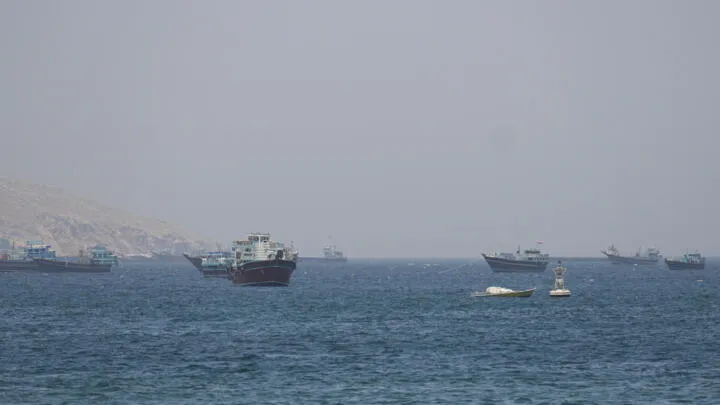
The US denies frigate hit by missiles in Hormuz Strait as Global Tensions Rise
US denies frigate hit by missiles in Hormuz Strait, firmly pushing back against alarming reports that threatened to shatter the fragile ceasefire in the Middle East and send global energy markets into a complete tailspin. On Monday afternoon, conflicting narratives emerged from the Persian Gulf, creating a fog of war that required immediate clarification from top military officials. While state-aligned media outlets in the Middle East boldly proclaimed a successful strike against American naval forces, the United States military apparatus categorically rejected these claims, stating unequivocally that no vessel under their command had been targeted or damaged.
The geopolitical landscape of the region is currently operating on a razor’s edge. This latest incident, whether a fabricated propaganda piece or a misinterpreted military maneuver, highlights the intense volatility that continues to plague one of the world’s most critical maritime chokepoints. As the international community watches with bated breath, the fact that the US denies frigate hit by missiles in Hormuz Strait serves as a vital anchor of truth amidst a sea of escalating rhetoric and regional posturing. eKayNews delves deep into the official statements, the conflicting reports, and the broader implications for international maritime security.
CENTCOM Issues Official Statement on the Alleged Attack
In the immediate aftermath of the startling claims broadcasted across the Middle East, the United States Central Command (CENTCOM) moved swiftly to control the narrative and reassure global allies. Taking to the social media platform X (formerly Twitter) on Monday afternoon, CENTCOM issued a definitive and highly detailed statement confirming that no American naval assets had been engaged by hostile fire.
The official denial was comprehensive. A senior US official, speaking directly to The Jerusalem Post, corroborated the military’s public stance, ensuring that the international press was operating with accurate intelligence. The official confirmed that not only was the report of a strike completely fabricated, but that two US-flagged commercial ships had actually successfully and safely transited the contested waterway earlier that very same day.
Furthermore, the military command emphasized its ongoing, active operations in the region. CENTCOM added to their statement that “US forces are supporting Project Freedom and enforcing the naval blockade on Iranian ports.” This strategic posture indicates that the American military remains undeterred by the aggressive posturing and will continue to execute its mandated missions to ensure the freedom of navigation for allied commercial vessels.
The Propaganda War and the US frigate Narrative
The necessity for such a strong and immediate denial arose directly from reports circulated by the Fars News Agency, an outlet heavily aligned with the Islamic Revolutionary Guard Corps (IRGC). The agency published a highly provocative and detailed claim stating that a US frigate had been actively engaged near the port of Jask, located at the vital southern entrance to the strait.
According to the IRGC-aligned report, the American warship had arrogantly ignored direct, explicit radio warnings from the local navy to halt its forward advance. The state media narrative then claimed that the armed forces launched two projectiles, successfully striking the US frigate and physically forcing the massive vessel to turn back and abandon its patrol route.
Because the US denies frigate hit by missiles in Hormuz Strait, military analysts and intelligence experts are now carefully dissecting the motivations behind the Fars News Agency’s publication. Many view this as a classic psychological operation designed to project strength to a domestic audience while simultaneously testing the information-response time of the American military apparatus. It is a calculated attempt to assert dominance over the narrative of the waterway, even if the physical reality does not match the published headlines.
The Geopolitical Strategy of Iran in the Persian Gulf
For months, the Islamic Republic has utilized a combination of asymmetric warfare, proxy engagements, and aggressive maritime posturing to counteract the crippling effects of Western economic sanctions and the ongoing US naval blockade.
According to the Tasnim News Agency, citing an unnamed but highly placed source, Tehran has meticulously prepared several “other scenarios” that its armed forces are ready to activate “if necessary.” This ominous warning suggests that the leadership in Tehran is fully prepared to escalate the conflict further should they feel their territorial integrity or economic survival is facing an existential threat.
The strategy of claiming successful strikes against formidable Western targets is not a new tactic for the nation. Over the past few months, Iran has repeatedly and publicly claimed to have struck several US naval ships operating in the surrounding region. Most notably, in early March, state media triumphantly announced a successful engagement against the USS Abraham Lincoln aircraft carrier.
Just as they did on Monday, military officials had to step in and correct the public record. Following the March incident, the central command issued a blunt statement clarifying that the reports were entirely false and that “the projectiles launched didn’t even come close” to the aircraft carrier. This repeated pattern of behavior heavily underscores the fact that the information space is just as fiercely contested as the physical waters of the Gulf.
Mapping the Contested Waters of the Strait of Hormuz
The physical geography of the region is at the very heart of this ongoing dispute. The Strait of Hormuz is arguably the most strategically important waterway on the planet, serving as the primary transit artery for approximately twenty percent of the world’s daily petroleum consumption. Control over this narrow passage equates to immense leverage over the entire global economy.
In a highly provocative move on Monday, coinciding with the false reports of the attack, the IRGC’s Navy officially issued a newly drawn map detailing the specific area of the Strait of Hormuz that they claim falls under their absolute, sovereign control. State media broadcasted the new territorial claims, though international maritime lawyers and foreign military analysts are still determining the exact extent to which this claimed area deviates from recognized international maritime borders.
According to the newly published coordinates, the claimed area begins in the west, running along a demarcated line between the westernmost tip of Qeshm Island and the United Arab Emirates’ Umm al-Qaiwain emirate. In the east, the designated area of control stops at a line drawn between Mount Mobarak and the UAE’s Emirate of Fujairah. By actively redrawing the map, the IRGC is attempting to establish new facts on the ground—or rather, on the water—demanding that all foreign entities recognize their ultimate authority over this critical global chokepoint.
The Threat of Drone Strikes and missiles in the Region
While the US denies frigate hit by missiles in Hormuz Strait, the threat of advanced weaponry in the region is incredibly real and increasingly volatile. The proliferation of highly sophisticated drone technology and long-range anti-ship ballistic technology has fundamentally altered the security calculus for every merchant vessel and military warship operating in the area.
The reality of this threat was starkly highlighted by a terrifying development reported by the United Arab Emirates. For the very first time since the implementation of the fragile US-Iran ceasefire, a formal missile alert was issued within the UAE, sending shockwaves of panic through the civilian population and the international business community based in the Emirates.
Adding fuel to the fire, the United Arab Emirates’ Foreign Ministry officially confirmed that a commercial vessel had fallen victim to an unprovoked attack. An ADNOC (Abu Dhabi National Oil Company) national tanker was violently struck by two weaponized drones while lawfully transiting the contested waterway. Fortunately, the UAE government reported that there were no injuries sustained by the crew, but the structural integrity of the vessel and the safety of the cargo were severely compromised.
The International Outcry and Diplomatic Ramifications
The unprovoked drone strike on the ADNOC tanker drew immediate, furious condemnation from the international community. The UAE Foreign Ministry did not mince words in its official diplomatic response, framing the attack as an assault not just on their sovereign vessel, but on the very foundations of international law.
The UAE firmly affirmed that the attack constitutes a “flagrant violation of UN Security Council Resolution 2817.” This specific resolution categorically emphasizes the absolute necessity of freedom of navigation in international waters and explicitly rejects the targeting of civilian commercial vessels or the deliberate disruption of established international maritime trade routes.
In a scathing rebuke, the UAE’s official statement declared, “Using the Strait of Hormuz as a tool of pressure or economic blackmail constitutes acts of piracy by the Iranian Revolutionary Guard and poses a direct threat to the stability of the region and its people, as well as to global energy security.” This strong language indicates a significant hardening of the diplomatic stance taken by the Gulf states, who are no longer willing to quietly tolerate the disruption of their primary economic lifelines.
Project Freedom and the Future of Maritime Security
The overarching context for this dramatic escalation is the implementation of new American maritime policies. The entire incident occurred shortly after officials in Tehran issued stark warnings earlier on Monday regarding a newly proposed US maritime initiative. The American proposal, aimed at actively escorting and guiding vulnerable commercial vessels safely through the dangerous waters, was immediately labeled by Tehran as a direct and hostile violation of the established ceasefire parameters.
In response to the American escort plan, the unified command of the armed forces issued a definitive and threatening statement warning the US Navy against entering the waterway under any circumstances. “We have repeatedly stated that the security of the region is under the control of the armed forces of the Islamic Republic, and under all circumstances, any safe passage must be coordinated with the armed forces,” the unified command declared.
The statement explicitly threatened to launch overwhelming attacks against any foreign military forces—particularly American forces—that attempt to enter or even approach the strait without prior authorization. This sets the stage for a highly dangerous game of naval brinkmanship. With the United States committed to “Project Freedom” and enforcing the naval blockade, and the IRGC fiercely defending their newly drawn maps of control, the potential for a catastrophic miscalculation is higher than it has been in years.
YOU MAY LIKE:
Iran fires missiles at US warship to prevent it entering Hormuz
Conclusion: Navigating a Highly Volatile Future
The fact that the US denies frigate hit by missiles in Hormuz Strait provides a temporary sigh of relief for global markets that dread the outbreak of an all-out regional war. However, the underlying tensions, the drone strikes on commercial tankers, and the aggressive redrawing of maritime borders guarantee that this crisis is far from over.
As the situation rapidly evolves, the international community remains deeply concerned about the stability of global energy security. The warring narratives, the deployment of advanced weaponry, and the absolute refusal of either side to back down from their strategic objectives create a highly combustible environment. The US denies frigate hit by missiles in Hormuz Strait today, but the ongoing provocations ensure that the naval forces of all nations operating in the Persian Gulf will remain on the highest possible alert.
References
- Reuters
U.S. denies reports of attack on warship in Strait of Hormuz
https://www.reuters.com/world/middle-east/
(Trusted reporting on military statements, denials, and Gulf maritime security developments.) - BBC News
Strait of Hormuz tensions: What’s happening and why it matters
https://www.bbc.com/news/world-middle-east
Keep the Headlines Fresh!

Quality news takes time, effort, and a whole lot of coffee. If you value what we do at eKayNews, consider “buying a round” for the team!
-
Join the Inner Circle: Set up a custom subscription.
-
The Instant Jolt: Send a one-time “coffee” donation.
Why trust us? We use PayFast for 100% secure, encrypted transactions. Your data stays yours; the news stays ours.
To our amazing readers: You’re the reason we’re first on the scene. Thanks for being part of the family!
Feel the Pulse of the News with eKayNews!

Join the ever-growing eKayNews community and stay connected to the stories that matter. Follow us on Facebook, X, and WhatsApp for real-time updates, breaking news, and exclusive alerts straight to your feed. Your support keeps us digging deeper and sharing the news you can trust.
Stay Connected:
-
Facebook: [eKayNews on Facebook]
-
X (Twitter): [eKayNews on X]
-
WhatsApp: [Join the eKayNews WhatsApp Channel]
Become part of our inner circle and get instant news alerts as events unfold across South Africa and beyond!
Promote Your Brand with eKayNews
Looking to reach a wide, engaged audience? Explore our advertising packages:
-
Link Booster: 7 links to 7 articles over 7 days – R2,500
-
Permanent Feature: Sponsored blog article hosted permanently – R4,000
-
Prime Visibility: Home page banner ad for 30 days – R5,000
Don’t miss your chance to connect with our audience. Book your package today via email at info@ekaynews.co.za or WhatsApp us on +27710961185.
Be part of a platform where news meets community—stay informed, stay ahead, stay with eKayNews!